

Beyond Safari: Ol Pejeta's Most Popular Conservation Experiences
Your safari at Ol Pejeta is extraordinary on its own, but three additional conservation activities transform it from wildlife viewing to understanding real conservation work. Meet the world's last two Northern white rhinos, visit rescued chimpanzees in the Sweetwaters Sanctuary, and witness the K9 anti-poaching unit track suspects (you!) through the bush. These are the experiences that change what your safari means.
Your safari at Ol Pejeta Safari Cottages is extraordinary on its own. But to compliment it there are a selection of activities that are coordinated by Ol Pejeta that we would recommend you consider adding on. These are experiences that shift what your visit means. They help you understand a little more about where your money is going and what it takes to run an award-winning wildlife conservancy like Ol Pejeta.
There are three most notable activities that our guests book and enjoy the most and these are the ones we’re talking a little bit more about today. This blog tells you what they are, what to expect, and how to decide which ones matter to you.
The Northern white rhino encounter
Behind-the-scenes with the chimpanzees visit
The K9 anti-poaching unit tracking demo
1. Meet the Last Two Northern White Rhinos left on Our Planet
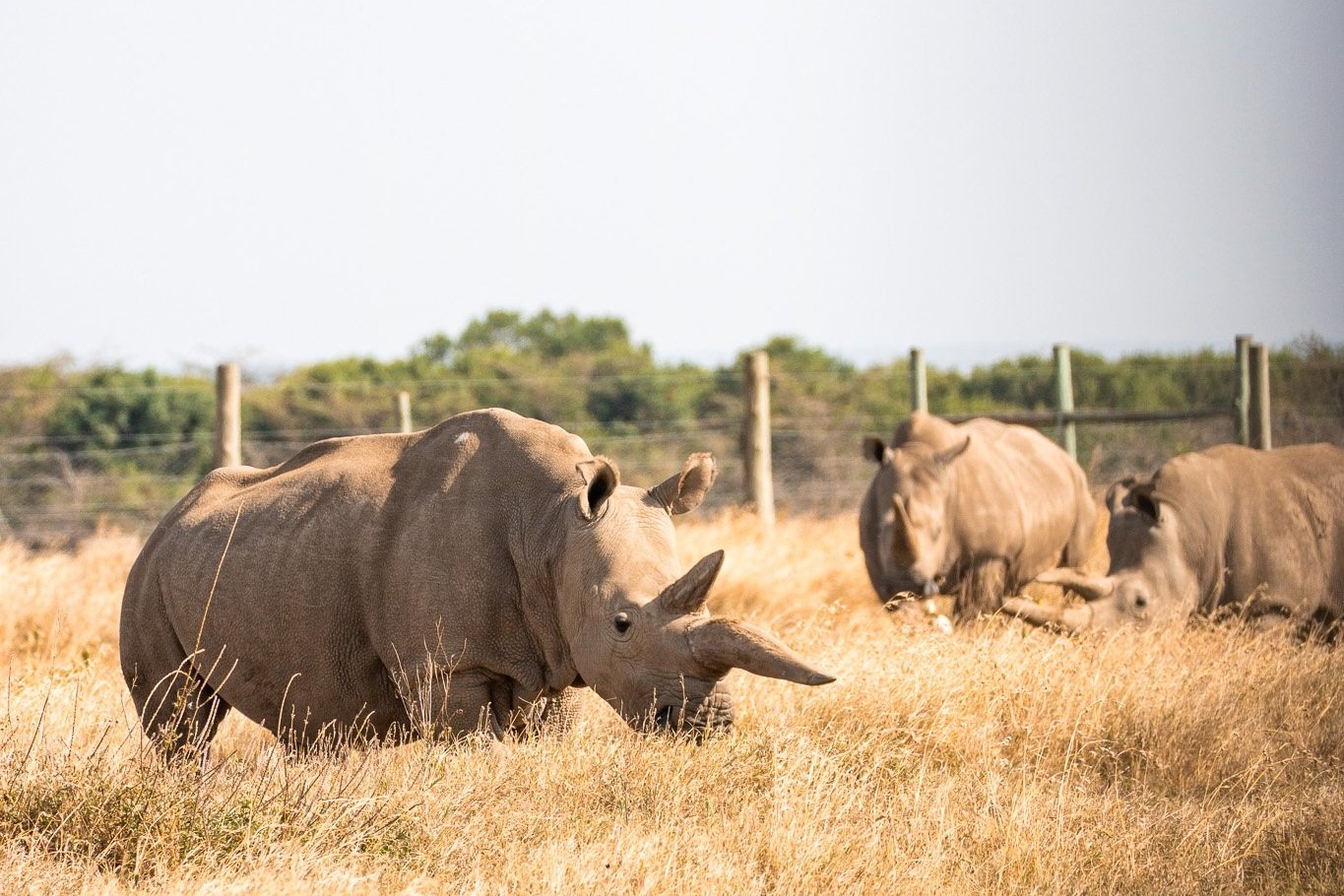
This is not a regular rhino experience. Ol Pejeta is home to Najin and Fatu — the last two Northern white rhinos on Earth. Not the last two at this conservancy. The last two on the planet!
For most safari-goers, seeing a black rhino or a white rhino is already a profound moment but seeing these two is something else entirely. You're not just witnessing rare wildlife — you're witnessing the last members of a species that numbered in the thousands until recently.
What Actually Happens
You arrive at the Northern White Rhino’s dedicated enclosure with your guide and one of the keepers who knows them personally and tends them daily. Najin and Fatu are in a spacious, carefully managed habitat within the conservancy and you’ll enter in the vehicle. You'll spend time watching them, learning their personalities, understanding what the keepers are doing to protect them. You will stay in the vehicle at all times, but the proximity is much closer than you would experience with other rhinos in Ol Pejeta.
What strikes most guests isn't the rarity (though that's undeniably powerful). It's the intimacy - you're close enough to see the detail of their skin, to notice how they move, to understand that they're individual personalities, not just "the last of their kind."
Why This Experience Matters
Your booking fee directly funds the 24/7 care these rhinos require. The keepers, the veterinary support, the research into potential breeding — it all depends on conservancy revenue. When you visit, you're not just witnessing history. You're participating in the effort to rewrite it.
Many guests tell us this particular experience changed their safari experience from "seeing wildlife" to "understanding conservation."
Notes: The Northern White Rhino Encounter must be booked in advance, is available 6 days a week (not on Tuesdays) and is available to children older than five.


2. Behind the Scenes With the Chimpanzees
A unique opportunity to learn about Chimpanzee conservation.
Sweetwaters Chimpanzee Sanctuary sits on Ol Pejeta land. It's home to rescued chimpanzees who can't survive in the wild — victims of habitat loss, orphaned by hunting, removed from places where they can't safely live. Their stories are of suffering and heartbreak and Ol Pejeta has provided a safe landing space for them after a life of difficulty.
What Actually Happens
It’s important to note that this is a hands-off experience. You see the chimpanzees during their feeding time and morning activity period from behind a safety barrier. Then an Ol Pejeta veterinarian walks you through the enclosure and explains each chimp's background — where they came from, how they arrived, their personality, their relationship with the group.
Chimpanzees are individuals with complex social dynamics, preferences, fears, and connections. Watching them, you realize how much they're like us. The way they interact. The way they protect younger group members. The way they navigate social hierarchies.
The vet will point out behaviors you'd probably miss otherwise, explain the difference between how chimpanzees naturally live and what's required to keep them safely in a conservancy setting. You’ll learn so much about chimpanzees and about the ongoing threat of the bush meat trade and habitat loss.
Notes: Behind The Scenes with the Chimpanzees must be booked in advance and is available to children older than twelve.

Why This Experience Matters
Chimpanzees are not native to Kenya, but they're present at Ol Pejeta with thanks to Dr Jane Goodall, because habitat loss across Africa has made their situation dire. Their existence at the sanctuary speaks to a broader conservation challenge.
Visiting helps fund that care. Every guest who books this activity supports the keepers, the veterinary care, and the ongoing work to create conditions where these animals can live with dignity.
Who Should Book This
If you want to understand wildlife beyond the iconic Big Five. If you're interested in rehabilitation and sanctuary work. If seeing chimpanzees matters to you personally. It’s important to understand that this is an educational experience and some people can find the chimpanzees stories very emotional.
3. K9 Dog Tracking Demonstration
One for the the dog lovers.
Ol Pejeta's bloodhound unit is legendary. They are trained to track human scent across 20–30 kilometers of bush. Originally deployed for anti-poaching work — when a suspected poacher is spotted, the bloodhounds are released and track their scent with accuracy that's almost supernatural.
The K9 demo inverts that: you run and hide, the bloodhounds find you.
What Actually Happens
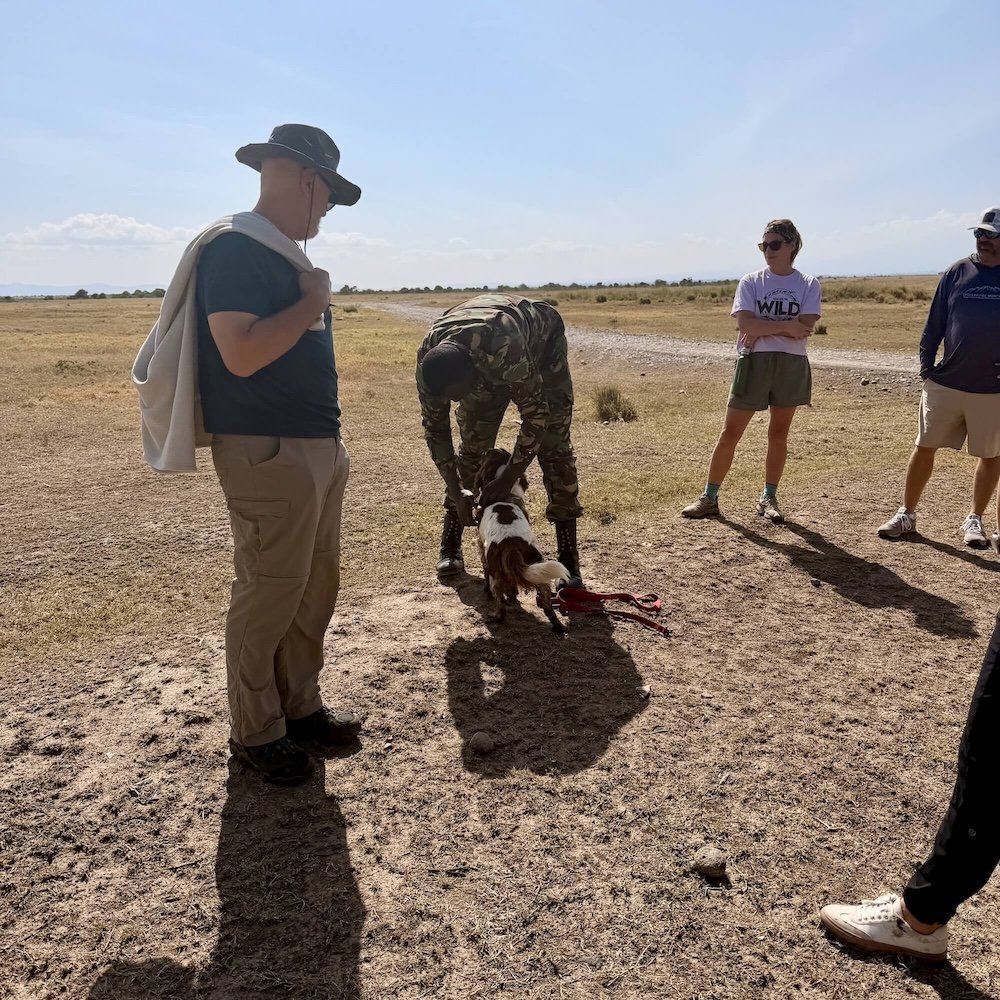
You’ll meet the dogs behind the scenes with their handlers. First, they’ll show you how their ammunitions expect (a cocker spaniel) works by finding bullets that you have hidden with ease! Then it’s the blood hounds turn. You'll walk with an armed ranger into the bush to hide. Then the dogs are released and they sniff you out.
After the demo, the handler explains what you just witnessed — how the dogs actually locate you (scent, not sight), why they're so effective in anti-poaching work, what it takes to train them. You'll pet them, talk to them, understand that they're not weapons — they're partners in conservation work.

Why This Matters
Anti-poaching efforts at Ol Pejeta require all available tools. Rangers on patrol. Technology and monitoring. And the bloodhound unit. Seeing the dogs in action, understanding their capabilities, realizing how crucial they are — it changes your perspective on what "conservation" involves.
Your booking fee supports the dogs' care and training. It sounds like a small thing, but those five dogs are worth thousands of dollars annually in veterinary care, training, and maintenance. Guests who book this activity are directly funding that critical work.
Who Should Book This
If you want the energy and adrenaline of something different from a game drive. If you're interested in anti-poaching efforts and conservation work. If you want a genuinely fun, interactive experience that's unique to Ol Pejeta. If you want to understand conservation beyond the animals to the people and tools doing the protecting.
This is the one that families often regret not booking more than any other activity. Kids absolutely love it. Adults love it. Everyone is breathless and grinning when the dogs find them.
Notes: The Anti-poaching demonstration must be booked in advance and is available to children older than twelve. Reasonable fitness levels are required for walking short distances and closed shoes must be worn.
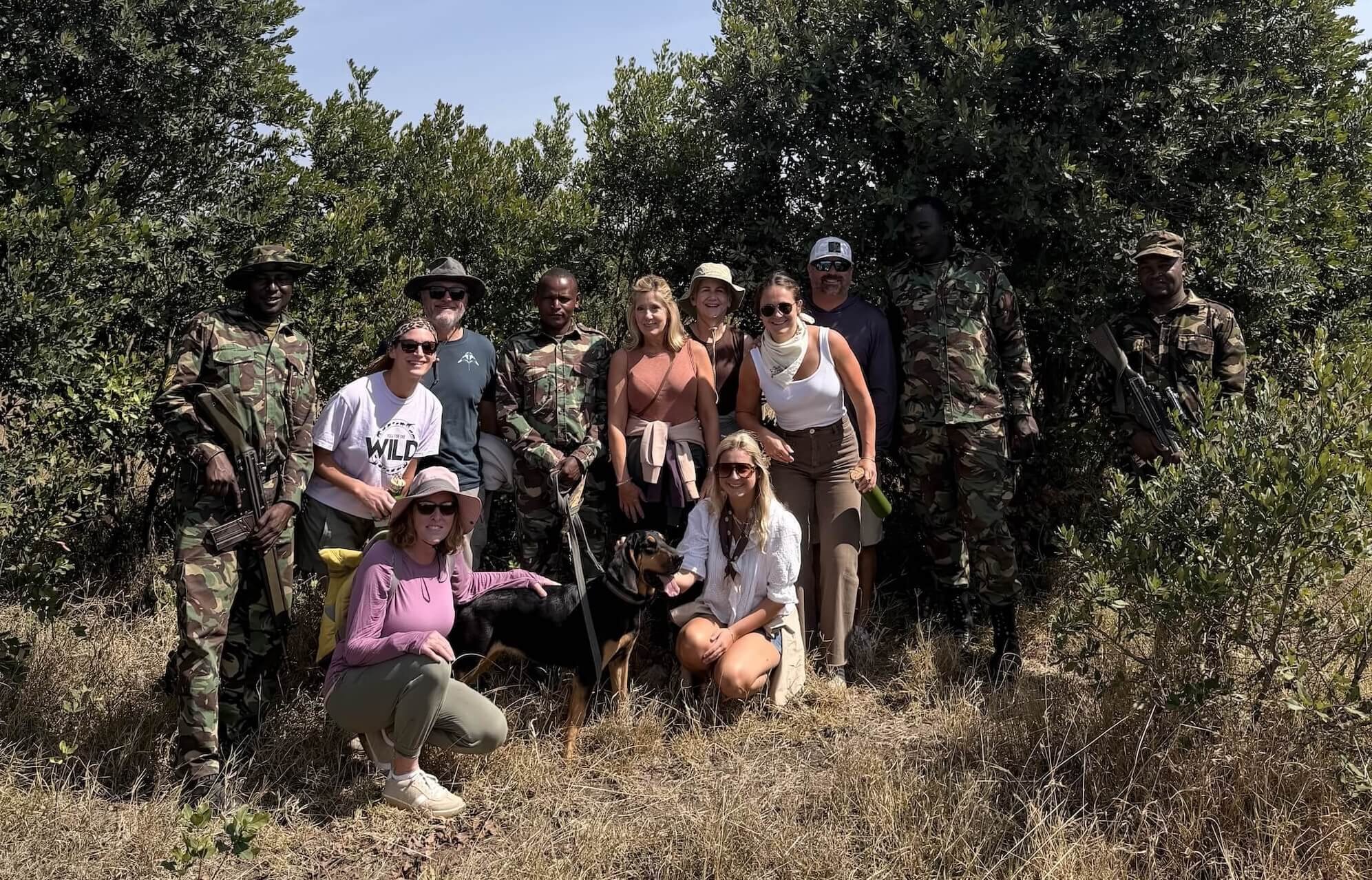
Yoga For The Wild and the K9 anti-poaching unit after a demonstration from the blood hounds
How to Decide Which Activities to Book
Book all three if you have time. They're each different enough that they don't feel redundant, and together they tell the complete Ol Pejeta story.
If you have to choose: Start with the Northern white rhino visit. It's the shortest and the most emotionally impactful. You'll understand why Ol Pejeta exists, what their dreams are for wildlife conservation at large and how they’re playing their part.
Then book the K9 demo because it's physically engaging and genuinely fun. It's the experience you'll tell stories about at home.
Add the chimpanzees if you have flexibility in your schedule. It's less dramatically exciting than the other two, but it's the deepest and most thought-provoking.
A final note
Your standard safari will really fill your cup - Ol Pejeta has so much to see and so much to offer without additional experiences. But what these experiences do is put everything you see in the wild into context; they show you that the animals here are not thriving because of luck, but because of passion and hard work. These three activities are conservation education. They show you what Ol Pejeta actually does, who does it, and why it matters.
The Northern white rhino visit tells you about species preservation. The chimpanzee encounter teaches you about habitat loss and sanctuary care. The K9 demo shows you anti-poaching in action. Together, they transform your safari from “enjoying the results of conservation" to "understand the work behind conservation."
Ready to Book?
When you book your stay at Ol Pejeta Safari Cottages, ask about adding these experiences. Your guide can help you schedule them around your game drives, or you can arrange them in advance.
A safari is memorable. These three activities make it meaningful.
Keep Reading
MORE FROM THE SAFARI COTTAGES BLOG





What to Expect on a Day Trip to the Aberdares: Cloud Forests, Waterfalls & High-Altitude Wildlife
The Aberdares are one of Kenya's most dramatic and underrated destinations — a high-altitude cloud forest completely different from the plains. A day trip offers you a chance to explore its pristine forest, spectacular waterfalls and wildlife found nowhere else in Kenya. It's the perfect complement to your Ol Pejeta safari, offering scenery, adventure, and a taste of Kenya's diverse ecosystems.
The Aberdare Range is one of Kenya's most dramatic mountain forests — a sprawling high-altitude wilderness where the landscape shifts from open plains to dense cloud forest within hours. While most visitors to Kenya head to the Masai Mara or the Rift Valley, the Aberdares remains one of the country's best-kept secrets. If you're staying at Ol Pejeta and looking for something completely different from a traditional game drive, a day trip to this fantastic part of the country offers scenery, wildlife and experiences you simply won't find elsewhere.
Your Aberdares Adventure Begins
Like all our day excursions, you'll start with an early breakfast at your safari cottage — steaming Kenyan coffee or tea, fresh fruit, a selection of baked goods and Sonja's famous homemade granola. After fueling up, your guide will collect you and you'll set out toward the Aberdare Range, driving through rural farmland and small villages toward the foothills of the range. This is where you'll get a real glimpse of life in the Kenyan highlands: terraced farms, working communities, children walking to school. It’s wonderful to watch the rhythm of rural Kenya unfolding around you.
As you climb in elevation, the landscape shifts. The savannah gives way to green hillsides, then to thick forest. The air becomes noticeably cooler. By the time you arrive at the forest gate in mid-morning, you're in a completely different ecosystem — misty, lush, alive with possibility.
The Aberdare Forest: Watch the Landscape Transform
The Aberdare Range is a place of extraordinary beauty and scale. Dense cloud forest covers the high peaks, creating a landscape that feels primordial and untouched. The air smells of earth and vegetation and light filters through the canopy in dramatic shafts. The forest is alive with sound: birds calling, leaves rustling, the distant sound of running water.
Your explorations begin the moment you pass through the gate.
The Aberdares are altitude between 2,000 and 3,000 meters — high enough that the vegetation is completely different from the dry plains of Laikipia. You're walking through indigenous forest full of giant heather, wild banana plants, and towering cedar and olive trees.
The temperature is cool in the mornings then warms up as the day breaks in ernest — bring layers. Though the forest canopy is dense enough that rain is a possibility even on otherwise clear days.
The Aberdares' Unique Wildlife
While the Aberdares are known more for scenery and birdlife than for big game, the mountain forest has its own wildlife story. The altitude and vegetation support species you won't find on the plains.
Leopards live in the Aberdares and occasionally leave tracks on the forest paths, though actual sightings are rare. Your guide will point out their pug marks in the mud.
Hyenas are present but nocturnal. You won't see them on a day trip, but they're part of the forest ecosystem and you’ll see evidence of them everywhere.
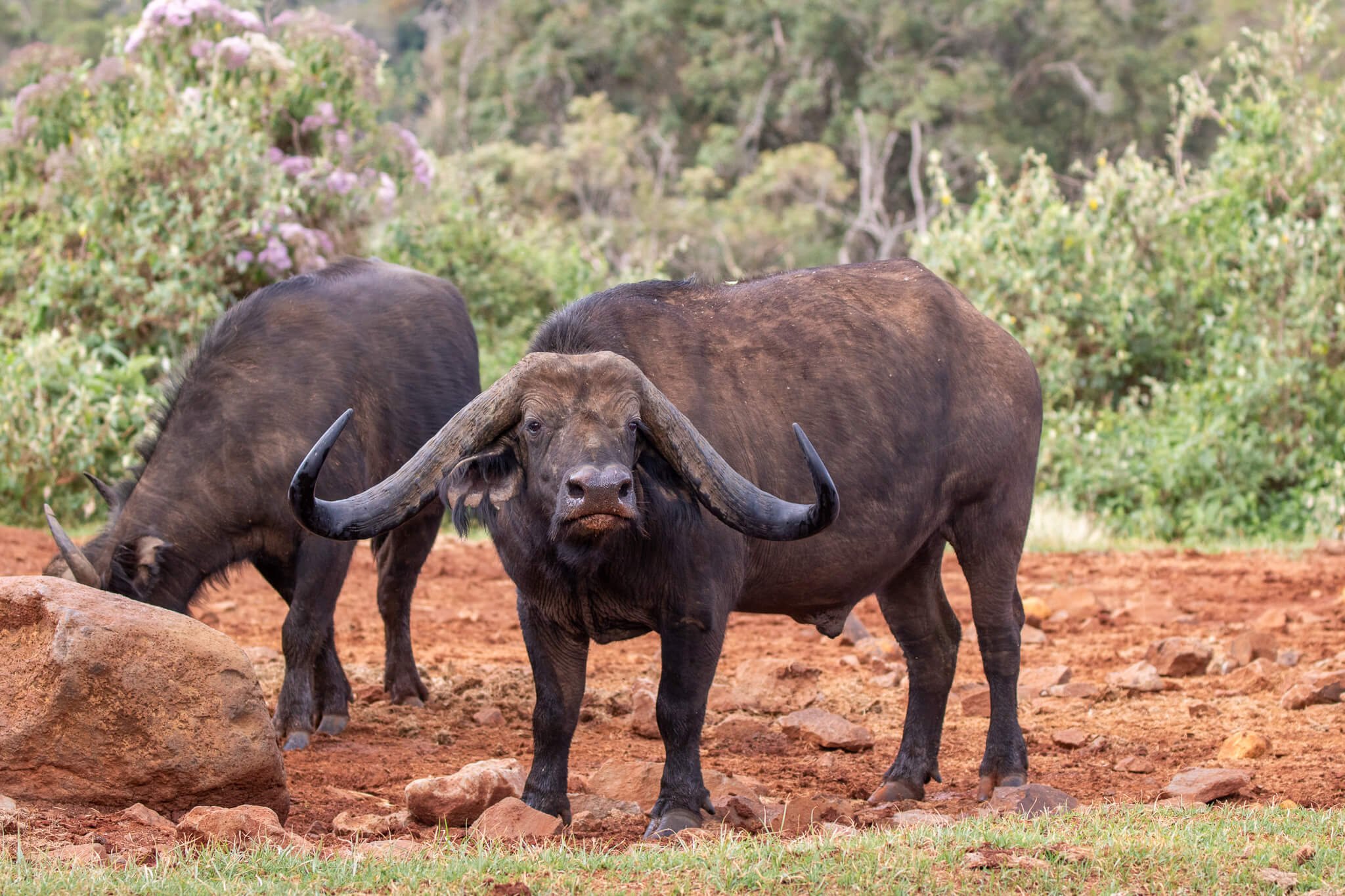
Forest buffalo — a smaller subspecies than plains buffalo — move through the Aberdares. They're shy and avoid humans, but evidence of them is everywhere: dung, tracks, heavily worn paths through the dense vegetation where herds regularly move.
Giant forest hogs are unique to this area. They are secretive but spotted often.
Bongo are rare to see but if you’re going to see one anywhere, it will be in the Aberdares. Keep your eyes up.
Bushbucks and other forest antelope often cross your path too.
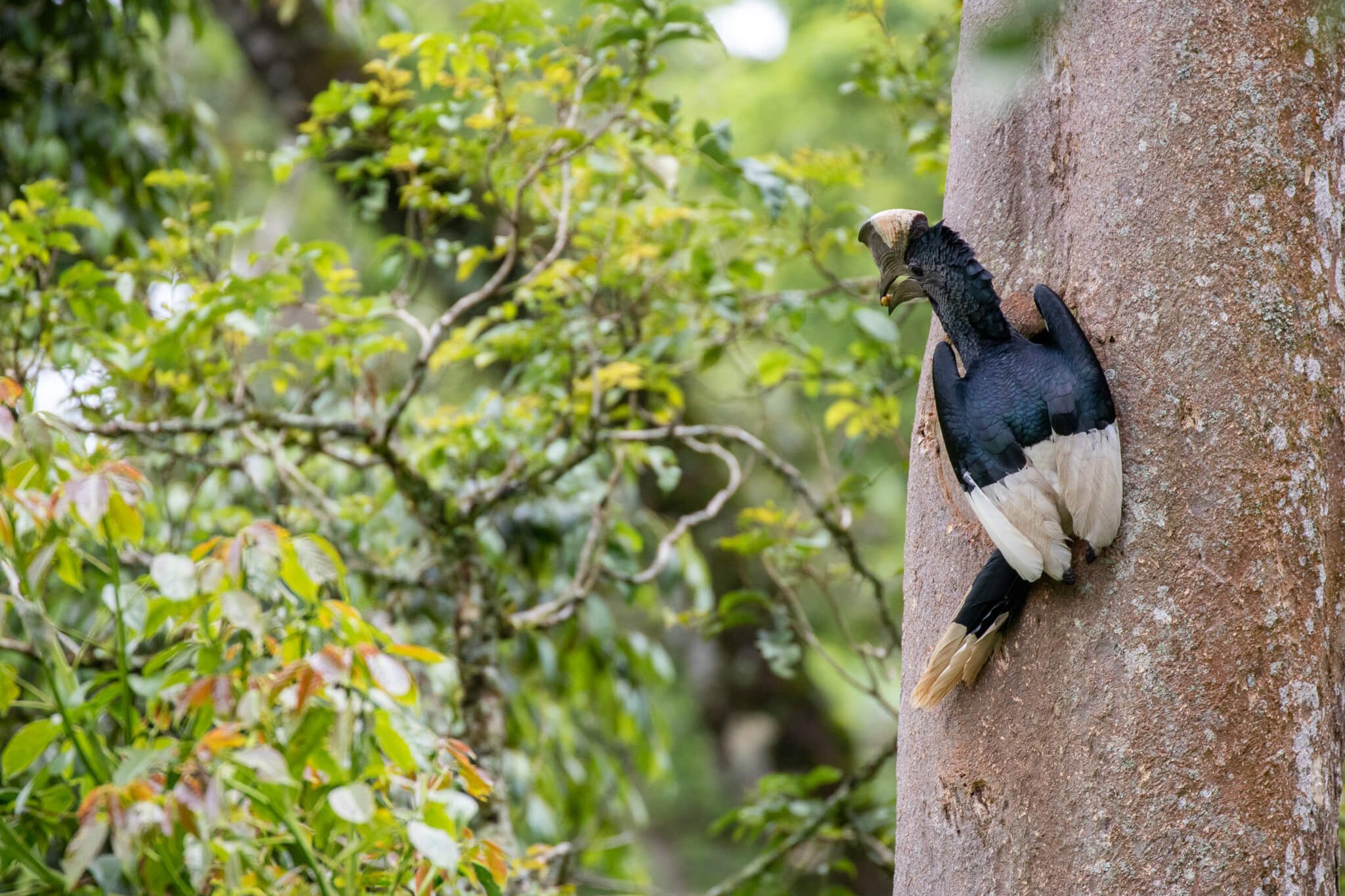
But the real wildlife spectacle is the birds. The Aberdares are a paradise for birdwatchers. At altitude, you'll see species found nowhere else in Kenya. Hurtlab's turaco, the Silvery-cheeked hornbill, the Malachite kingfisher on forest streams, and countless others. Your guide will listen for calls and point out birds high in the canopy. Even non-birders find the bird activity astonishing — the volume of sound, the variety, the constant movement through the trees.
The forest is alive with smaller wildlife too: monkeys (including the rare Colobus), squirrels, hyraxes, and an extraordinary diversity of insects. This is a rich, functioning ecosystem that feels completely different from the plains.
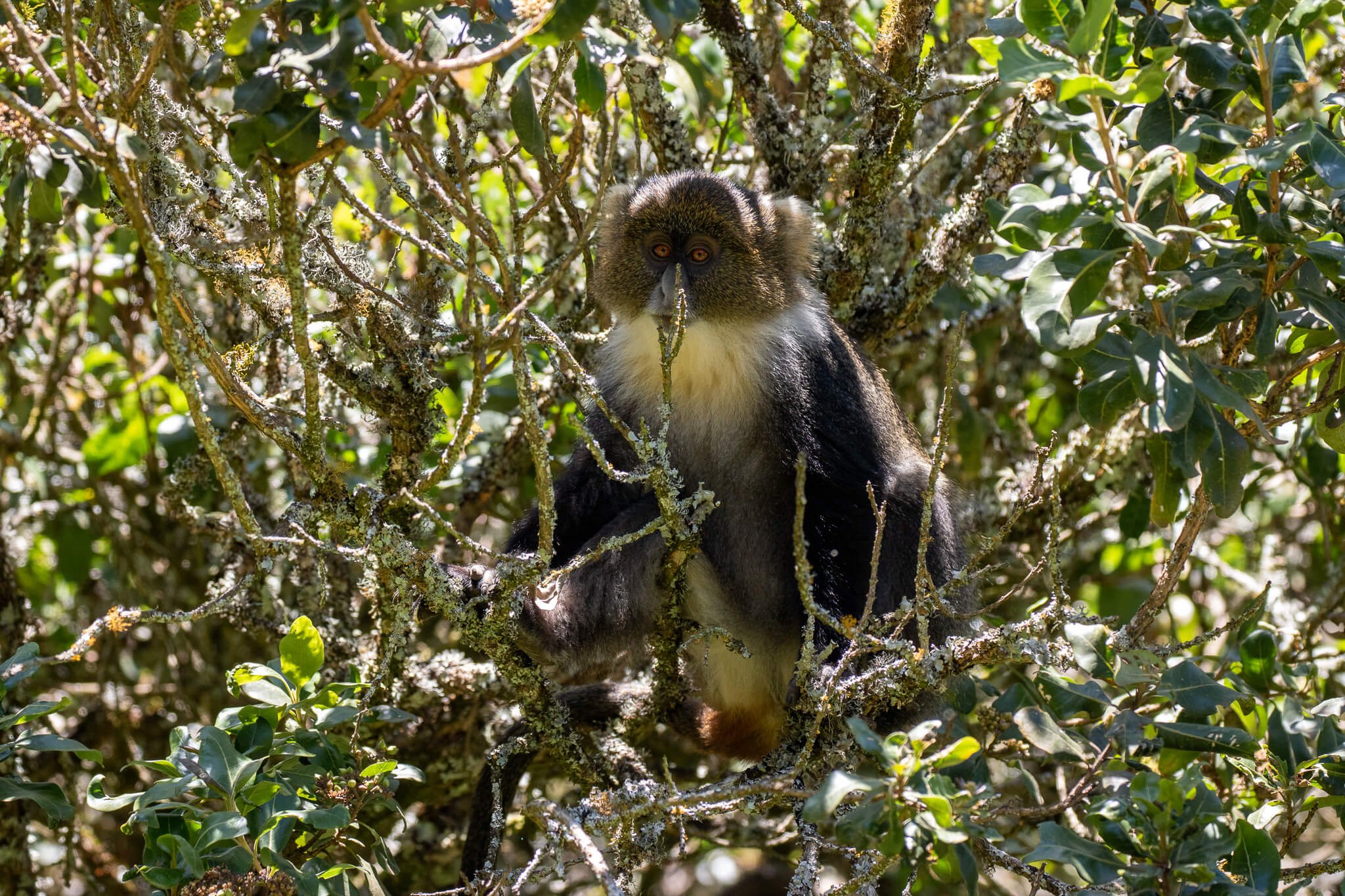
Colobus Monkey in the Aberdares
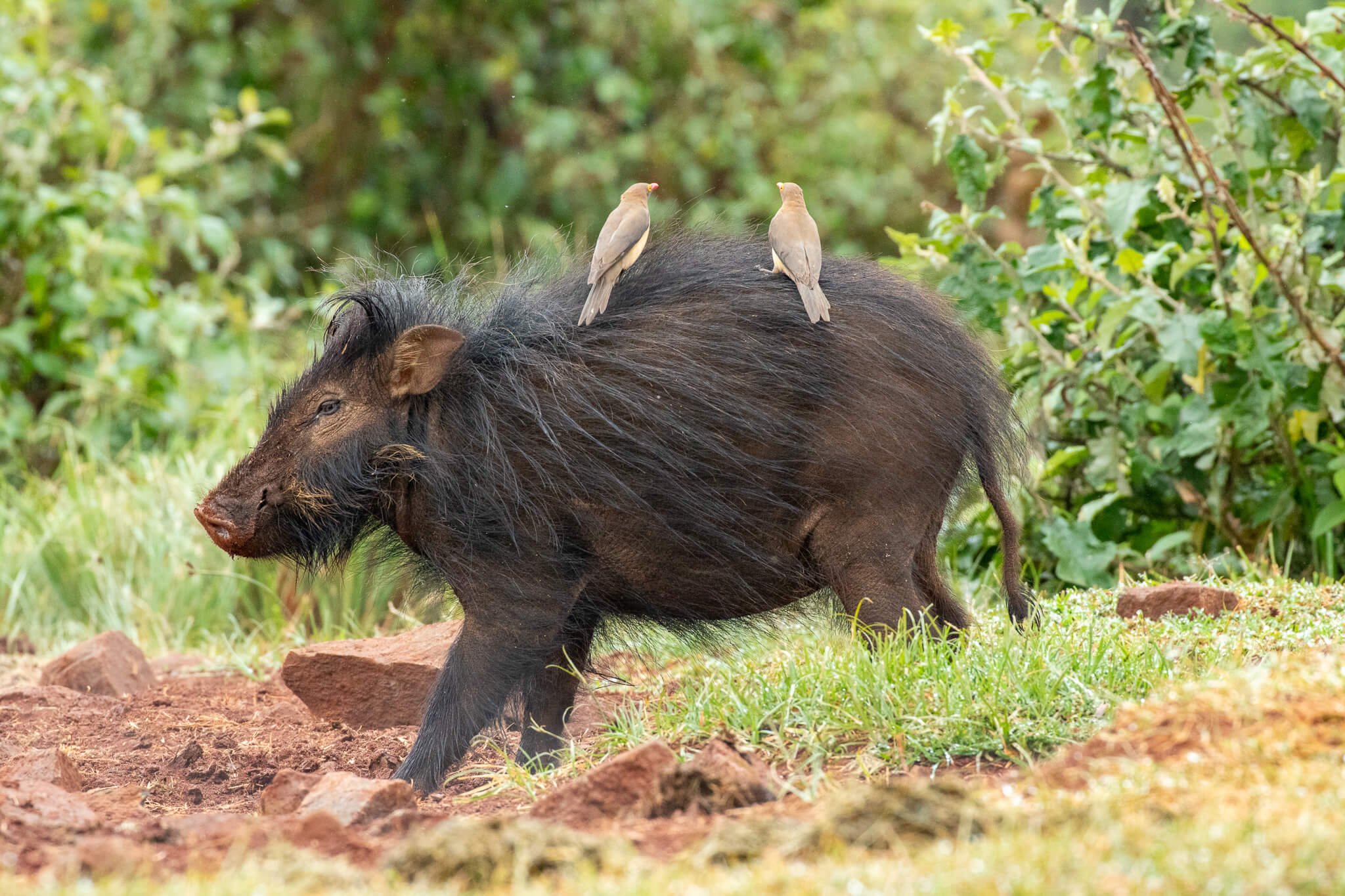
A young giant forest hog in the Aberdares
Waterfalls and Flora That Stops You in Your Tracks
The Aberdares are defined by water. Mountain streams cascade down the hillsides, fed by the high rainfall at altitude. If weather and time allows your day trip includes stopping in at the spectacular Karura Falls where you can choose to hike to the base (depending on the time of year) and soak up it’s magic as it crashes into the ground below. The sound is thunderous. The mist rises and cools you after the exertion of hiking. In the rainy season, the falls are particularly dramatic — crashing down with tremendous force. In drier months, they're more gentle but equally beautiful.
The vegetation of the Aberdares is unlike anywhere else at this latitude too. At altitude, the climate changes enough that plants found on the high mountains of central Africa thrive here. You'll see giant heathers — plants that can grow to 4 meters tall, creating a landscape that looks almost alien. Wild banana plants with their enormous leaves. Strange orchids growing on tree trunks. Moss covering rocks and branches so thickly that the entire forest seems to be wearing a green blanket. Prehistoric-looking tree ferns in shaded areas. Flowering plants you've never seen.
Photography here is exceptional if you love landscape, macro, or botanical images. The colors, textures, and drama of the forest provide endless subjects.

A Typical Aberdares Day Schedule
Early morning: Breakfast at your safari cottage, then depart toward the Aberdares (45 minutes to 1 hour drive depending on route and weather).
Mid-morning: Ascend through the forest with your vehicle, looking for forest elephants, bushbucks, bongos and more as you go. You’ll ascend to the foothills and explore the open moorland - keep an eye out for buffalo and predatory cats. Should time and weather allow you can hike down to the base of Karura Falls and take in this spectacular 273m waterfall from the bottom of it!
Late morning/midday: Settle in at a picnic spot to enjoy the view and tuck into a well deserved lunch.
Afternoon: Descend toward Ol Pejeta, stopping if wildlife is spotted or to simply absorb the changing light as you descend from cloud forest into open plains.
Evening: Arrive back at your cottage by late afternoon. Stop for a sundowner on the plains or head straight back if it’s getting dark to enjoy dinner under the stars.

A cosy evening in after a day of adventures in The Aberdares.
Ready to add an Aberdares day trip?
A day in the Aberdares is a complete change of pace from safari. It’s slower, denser and quieter in a lot of ways too. The focus here isn’t lions and rhinos, it’s unique species, birdlife and brilliant scenery.
If you want to experience the full diversity of Kenya's landscapes during your stay, an Aberdares day trip pairs perfectly with safari drives at Ol Pejeta. You'll leave with memories of both the wildlife of the conservancy and the dramatic beauty of Kenya's mountain forests.
Let us know you'd like to add an Aberdares day trip when you enquire about your stay, and we'll get you sorted!
MORE DAY TRIPS

MT KENYA DAY TRIP
This is what your day could look like exploring Africa’s second highest mountain.
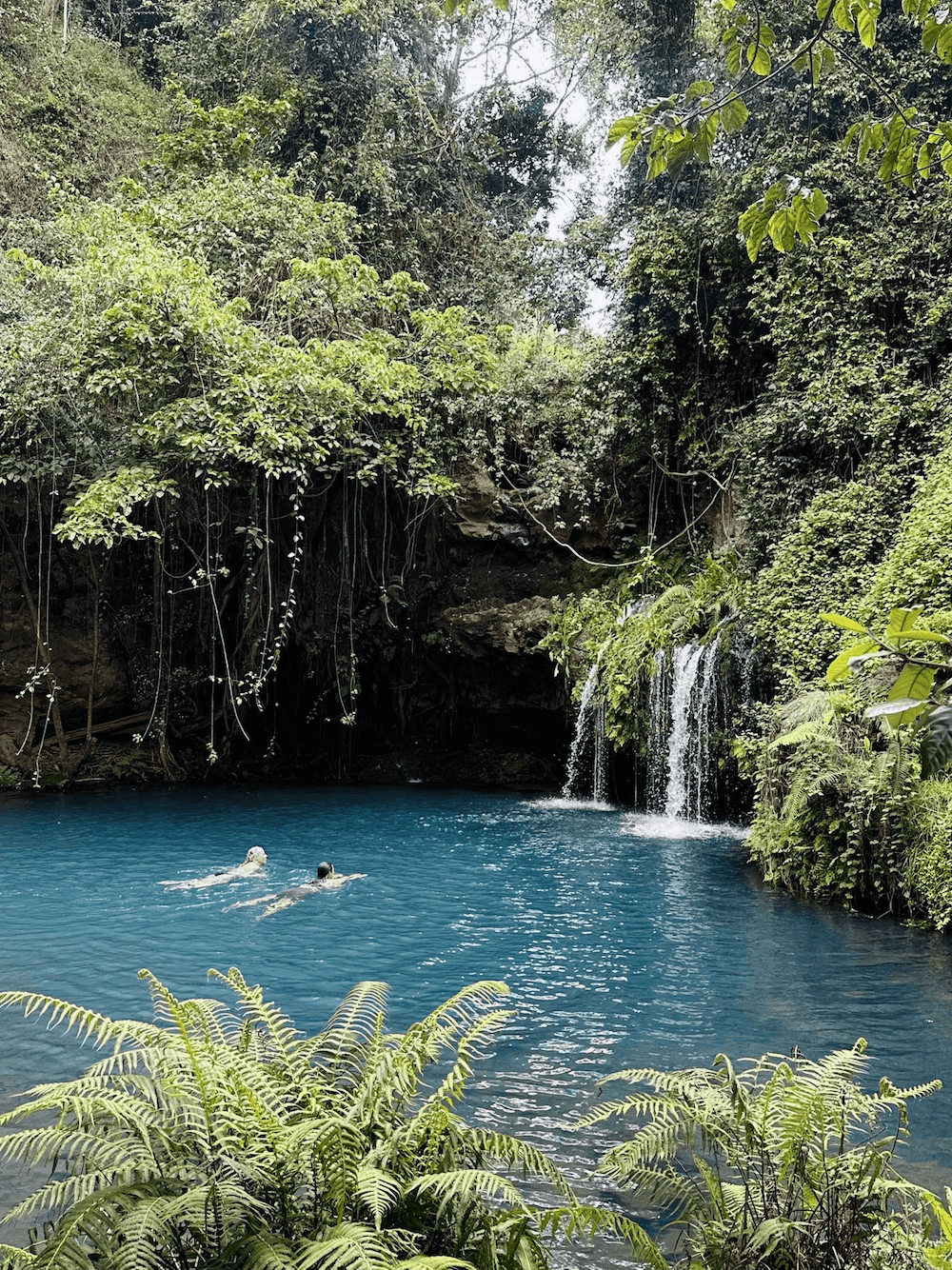
NGARE NDARE DAY TRIP
Hiking, birding and wild swimming in a community owned and run forest reserve.
More from The Ol Pejeta Safari Cottages blog…
Should you Fly or Drive to Ol Pejeta? Here’s what you need to know.
Getting to Ol Pejeta from Nairobi isn't complicated, but you have a real choice: fly in 60 minutes or drive in 5 hours. Both work. Both have advantages. The best option depends on your budget, how much time you value, and whether you're traveling solo or with others. Here's a breakdown of flights vs driving.
Getting to Ol Pejeta from Nairobi is straightforward, but you have a real choice to make: fly or drive. Both work. Both have their merits. The decision is entirely a personal one. It depends on your comfort level, your schedule, and whether you'd rather start your safari in the air or on the road.
Here's the breakdown.
The Two Options
Option 1: Fly directly to Kamok Airstrip (approx 60 minutes total) A small plane from Nairobi lands on our private airstrip, right on the conservancy. You step off the plane and drive straight into the bush.
Option 2: Drive from Nairobi to Nanyuki (5 hours) then transfer to Ol Pejeta (1.5 hours) A vehicle picks you up from your Nairobi hotel after breakfast, you drive through Kenya's highlands, and you arrive at Ol Pejeta by lunchtime.
Both get you here, but they're different experiences — and different costs.
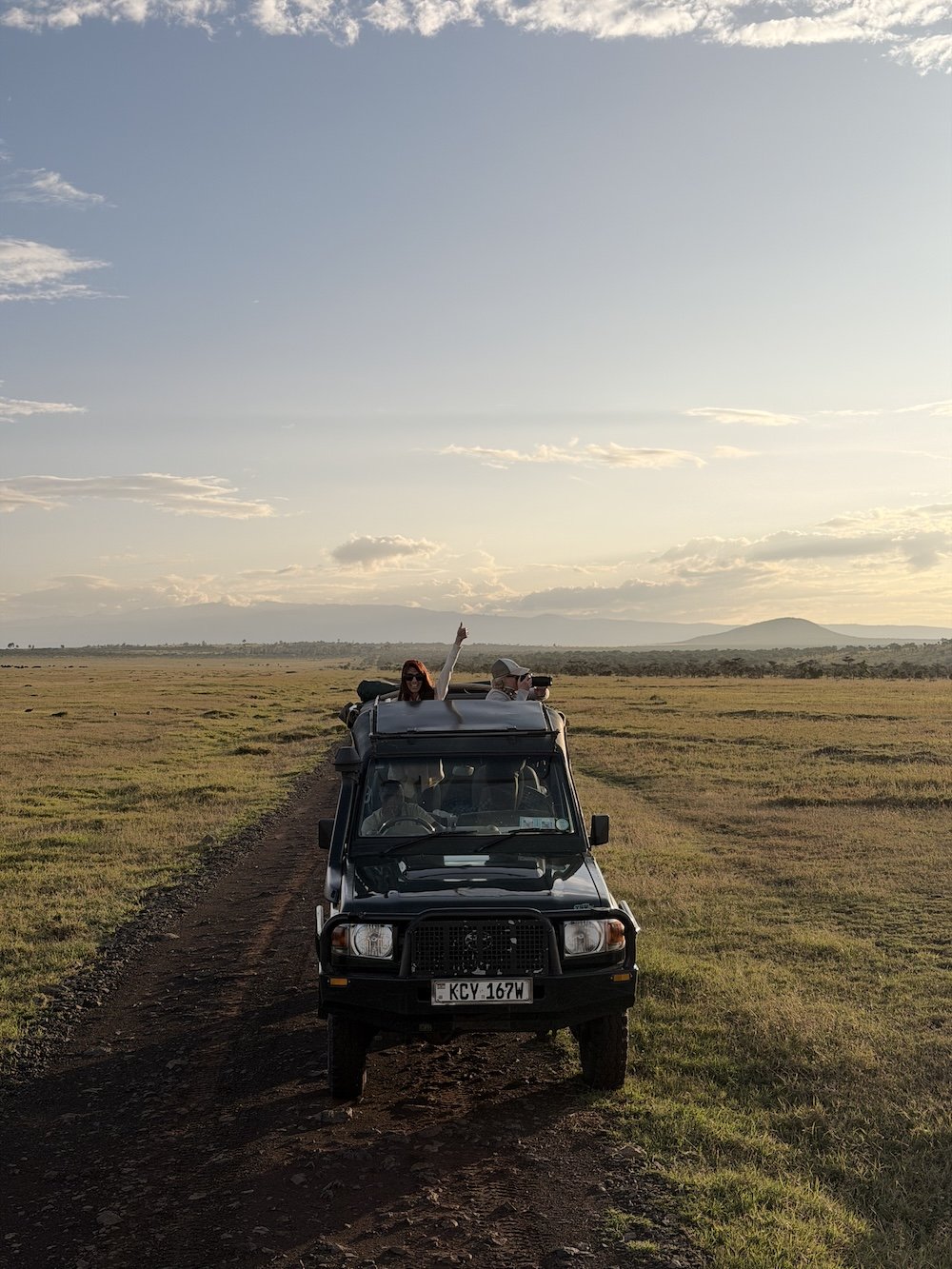
Arriving by air: the transfer to camp from Kamok Airstrip (image x Yoga For The Wild)
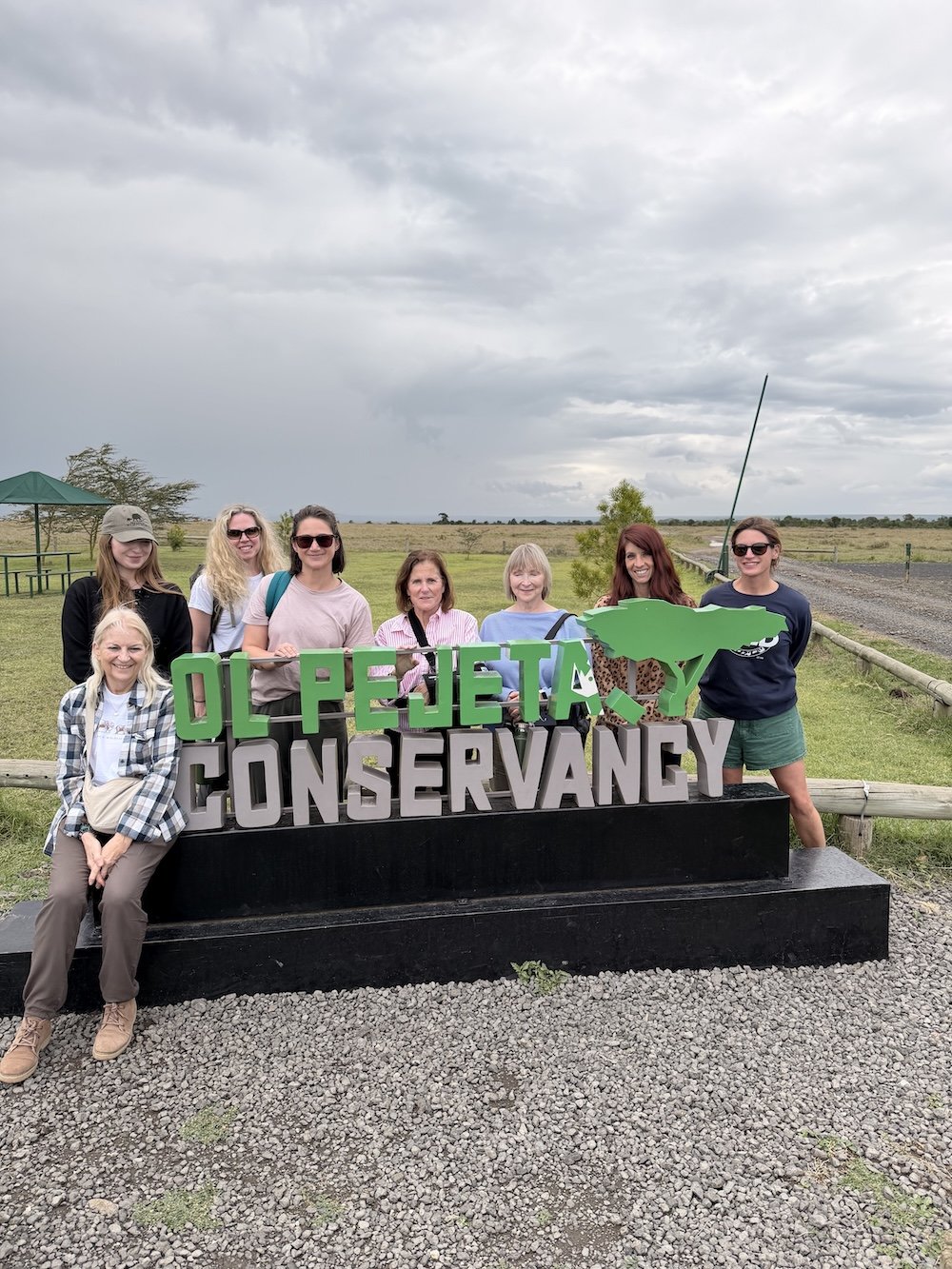
Arriving by road: checking in at Rongai Gate (image x Yoga For The Wild)
Flying to Kamok Airstrip: The Direct Route
What actually happens:
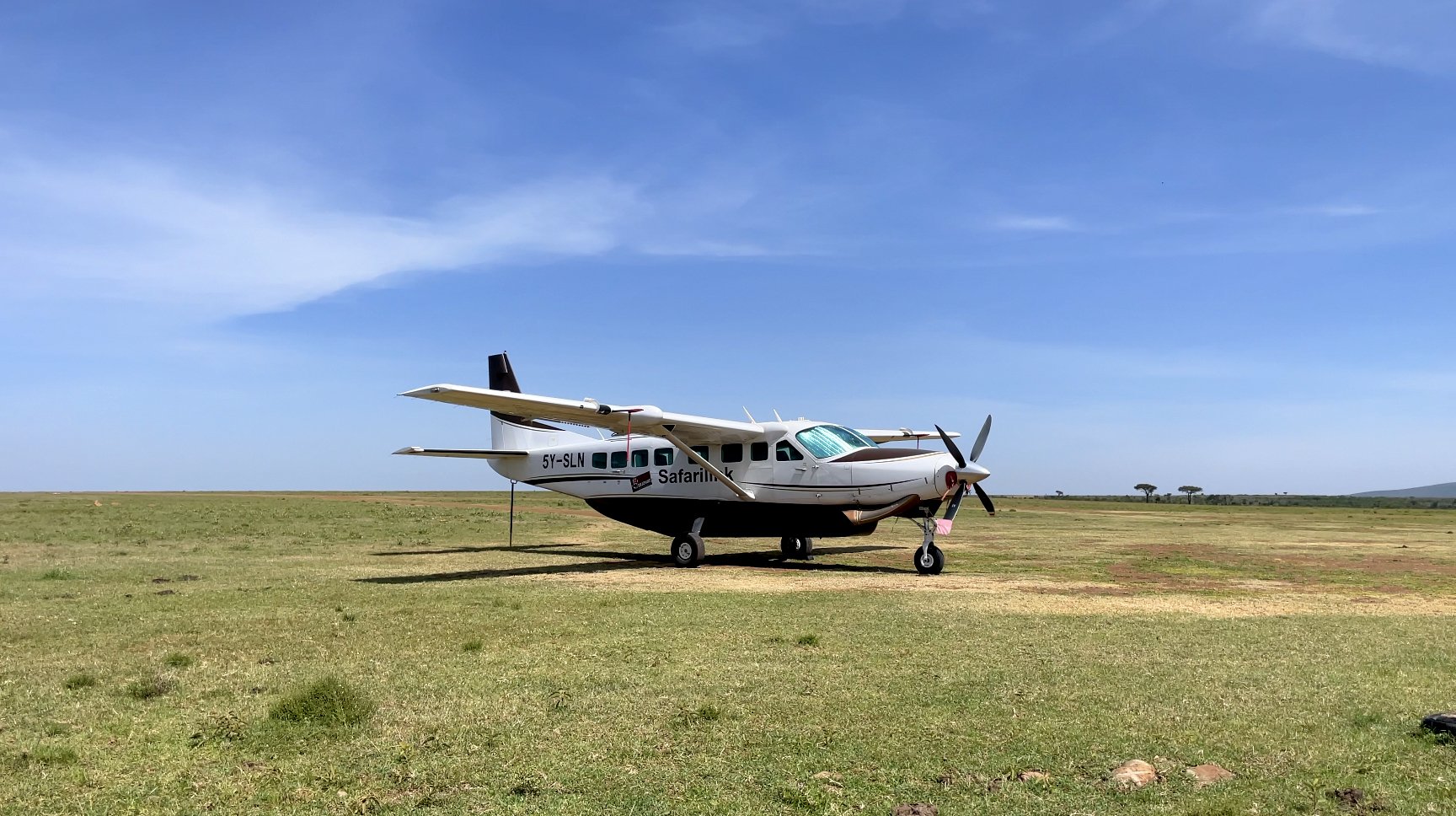
You fly from Nairobi's Wilson Airport (a domestic terminal, not the main international airport) on a small aircraft — usually a Cessna or similar — with Air Kenya or Safarilink. The flight takes about 60 minutes door-to-door depending on stops.
The plane lands at Kamok Airstrip, which sits on Ol Pejeta Conservancy itself. This is a dirt airstrip (not tarmac), but it's well-maintained and safe. When you land, a vehicle from Ol Pejeta Safari Cottages is waiting. You drive straight into the bush — no town, no transfers, no extra driving.
You’re game driving from the moment your plane touches down.
The cost:
Safarilink (and Air Kenya operates similar pricing) charges $220 one-way and $382 round-trip per person for flights between Nairobi and Nanyuki. These are the standard published fares.
For two people, round-trip flights = approximately $764.
Compare this to:
Driving ($250–$300 per vehicle one-way = $500–$600 total for two people round-trip)
Plus your time (5 hours of driving each way = 10 hours total)
Flying is more expensive than driving for two people, but you save 10 hours of road time. Whether that premium is worth it depends on how you value your time and how much you want to maximize game drive hours on your first day.
The advantages:
The experience. Flying to Kamok and driving through the conservancy to your safari cottage is really special. You see the landscape from the air, then move through it on the ground. Your safari begins immediately — you're not recovering from a long drive.
Important weather caveat:
Kamok Airstrip is a dry-weather airstrip. During heavy rain (usually seen in April/May, November), the runway can become waterlogged. If weather is questionable, the airline will divert to Nanyuki Airstrip instead. They'll let us know, and we'll pick you up from there without issue — no extra cost, no drama.
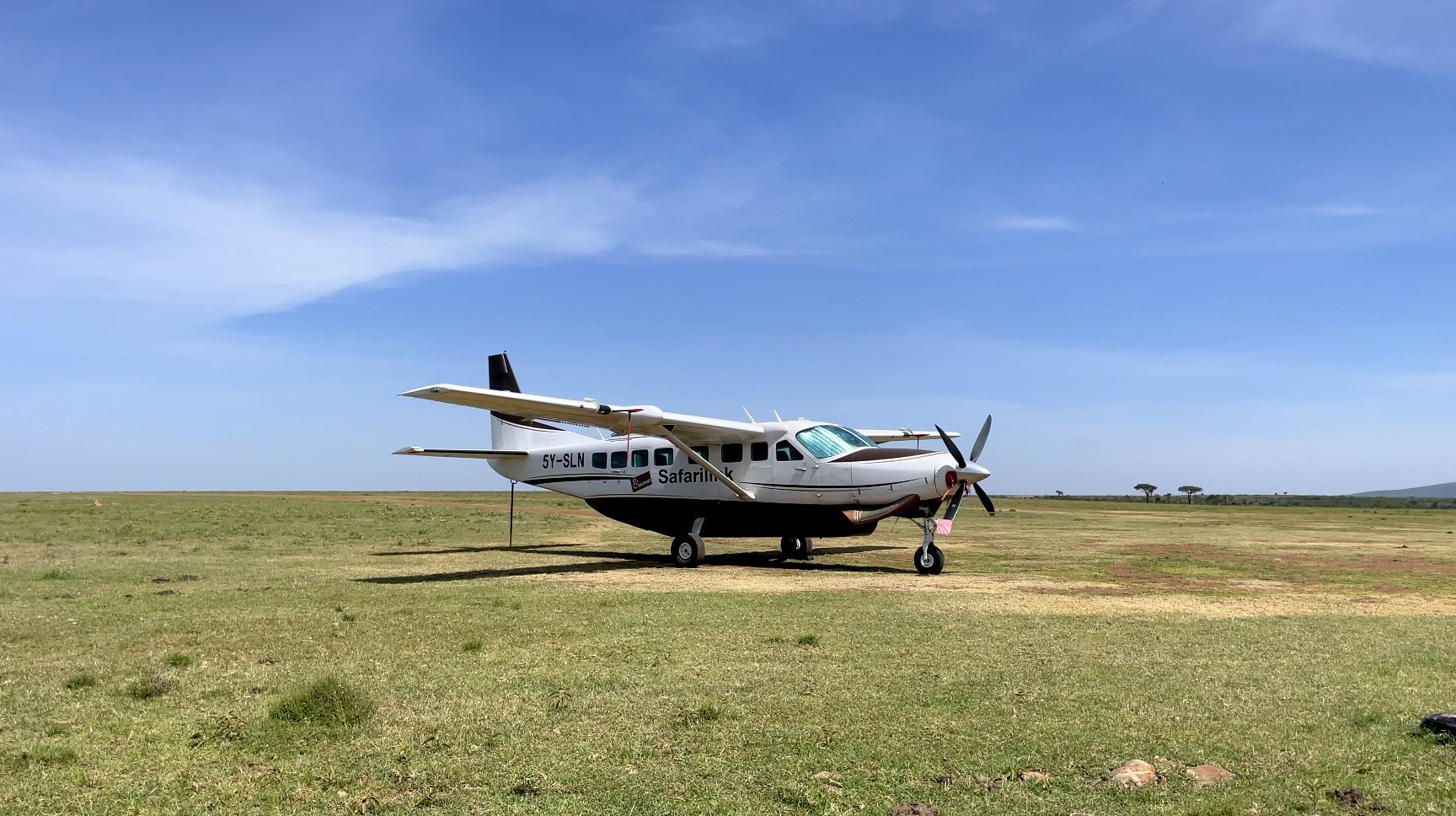
Landing in the bush with Safarilink from Nairobi
Driving from Nairobi: The Scenic Route
What actually happens:
A vehicle picks you up from your Nairobi hotel (we can help you with this or you can arrange your own transport). You drive north through Kenya's highlands on good, well-maintained roads. The drive is scenic — you pass through towns, climb through cloud forest, and gradually ascend onto the Laikipia plateau.
Total driving time: approximately 4-5 hours depending on traffic and stops. If you leave before 8AM most guests arrive at Ol Pejeta between 12–2 PM.
The cost:
A vehicle that fits 4 passengers costs approximately $250–$300 per way, which works out to $60–$75 per person one-way if you're sharing. For two people, that's roughly $120–$150 per person round-trip.
This is significantly cheaper than flying.
**If you're solo traveling, you're paying the full vehicle cost ($250–$300 one-way), which makes the math closer to flying, but remember to factor inthe cost of a taxi from your hotel to Nairobi Wilson airport too.
The advantages:
Cost. If you're budget-conscious or traveling with a group, driving is cheaper. You also have the flexibility to leave Nairobi at whatever time works for you — no flight schedules, no early morning airport departures. PLUS you won’t have the strict 15kgs baggage restriction that airline transport has.
The experience:
You see Kenya. The drive from Nairobi to Nanyuki is genuinely beautiful. Many guests enjoy this as the opening act of their safari: ease into the experience by watching the landscape change as you travel north.
The disadvantage:
It's a long day. You wake up in Nairobi, spend 5+ hours in a vehicle, and arrive tired. Most guests rest on their first afternoon or are in bed early. If you’re delayed for any reason, you may not get on a drive until late afternoon or evening — and by then, the best light is passing. You may not arrive in time for a drive at all.
You also lose safari time overall. A full day of travel means you effectively lose a day of your safari if you only have 3–5 nights.
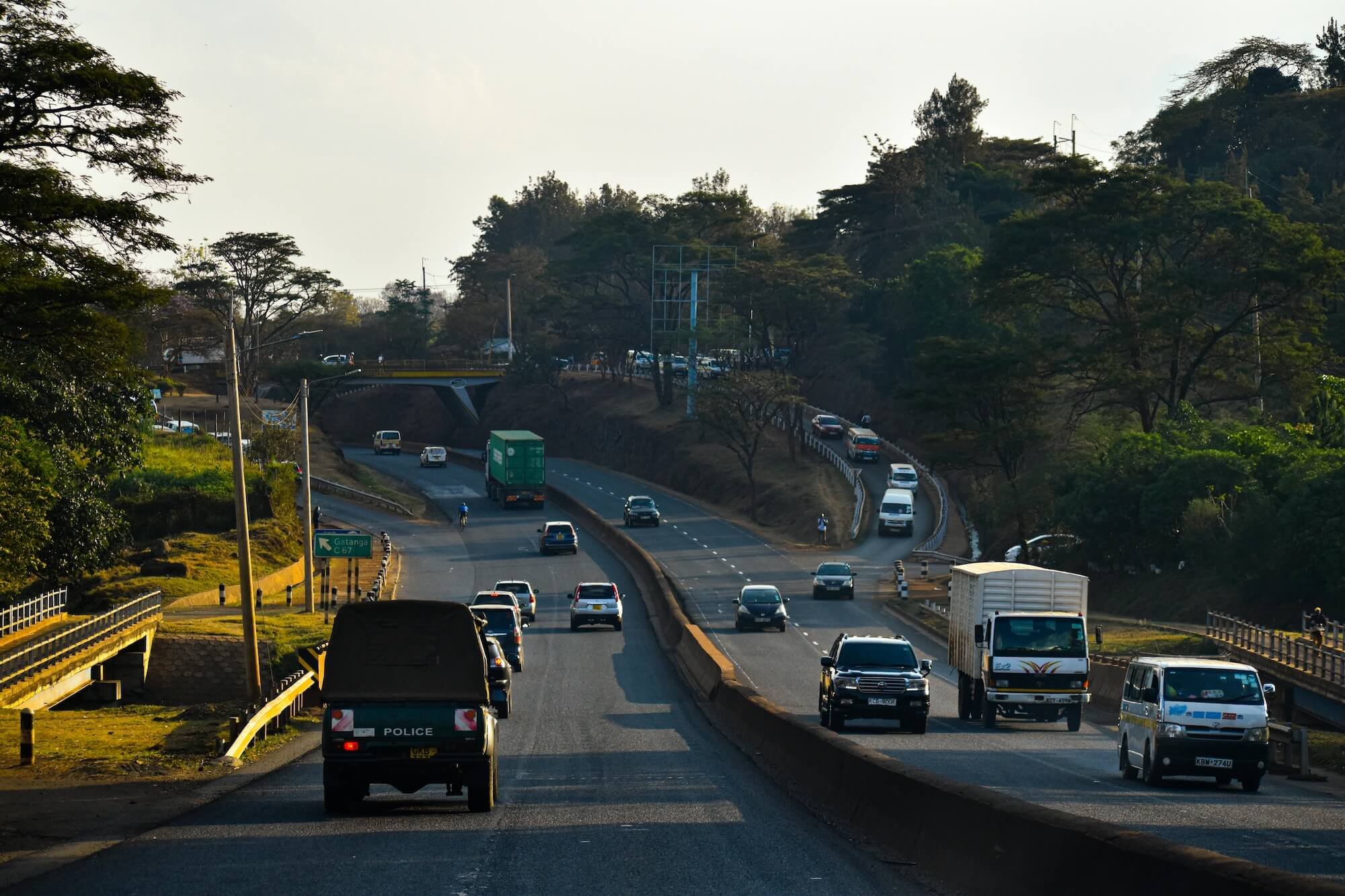
The road from Nairobi - Nanyuki
When to Fly vs When to Drive
Fly to Kamok if:
You only have 3 nights (time is your most valuable resource)
You want to maximize game drive hours on your first day (catch a morning flight out of Nairobi)
You're flying during dry season (June–October, December–January)
You value the experience of arriving by plane and driving through the conservancy
Your budget allows it
Drive from Nairobi if:
You’re travelling slowly and have time for it - 5+ nights
You're budget-conscious and want to minimize costs
You're carrying a lot of baggage
You want to see the landscape and take a more leisurely pace
Honest assessment:
If you're staying 5+ nights, driving makes sense. The cost savings outweigh the time loss. If you're only here for 3 nights, flying to Kamok is worth the premium — you get more safari time and a better arrival experience.
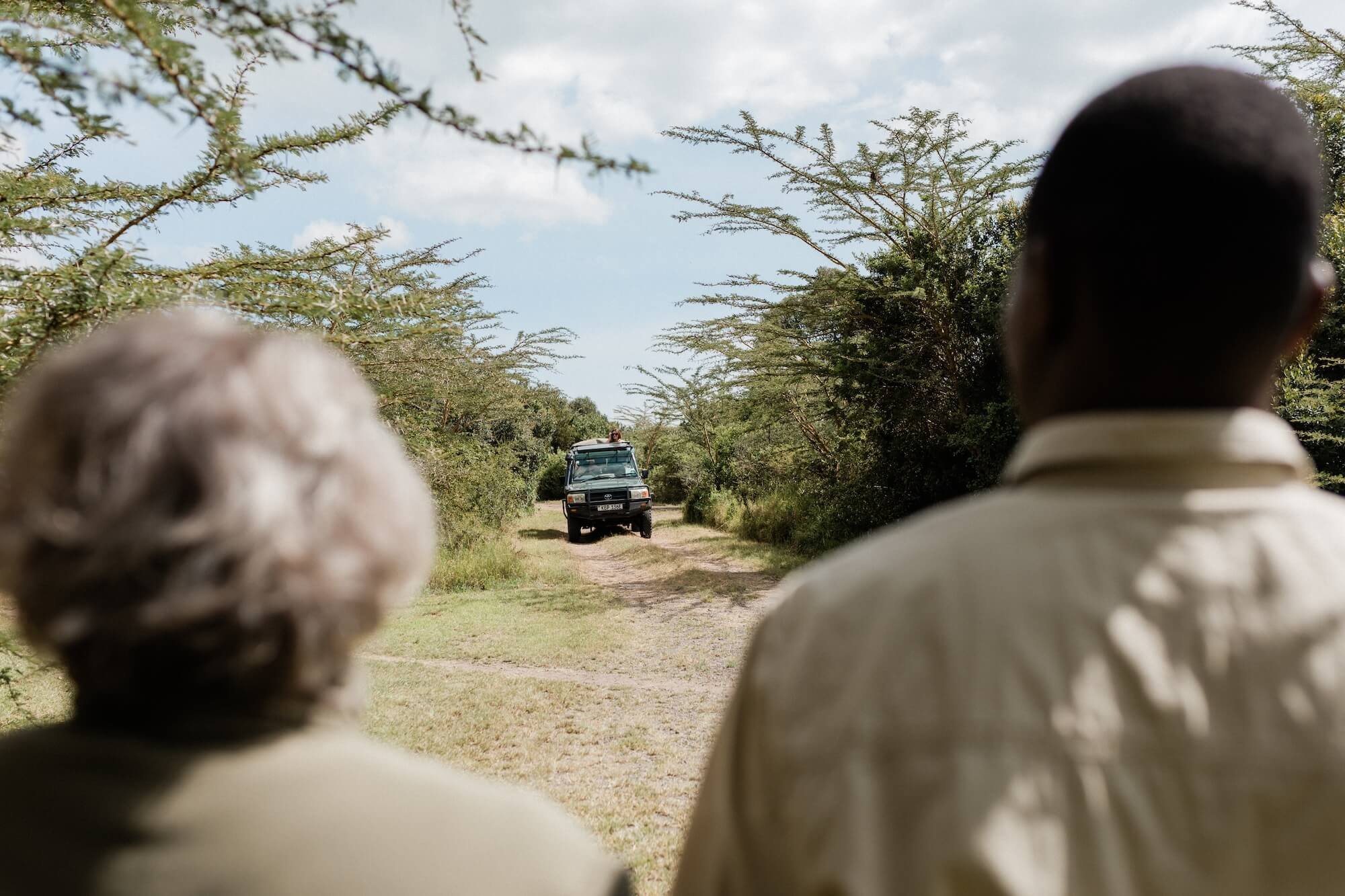
Arriving at The Safari Cottages
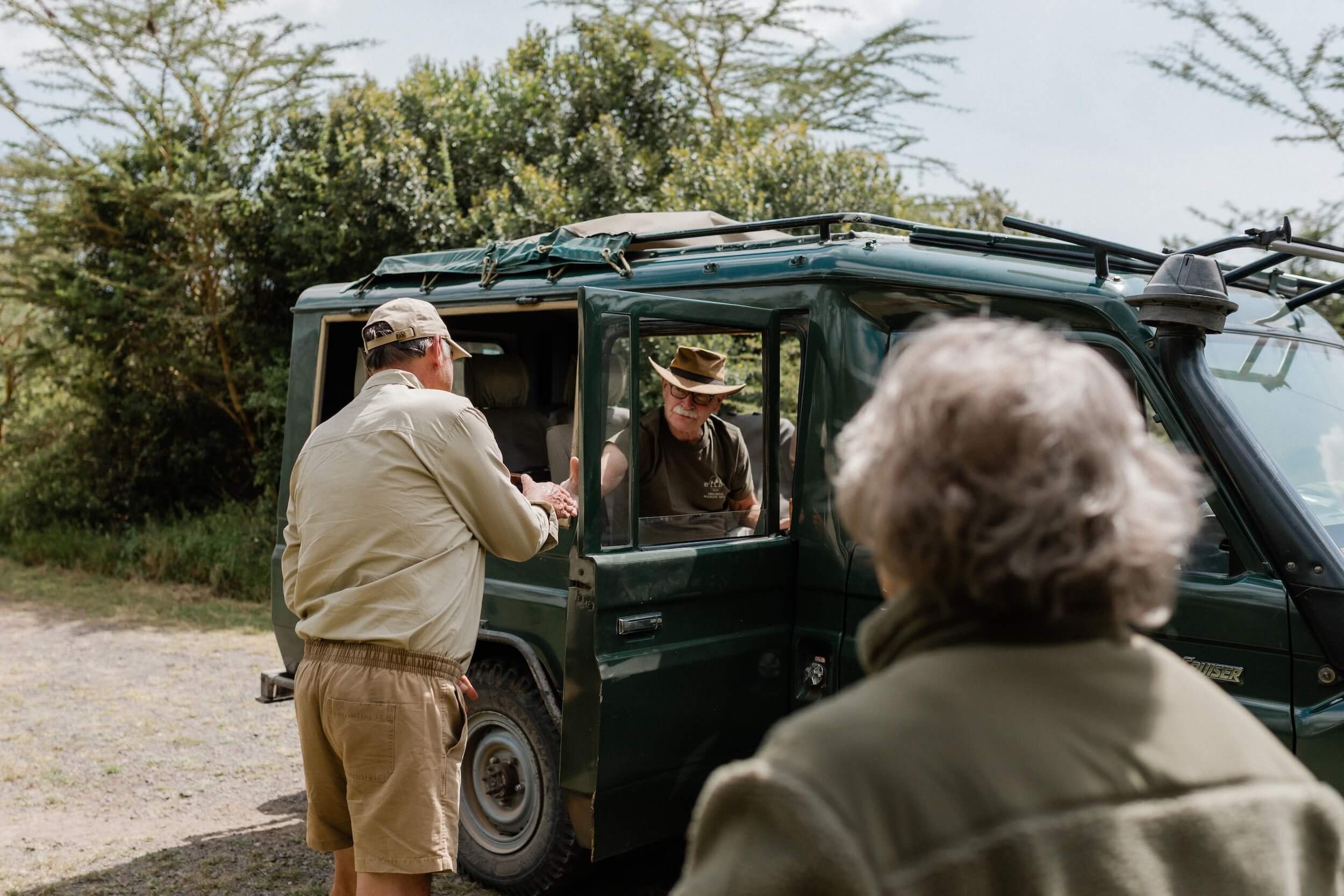
Arriving at The Safari Cottages
The Flying Details You Need to Know
Airlines: Air Kenya and Safarilink both operate multiple daily flights from Nairobi's Wilson Airport to Kamok Airstrip and Nanyuki Airstrip. Book direct with them or via your travel agent.
Luggage: Small aircrafts have weight and baggage limits. Expect to pack lighter than a commercial flight — local flights in Kenya allow passengers 15kgs per person in soft sided bags only (no hard shell cases).
The bus route thing: It’s important to note that these aren't private flights - they operate like a bus service. You might land at one or two other airstrips on the way to Kamok (picking up or dropping off other passengers). The route changes daily depending on passenger schedules. This doesn't affect you — it just means the flight might take 90 minutes instead of 60 depending on stops. It's normal.
Arrival time: If you book a morning flight (usually 8/10AM AM departure from Wilson), you'll genrally arrive at Kamok by late morning. This gives you time for lunch and an afternoon game drive. This is our recommendation.
What the airstrip actually looks like: Kamok is a dirt runway maintained by the conservancy. It's safe and professional. You won't feel unsafe landing on it — bush airstrips are designed for this. The landing is smooth. When you step out of the plane, you're in the middle of the conservancy, surrounded by acacia trees and plains. It's a really special introduction to your safari.
The Driving Details You Need to Know
The route: Nairobi → Nanyuki → Ol Pejeta. The road is well-maintained tarmac most of the way. You pass through towns, farms, and beautiful highland scenery.
The driver: You can arrange your own driver or have your travel agent arrange one for you. If you’re booking directly with us we can also arrange this for you.
Stops along the way: Most guests like to drive straight through, but if you’d like to stop enroute there are curio shops and restaurants on the way to stretch your legs.
Arrival: You'll arrive at Ol Pejeta mid-afternoon. If you book a morning departure, you can often fit in a late-afternoon game drive. You’ll likely be exhausted from all the travel and in bed early tonight, but you would have packed a lot in to day one!
What to pack: The drive is comfortable but long. Bring water, snacks, a book, or entertainment. The scenery is interesting enough that many guests enjoy just watching the landscape.
Our Recommendation
Our take: We always recommend flying to Kamok if the weather is stable and your budget allows. The experience of arriving by plane and being driven through the conservancy directly on arrival makes for a wonderful and easy start to your trip.
But if you're budget-conscious, traveling with a group, or staying 5+ nights, driving is completely sensible. The landscape is beautiful. The drive is comfortable. The cost savings are not modest.
There's no wrong choice. Just different trade-offs.

MORE FROM THE SAFARI COTTAGES BLOG
Keep Reading…
First-Time Safari: Your Pre-Trip Anxiety Guide (Nothing to Fear)
Booking your first safari comes with questions most people won't voice: Will I be safe? What if I need a wee? Will a lion eat me? This guide answers the some of the common questions we get from first time safari goers with honest, practical reassurance. Because these concerns are normal, and the answers are usually better than you're imagining.
If you're booking your first safari and you have questions like 'What if an animal charges?' or 'What if I get sick?' or 'What if I need a wee?' or 'What if I'm actually terrified the whole time?' — this post is for you. Because those questions are totally normal, very common (even if people aren’t asking them outright) and the answers are probably not what you're imagining.
The Questions Nobody Wants to Ask (But Everyone Thinks About)
What if a lion attacks the vehicle?
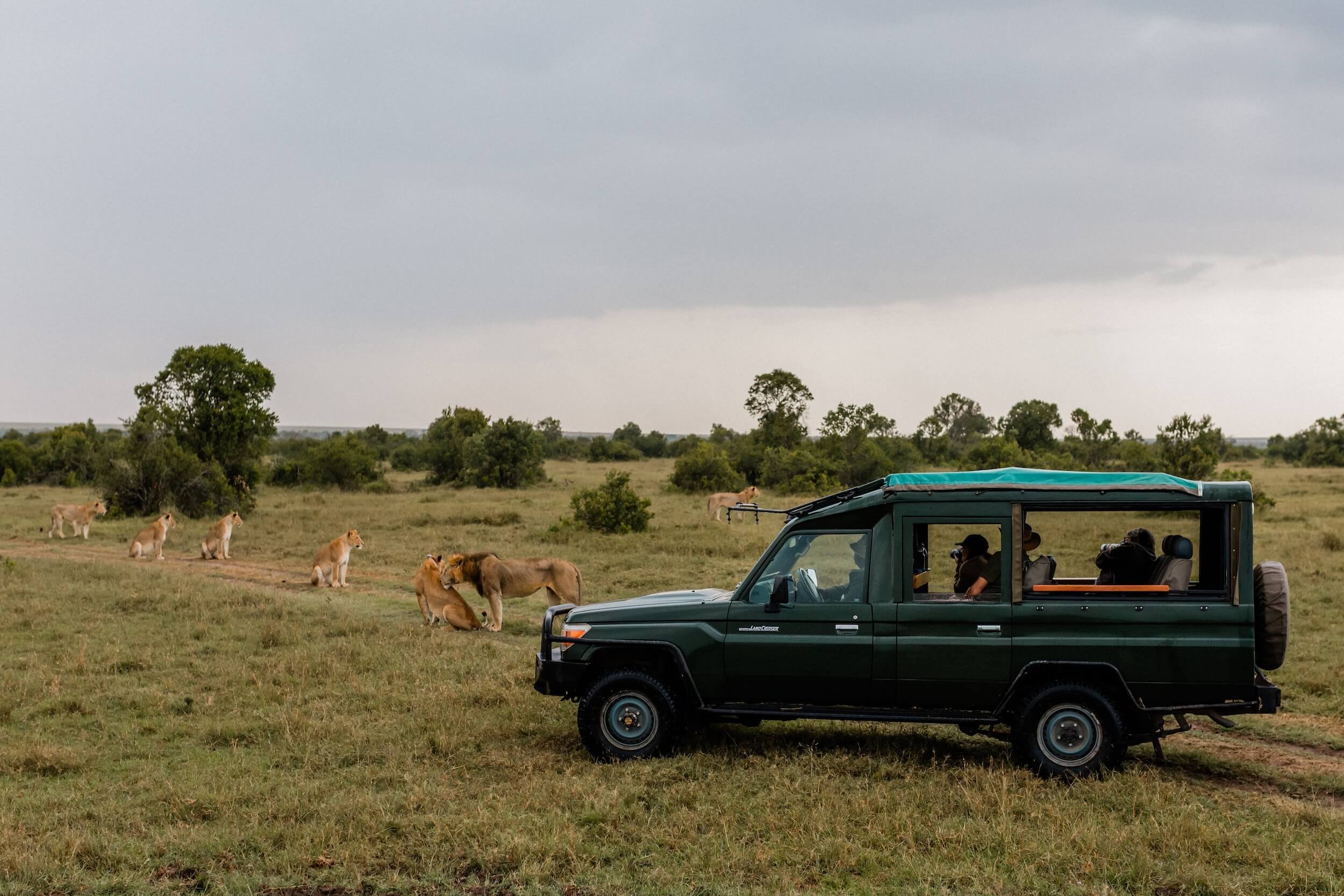
Lions in Kenyan parks and conservancies almost never attack vehicles unless they are aggressively provoked. In fact in some places lions are incredibly comfortably with vehicles and even use them for shade! That’s because lions don't see a vehicle full of people as prey — they see you as a whole obstacle, like a rock.
If you’re travelling with an ethical safari operator (and we very much hope you are) your guide will tell you to keep your limbs in the vehicle at lion sightings, not to sit on the roof and not to make loud disruptive noises around lions. This is so that they continue to see the vehicle as one unit, rather than a lot of gawking people.
In the wild, the general rule is “leave the wildlife alone and it will leave you alone.”
What if I need to wee on safari?
We get this question a lot, and it’s really understandable. Our guides are very used to being requested pee breaks on safari so never feel embarrassed to speak up.
In Kenya, though you aren’t permitted to leave your vehicle in national parks, you can often pop behind the back of the vehicle in a quite spot and in private conservancies like Ol Pejeta you can stop wherever you’d like that’s appropriate.
For the most part we’d recommend you get comfortable with a bush wee. That’s the easiest option to make sure your movements are not restricted. But, Ol Pejeta does also have a handful of toilets scattered around the conservancy so we tell our guests to just let their guide know if they prefer using a toilet, then you can plan your journey around accommodating a stop here.
Is game driving safe?
This is the safest way to experience Kenya’s wildlife and, so long as you’re in the care of a professional safari guide, you are entirely safe in your vehicle. But safety is more often than not how you feel rather than what is actually happening, so if you ever don’t feel comfortable don’t be afraid to speak up and ask your guide to put more distance between yourself and a specific animal.

What if I see something that horrifies me?
Seeing predation in the wild is intense and profound. It's can be violent and sometimes quite shocking, but it can help to remember that you’re witnessing the food chain functioning exactly as it has for millions of years — it's a moment of genuine ecological reality. Most first-time safari guests who see a kill report it as one of the highlights of their trip. If you’re not comfortable with it though, or you’re not sure you will be, it pays to have a private vehicle for your safari so you can simply ask your guide to navigate away from any sightings that you don’t want to be a part of.
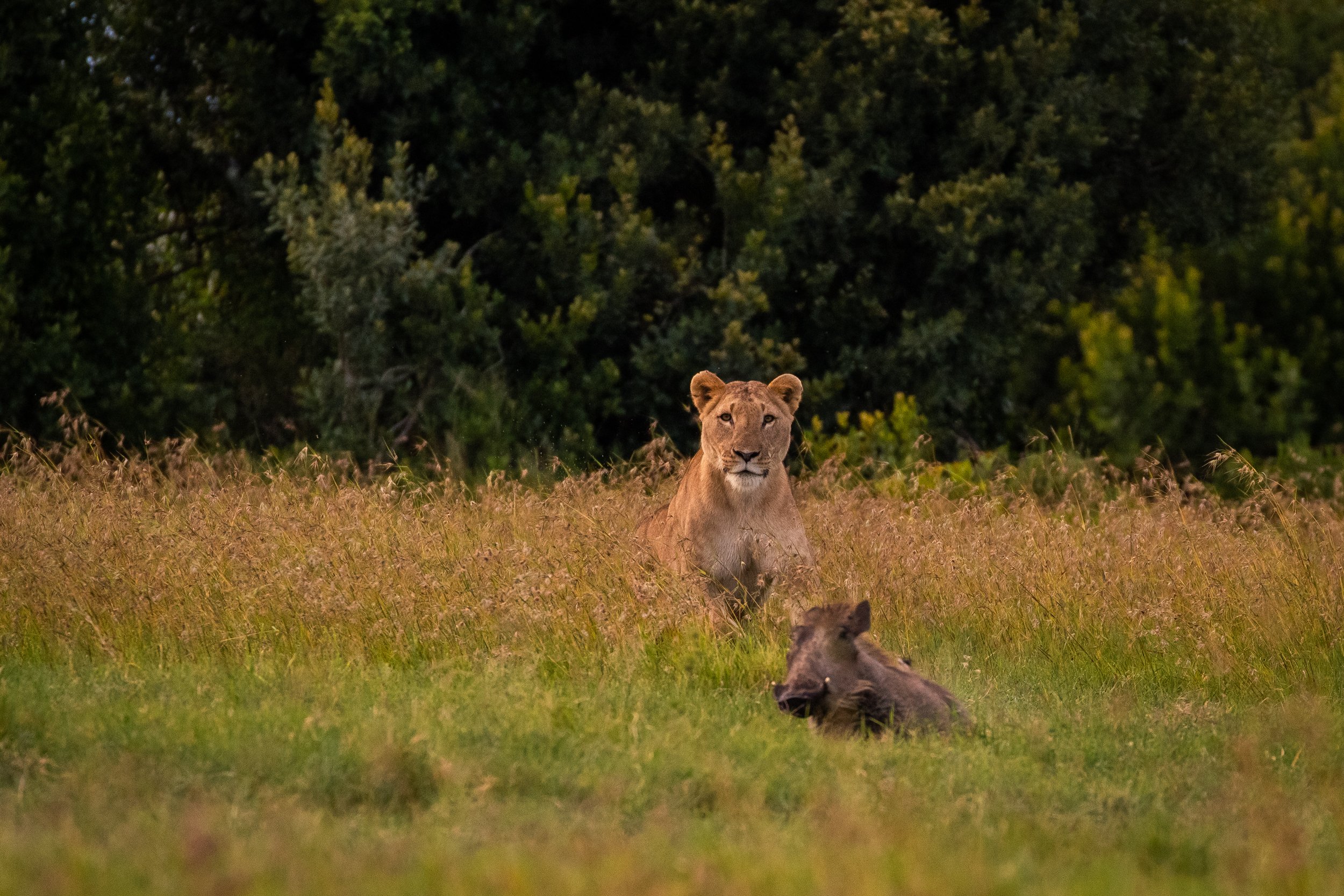
The Physical Reality of Safari
Activity level: Low. You're sitting down most of the day. Game drives can involve an hour or two of active movement, but you're in a vehicle moving slowly. We provide yoga mats in all our rooms for people to move a little after their game drives, and the entire property is fenced so you can take a walk and stretch your legs this way too.
Comfort: High. At The Safari Cottages you're sleeping in a comfortable cottage with good food and hot water. You're not camping. You're not roughing it. Most tented camps in Kenya will also be extremely comfortable. Some provide hot and cold running water, some run on more basic systems - it’s worth considering your comfort levels when you choose your accommodation.
Difficulty: Minimal. There's nothing difficult about a safari (except waking up early if you like a lie in). Everything else is leisure, food, and observation.
The Emotional Reality
Most first-time safari guests report that they feel safe and well cared for and are usually taken aback by the quality of the wildlife experiences they have on a safari with us. In our experience it only takes two or three days before most guests have shifted from 'am I safe?' to 'can I stay longer?'

Your first safari doesn't have to be scary. Book your stay at Ol Pejeta Safari Cottages and let us know it's your first time. We'll structure your trip to ease your anxieties and help you fall in love with the bush.
More from The Safari Cottages blog
5-Night Safari Itinerary at Ol Pejeta: What We'd Recommend
Five nights at The Safari Cottages is a different kind of safari altogether. You move from ticking animals off a sighting list to living in rhythm with the bush. The extra days unlock full-day trips out, unhurried night drives and encounters with rhinos you can’t have anywhere else in the world. Here's exactly how to structure it.
Five nights at The Safari Cottages offers you an entirely different experience. You move from ticking animals off a sighting list to actually living in rhythm with the bush. If you’re considering settling in and staying a little longer than the standard three nights, this is how we'd suggest you structure it…
Your Itinerary: Day by Day
Day One: Arriving and Settling In
Arrival
You can drive up from Nairobi or fly into our local airstrip, Kamok. In both cases you’ll likely be in the bush by midday and then it’s around a one hour drive to Ol Pejeta Safari Cottages. You’ll settle in, enjoying lunch alfresco and watching the wildlife amble down the river and then have a bit of down time - catch up on sleep, read a book, take a walk around the property. Relax and let it soak in.
Late Afternoon Game Drive
After a cup of tea at four o’clock you’ll meet your guide and set out on your first drive on the conservancy. You'll see elephants, buffalo, zebra, impala, giraffe. Maybe leopard or lion. The guides are learning your preferences and figuring out what your priorities are, so they can structure the following days accordingly. You’ll return after sunset to a roaring fire and dinner under the stars.
Arriving at The Safari Cottages
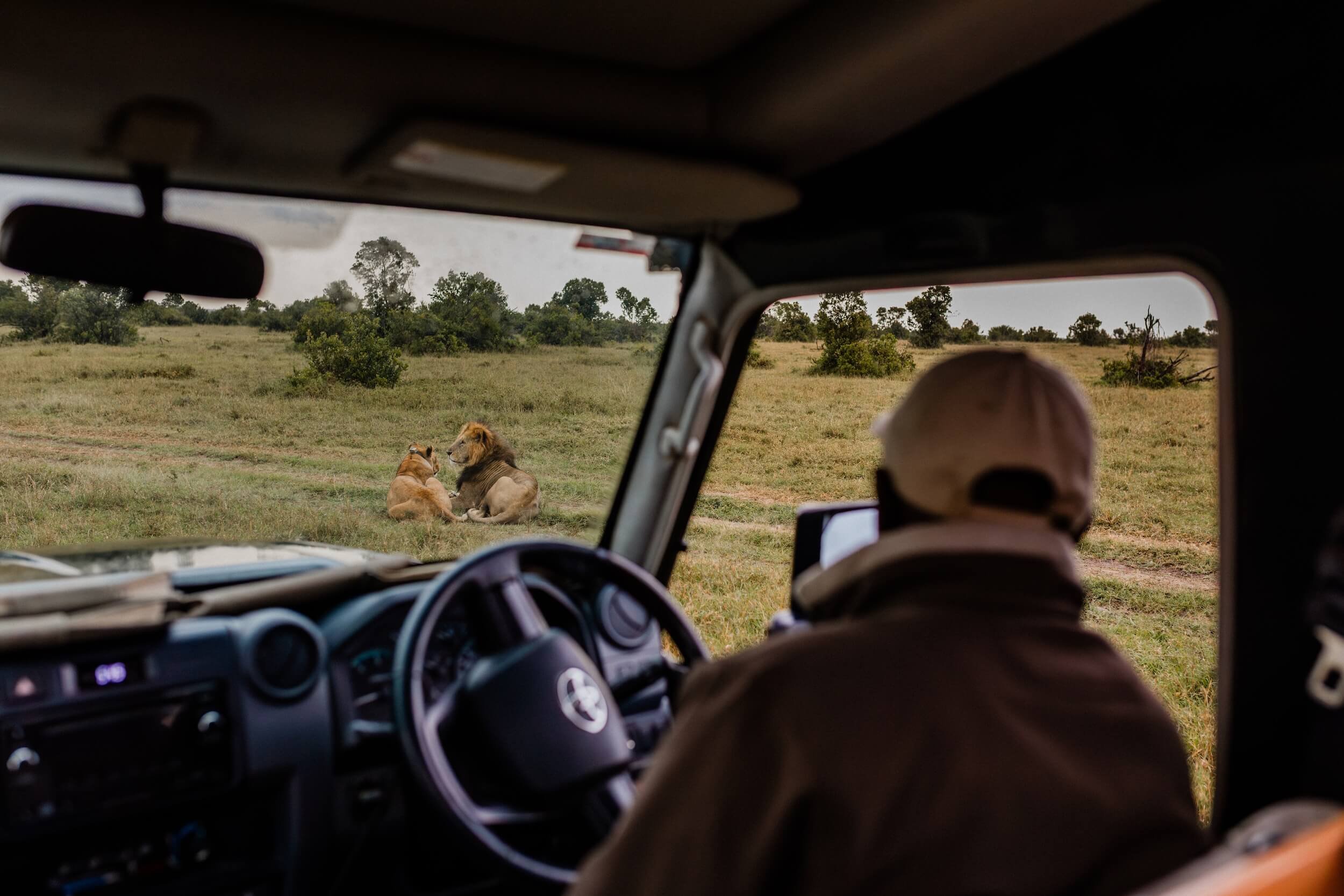
An afternoon game drive with your guide
Day Two: A Full Day of Ol Pejeta’s Wildlife
MORNING
Dawn Game Drive: You’ll be woken at dawn with a cup of freshly brewed tea or coffee then you’ll embark on a morning game drive. You'll see predators returning from hunts, babies springing across the plains and birds in early morning feeding frenzies. Depending on what the guides find, you might sit long with one sighting or amble across the plains taking it all in.
Here’s what you can see on a safari to Ol Pejeta.
Mid-Morning Picnic Breakfast: As the sun rises a little higher over Mt Kenya your guide will find somewhere to pull over. You can jump out the vehicle and stretch your legs. He’ll set up a picnic table and a few picnic chairs for breakfast. This is usually a selection of fruits and fruit salad, Sonja’s famous granola, some baked goodies and something “hot” that travels well.
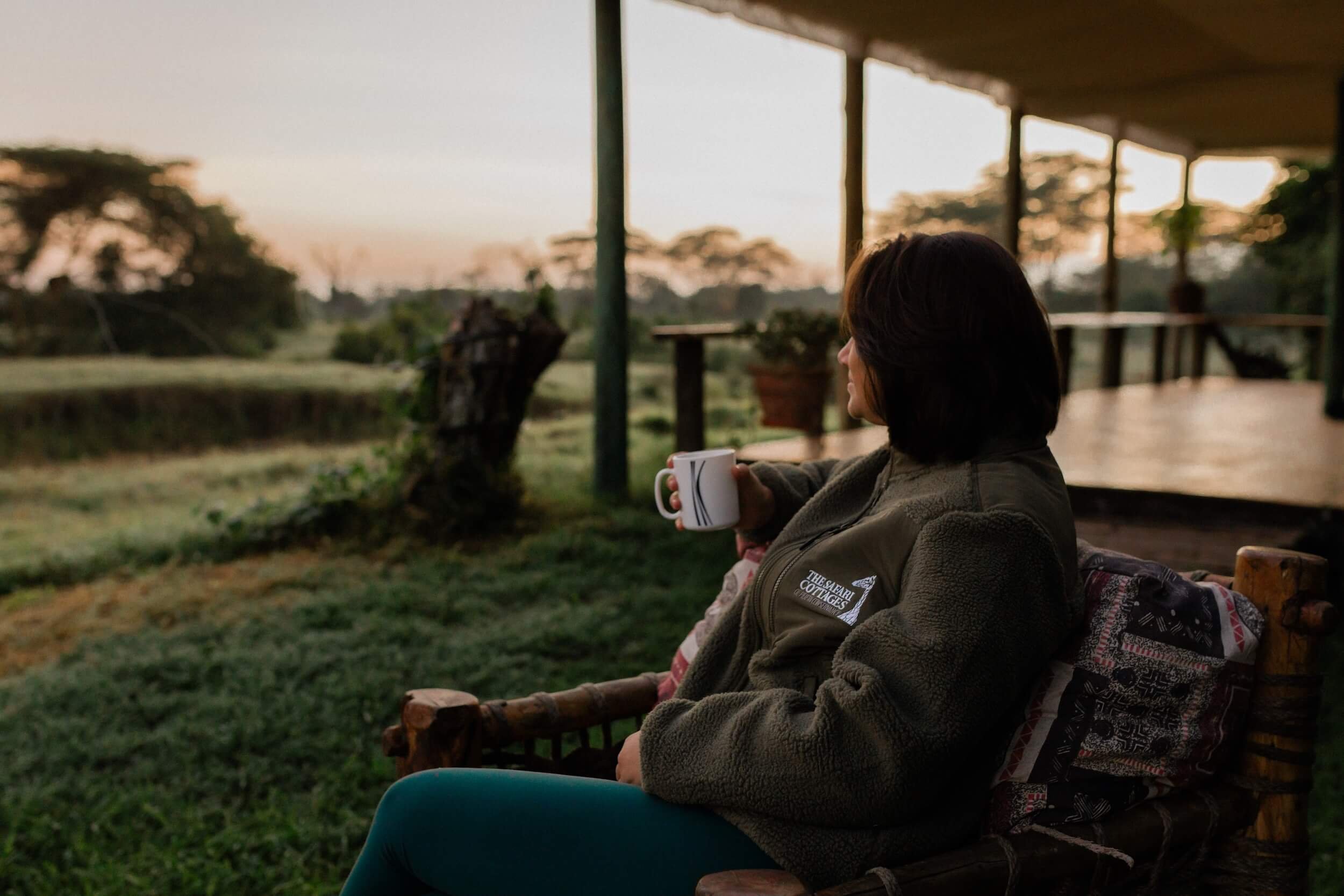
A morning coffee at dawn before your game drive

Tucking into a picnic breakfast in the bush
AFTERNOON
Lunch and Downtime: It’s been a full morning out and you’ve been up since dawn, so a delicious lunch followed by a siesta will likely be just what the doctor ordered. If you’re still bouncing with energy though this afternoon is a great opportunity to wander down to the staff camp and ask Dominic or Vicky for a tour of our kitchen garden.
Late Afternoon: You’ll head out again this afternoon for a late afternoon game drive. When the sun starts to slink below the horizon your guide will pull over the vehicle and pour you your favourite drink whilst you watch the sky light up and the world grow slowly dark. On your drive home tonight be sure to keep your eyes peeled for leopards, zorillas or nightjars. Arrive home in time for dinner and probably an early bedtime.
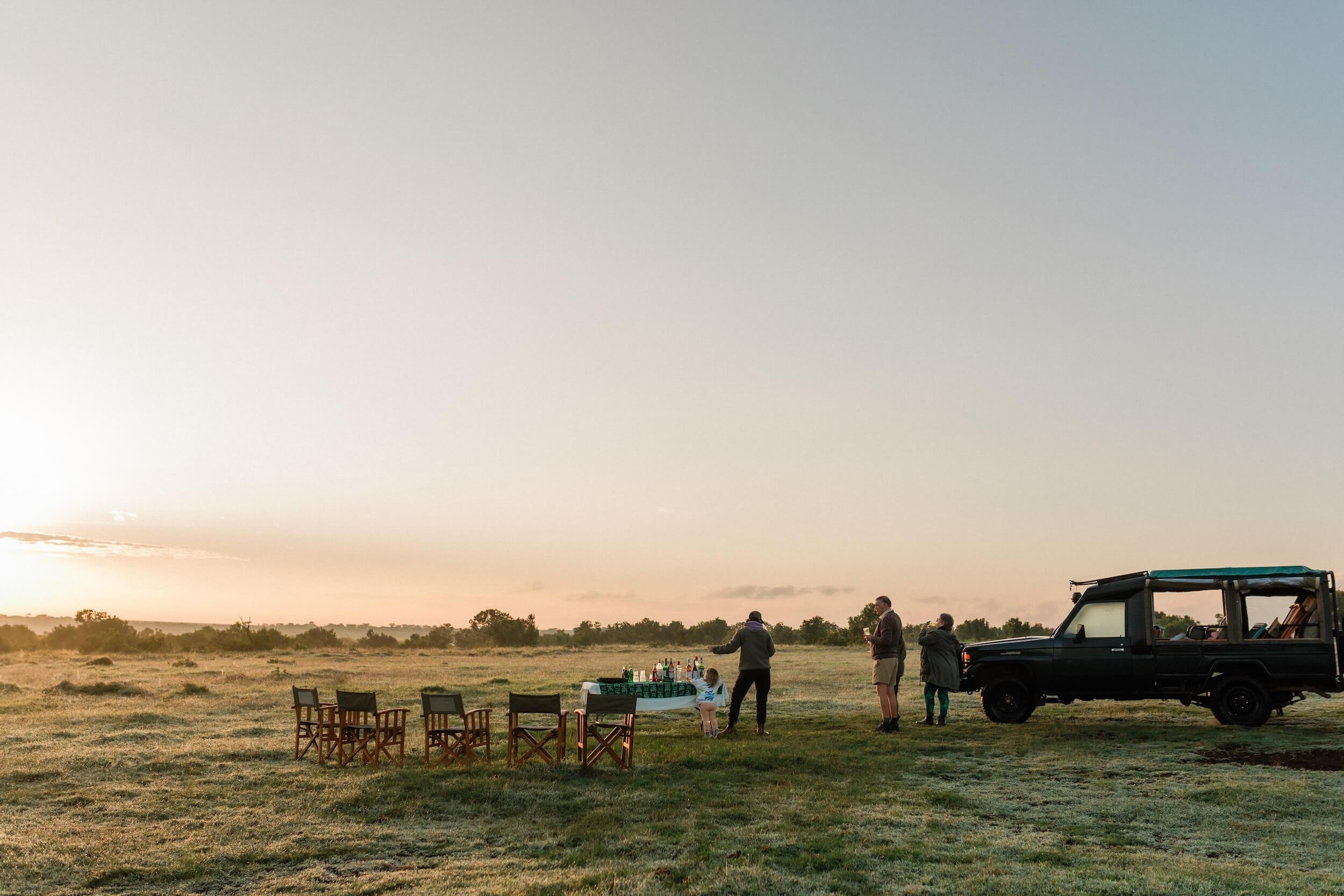
Watching the sun set across the plains
Day Three: Conservation
MORNING
Visit the Northern White Rhinos: After breakfast at camp today you’ll have the incredible honour of meeting the last two northern white rhinos left on our planet, as well as their caretakers. You’ll learn all about rhino conservation from the people on the ground, doing the work every day. Explore the conservation centre too, and meet Baraka - a blind black rhino that was rescued and rehabilitated right here on Ol Pejeta.
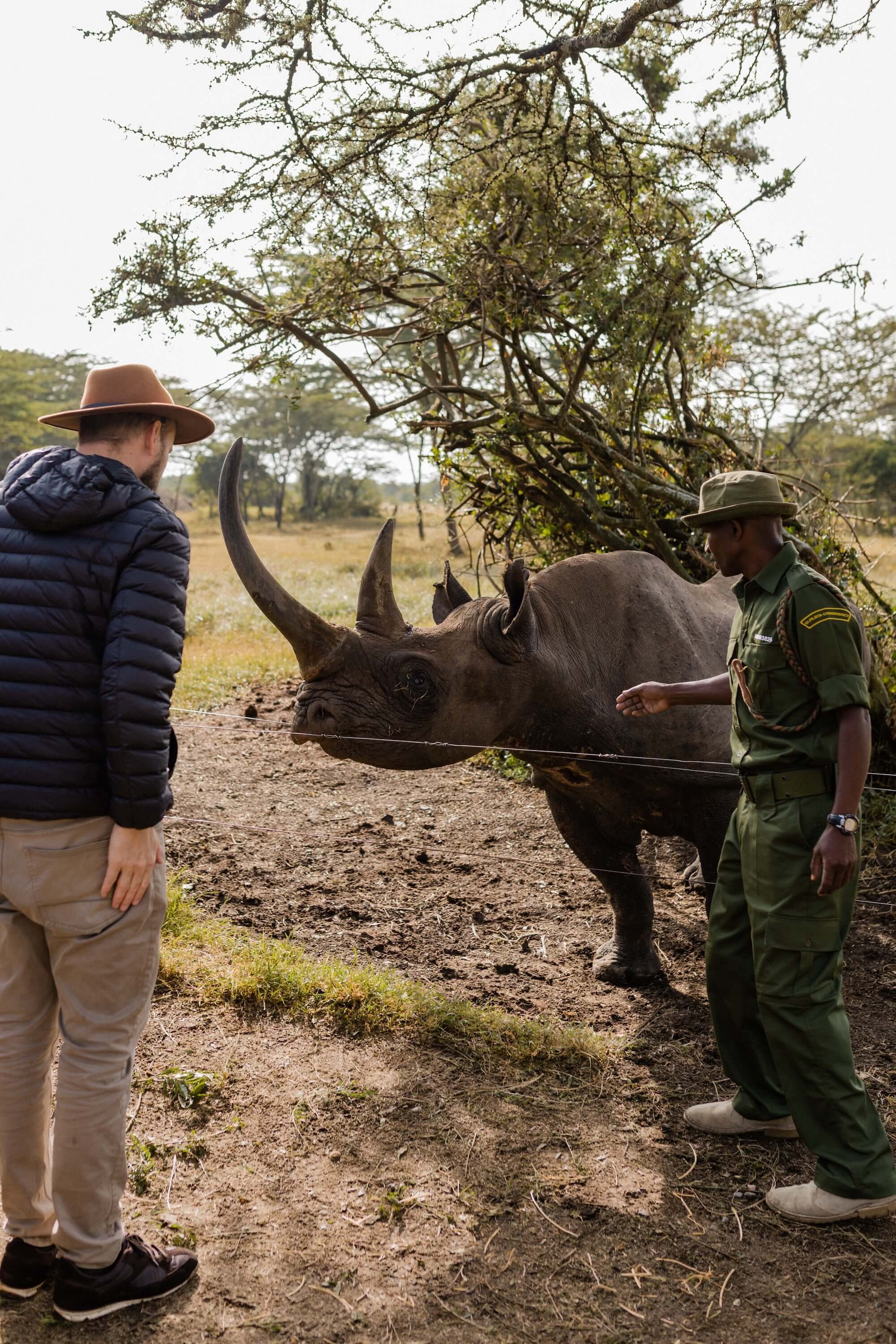
Meeting Baraka - rescued black rhino

One of the last Northern White Rhinos left in the world
AFTERNOON
Visit the Sweetwaters Chimpanzee Sanctuary: After lunch and a siesta you’ll head to the nearby Sweetwaters Chimpanzee Sanctuary. The sanctuary rescues chimps from the illegal trade and gives them the best life possible in captivity. When you watch them — really watch them — you understand something about intelligence, trauma, resilience, and inner lives recognisably similar to ours.
Night Drive: Enjoy your sundowner around the fire this evening, and an early dinner before you jump back into the vehicle and explore the conservancy after dark on a night drive. Nocturnal species are completely different from day animals. A leopard hunting at night moves with focused intensity. A serval is delicate and quick. Porcupines waddle through the grass and hyena clans move with purpose and hierarchy you can watch unfold.
Day Four: Day Trip
Full Day: Our central location in the heart of Laikipia means we are ideally placed for you to explore a little further afield. After an early breakfast at your safari cottage you’ll head out for the day with your guide to explore Mt Kenya, or the Aberdares or perhaps the Ngare Ndare forest. These areas are less about wildlife and more about incredible scenery, birdlife and the chance to hike and witness exciting and dramatic landscapes. You’ll carry a picnic lunch with you and return late after dark, for dinner.
A day trip to Ngare Ndare
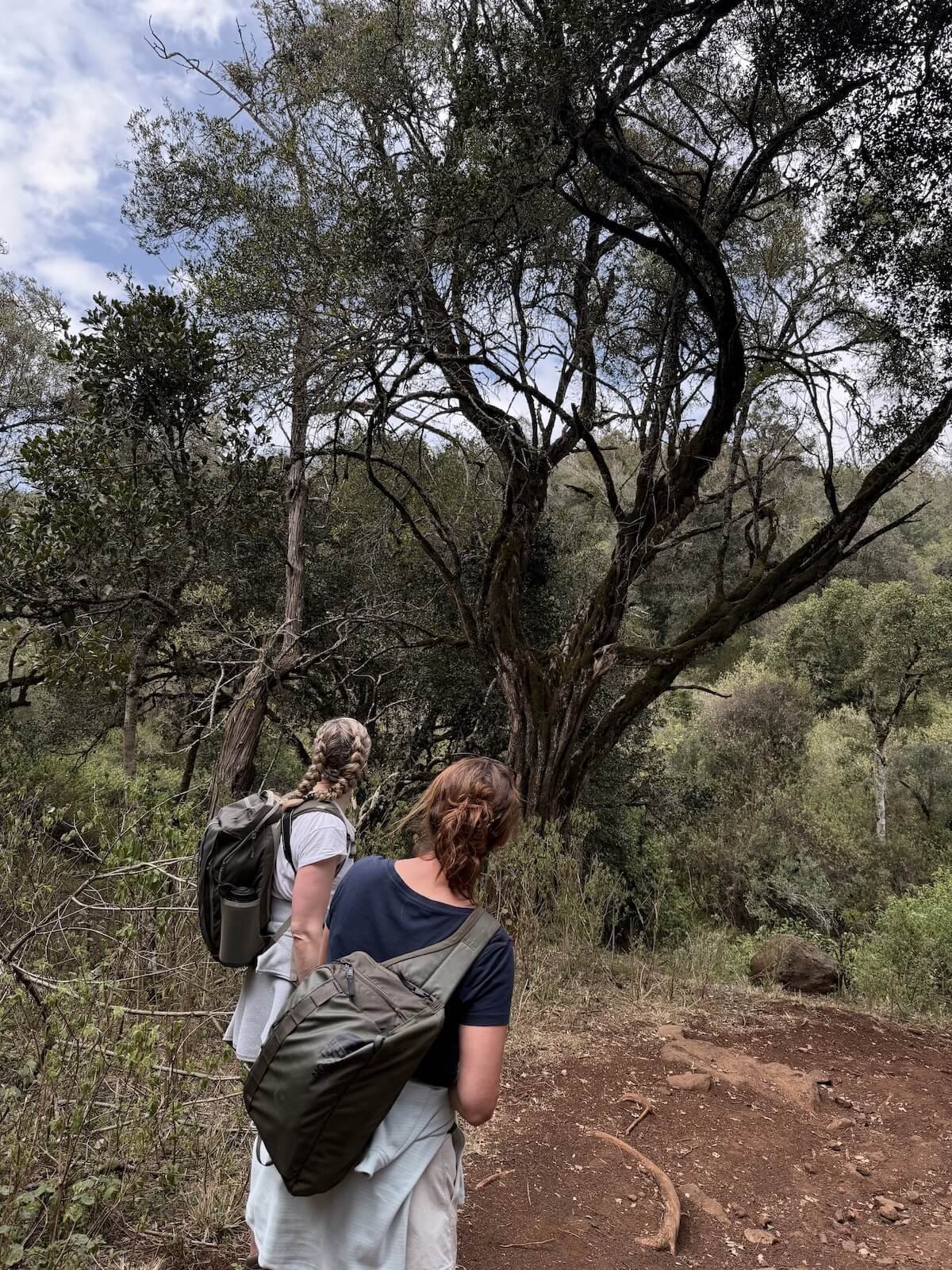
Hiking in Ngare Ngare
Day Five: Classic Safari Day
Early Morning Game Drive and Picnic Breakfast: It’s your final day on safari today and it’s your chance to see of experience anything you haven’t managed to just yet. Let your guide know what that is - they will always do their best to make sure you leave fully satisfied. Otherwise it’s a great opportunity to sit back and enjoy the magic of the bush unfolding without the pressure of an agenda. This is our favourite way to safari because you never know what will pop up!
Lunch, Tea and a Final Game Drive: After some downtime at your private safari cottage today (or maybe you challenged the staff to a volleyball game!) you will head out for a final afternoon game drive, stopping to enjoy a sundowner and a night drive on the way home. If your askari hasn’t yet embroiled you in his stories from home, he just might do so tonight - ask for some marshmallows to roast over the fire after dinner and enjoy one final heart-to-heart with the people who have poured their hearts into this place.
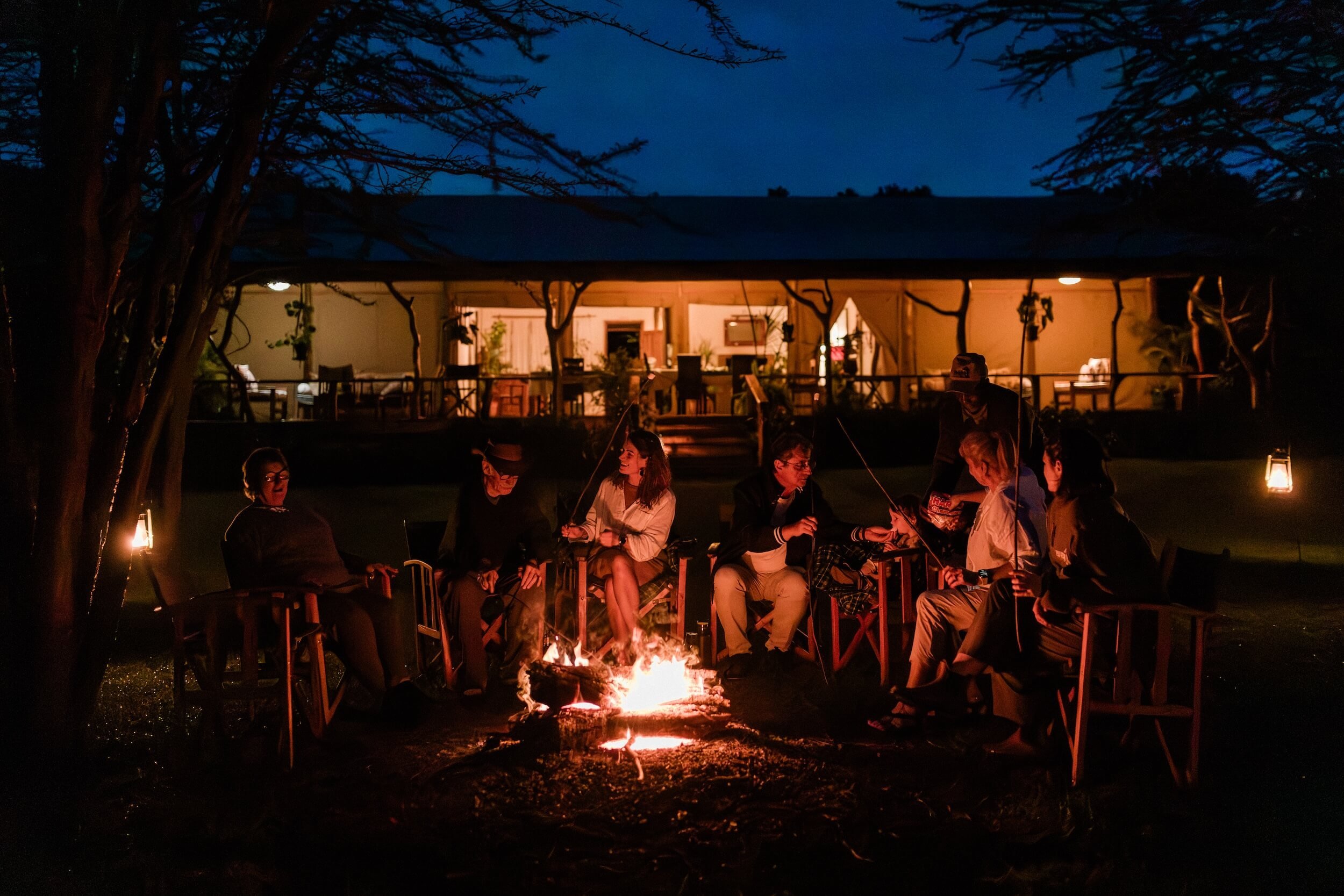
Roasting marshmallows around an evening fire
Day Six: Departure
After a leisurely breakfast at camp this morning your guide will assist you onto a flight or to meet your road transfer out of Ol Pejeta and on to your next destination. The longer you stay, the more the conservcany reveals itself and we hope that, by now, you’ve settled deeply into the rhythm of nature.
Customizing Your Stay
This is a template. Your actual itinerary shapes around what you're interested in (big cats, birds, conservation, your families specific needs), your comfort level with walking, and what the bush gives you on the day. Your guides know this conservancy intimately — they'll make the decisions that matter and do their very best to ensure you have a safari of a lifetime!
ESTIMATED COSTS FOR THIS 5-NIGHT OL PEJETA SAFARI COTTAGES SAFARI
High Season 2026 (15 June - 31 October & 16 - 31st Dec 2026): USD3,900 per person
High Season 2027: (1 Jan - 7 Jan & 15 June - 31 October 2027): USD4,070 per person
Low Season 2027: (01 May - 14 June 2027): USD3,060 per person (includes 1 night free!)
Notes on pricing:
Prices include accommodation, all meals, drinks and a private vehicle and guide. Transport to and from Ol Pejeta is not included.
The above prices are based on two people sharing
Children under 12 are half price and under 3 are free
Please contact us with the number of people in your party and the ages of any children + your preferred travel dates for a personal and accurate quote
BOOK YOUR 5-NIGHT SAFARI AT OL PEJETA SAFARI COTTAGES
Keep reading
National Park vs. Private Conservancy. Why it Matters for Your Safari.
What's the difference between a national park and a private conservancy in Kenya? Night drives, bush walks, off-road driving, vehicle numbers — here's what it means for your safari, explained by the people on the ground.
When people start planning a Kenya safari, they quickly encounter a choice that isn't always well explained: national park or private conservancy? The distinction sounds administrative but, in practice, this choice shapes almost everything about your experience — what you can do, when you can do it, how many other people are around you, and what your visit contributes to the landscape you're travelling to see.
We live and work inside a private conservancy. Ol Pejeta is one of Kenya's most significant — 90,000 hectares of protected wilderness in the Laikipia region, managed as a not-for-profit conservation organisation. So it’s important to note that we're not neutral on this question, but we'll try to be honest about what each option offers, because the right choice genuinely depends on what kind of safari you're looking for.
What Is a National Park, and What Is a Private Conservancy?
Kenya's national parks — Amboseli, Tsavo, Lake Nakuru, Meru and others — are government-managed protected areas administered by the Kenya Wildlife Service. They are open to anyone who pays the entry fee, the roads are fixed and signposted, and the rules are standardised across the country.
Private conservancies are a different model entirely. They are protected areas managed by private landowners, community groups, or conservation trusts — often in partnership with safari operators. Ol Pejeta is a registered not-for-profit whose conservation work is funded directly by tourism revenue. The Masai Mara ecosystem's famous conservancies — Mara North, Naboisho, Olare Motorogi — operate on land leased from local Maasai communities, with lease fees going directly to those communities regardless of whether their land is being grazed.
The management model matters because it determines everything from visitor numbers, to what activities are permitted, to where the money goes.
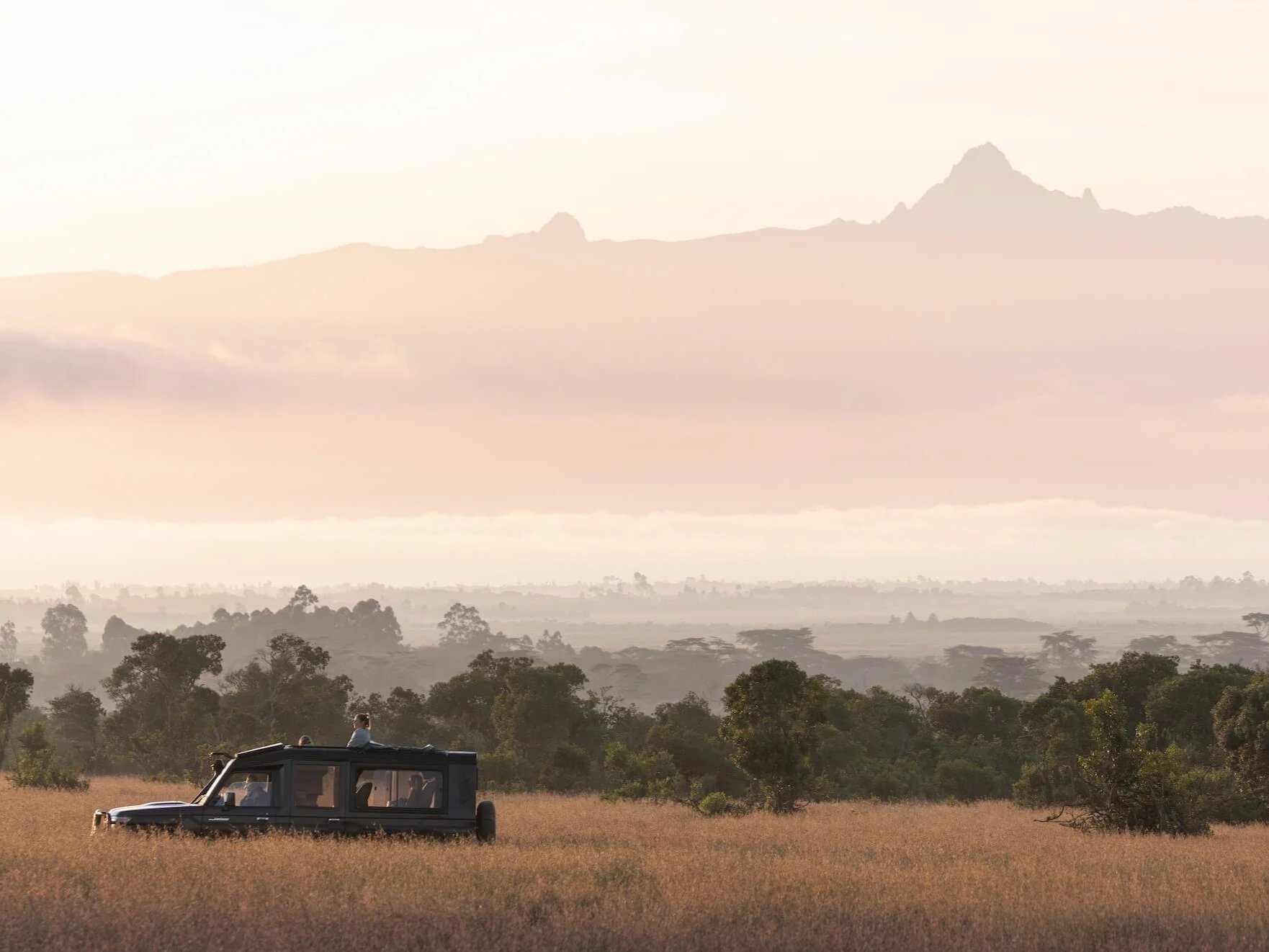
Game driving on Ol Pejeta - Mt Kenya in the background
The Four Practical Differences That Affect Your Safari
1. Night drives — permitted in conservancies, prohibited in national parks
Game drives within national park and reserve boundaries are restricted to set hours (normally 06:30 until 18:30) meaning no night drives are allowed at all.
This is one of the most significant practical differences, and one that first-time visitors often don't know about until they've already booked. The bush after dark is a completely different world. Leopards become more active, spotted hyena clans move across the plains doing what hyenas do when they think nobody is watching. Civets, genets, aardvarks, porcupines and bush babies emerge from wherever they've spent the heat of the day. If a night drive is an important experience for you, this is worth bearing in mind.
At Ol Pejeta, night drives are included in every fully inclusive stay. We go out after dinner, usually with a spotlight and a guide who knows exactly where to look. No two are the same.
2. Bush walks — permitted in conservancies, prohibited in most parks
Most of Kenya's national parks do not allow bush walks, this is only possible in private conservancies.
There is a specific quality to being on foot in the African bush that no vehicle can replicate. The scale shifts. You become aware of things — the smell of the soil after rain, the sound of your own breathing, the sudden realisation that the distance between you and the wildlife is no longer measured in metres of steel. And you can see more of the little magics of the wild world, that are so often missed on a game drive. Bush walks at Ol Pejeta are led by our experienced guides, accompanied by an armed ranger. They are included in fully inclusive stays.
3. Off-road driving — permitted in most conservancies, prohibited in parks
Private conservancies offer off-road game drives, night safaris, and guided walks — these activities are usually not permitted in national parks.
In a national park, your vehicle stays on the road. When a leopard is resting in a gully 40 metres off the track, you view it from the track. In a conservancy, if the terrain allows and the guide judges it appropriate, you can often get a little closer. This matters more than it might sound. Some of the most extraordinary sightings happen in places no road reaches.

A guided bush walk on Ol Pejeta Conservancy
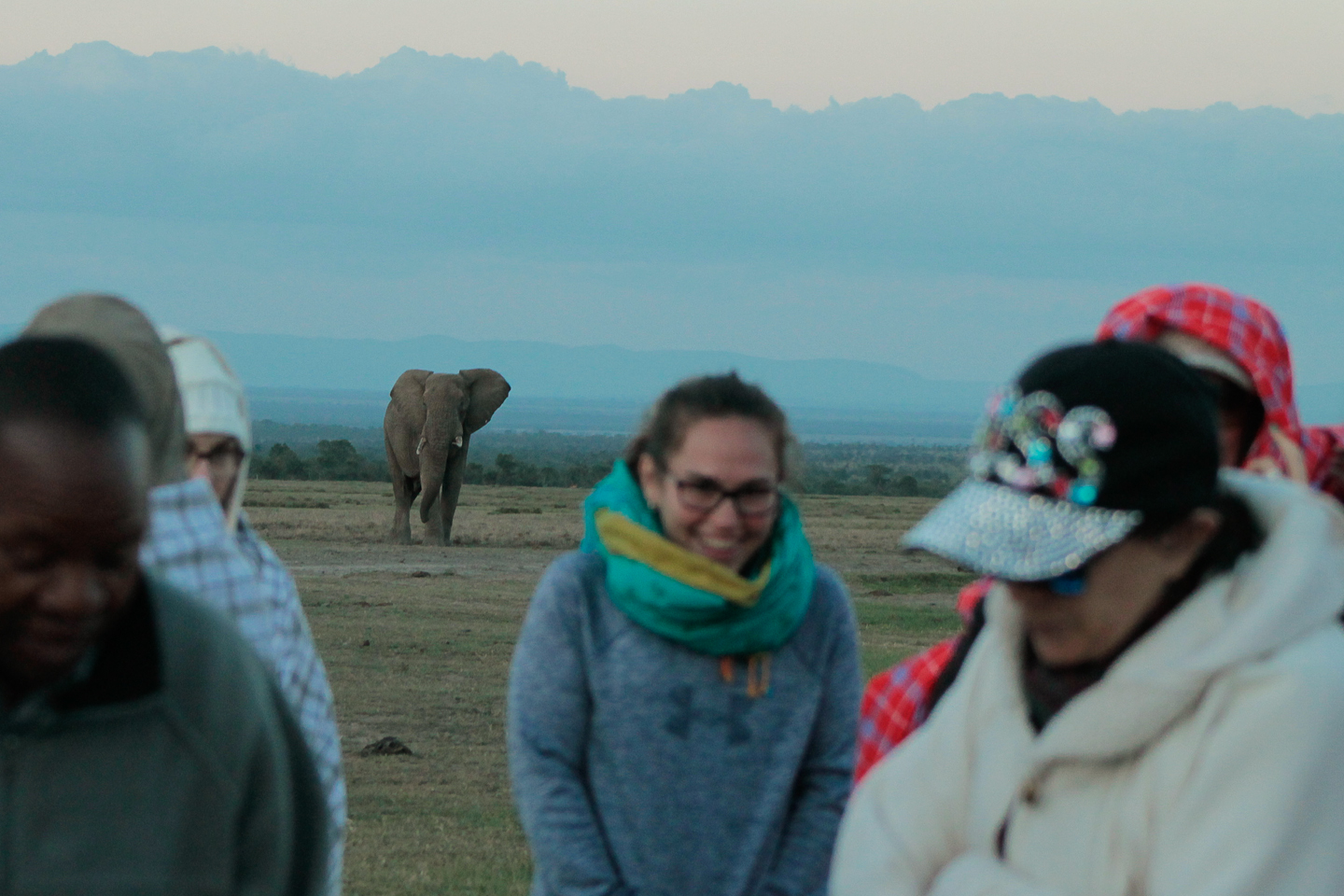
An elephant visits our guests during an evening sundowner
4. Vehicle numbers and crowds — controlled in conservancies, unrestricted in parks
This is perhaps the most visible difference for anyone who has experienced both. In Kenya's most popular national parks and reserves during peak season, a significant predator sighting can attract dozens of vehicles. The Masai Mara Reserve in July and August is one of the greatest wildlife spectacles on earth — and one of the most congested safari experiences available.
Conservancies limit visitor numbers, meaning fewer crowds at wildlife sightings and more intimate game drives.
At Ol Pejeta, vehicle numbers on the conservancy are strictly controlled and areas are tightly managed. There are mornings — even in peak season — when you will be the only vehicle at a sighting. Not because the wildlife is scarce, but because the system is designed to keep it that way.
What National Parks Do Better
That said, national parks do offer things that conservancies cannot always match.
Famous views or experiences. The Masai Mara Reserve is the only place in Kenya where you can witness the Great Migration in its full, staggering scale — hundreds of thousands of wildebeest and zebra crossing the Mara River between July and October. That spectacle happens inside the reserve boundaries, not the conservancies around it. If seeing the migration crossing is the primary goal of your trip, you need to be in or near the Mara Reserve.
Affordability. National parks charge park fees but these are still generally more affordable than most private conservancy fees. These conservancy fees, on top of accommodation rates, can add significantly to the overall cost of a stay. For first-time visitors on a tighter budget, a well-chosen national park camp might be a better option.
A uniqueness of their own. And some of Kenya's parks (for example, Amboseli with Kilimanjaro on the horizon, Nakuru with its lake views) have a unique quality that is simply their own, and not replicated elsewhere.
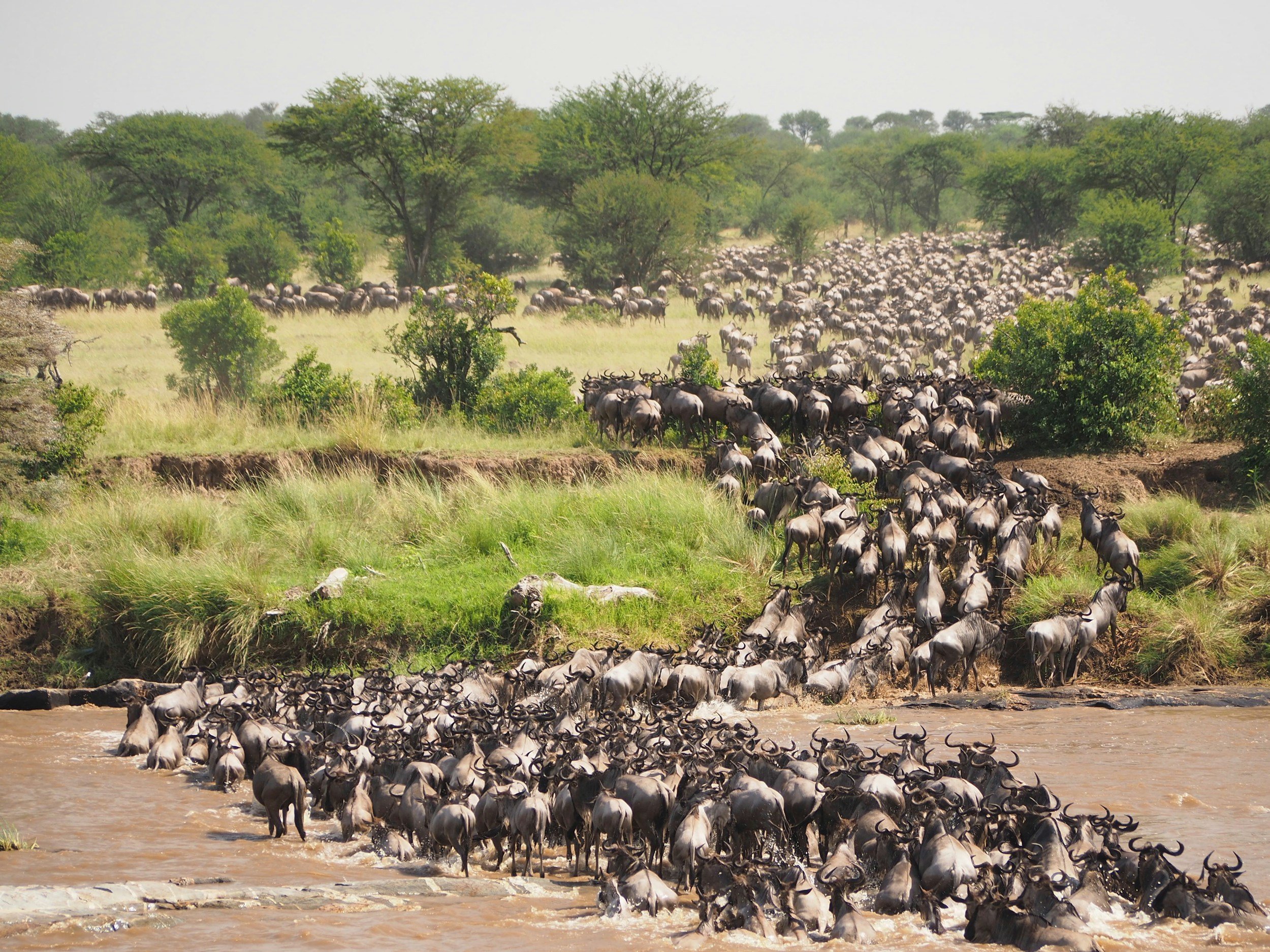
A river crossing during the great migration in Kenya’s Masai Mara reserve
What Makes Ol Pejeta Specifically Different
Ol Pejeta is not a typical conservancy in one important respect: its conservation mission goes significantly beyond wildlife tourism. It is home to the world's largest black rhino sanctuary in East Africa, 171 individuals — and to Najin and Fatu, the last two northern white rhinos on Earth. It runs the Sweetwaters Chimpanzee Sanctuary, which houses orphaned and rescued chimpanzees from across the continent. It manages 90,000 hectares as a not-for-profit, with every conservancy fee reinvested into ranger salaries, veterinary care, anti-poaching operations and community programmes.
Staying here means your conservancy fees go directly to this work. That isn't something every conservancy can say with the same transparency, and it's something we're very proud of.
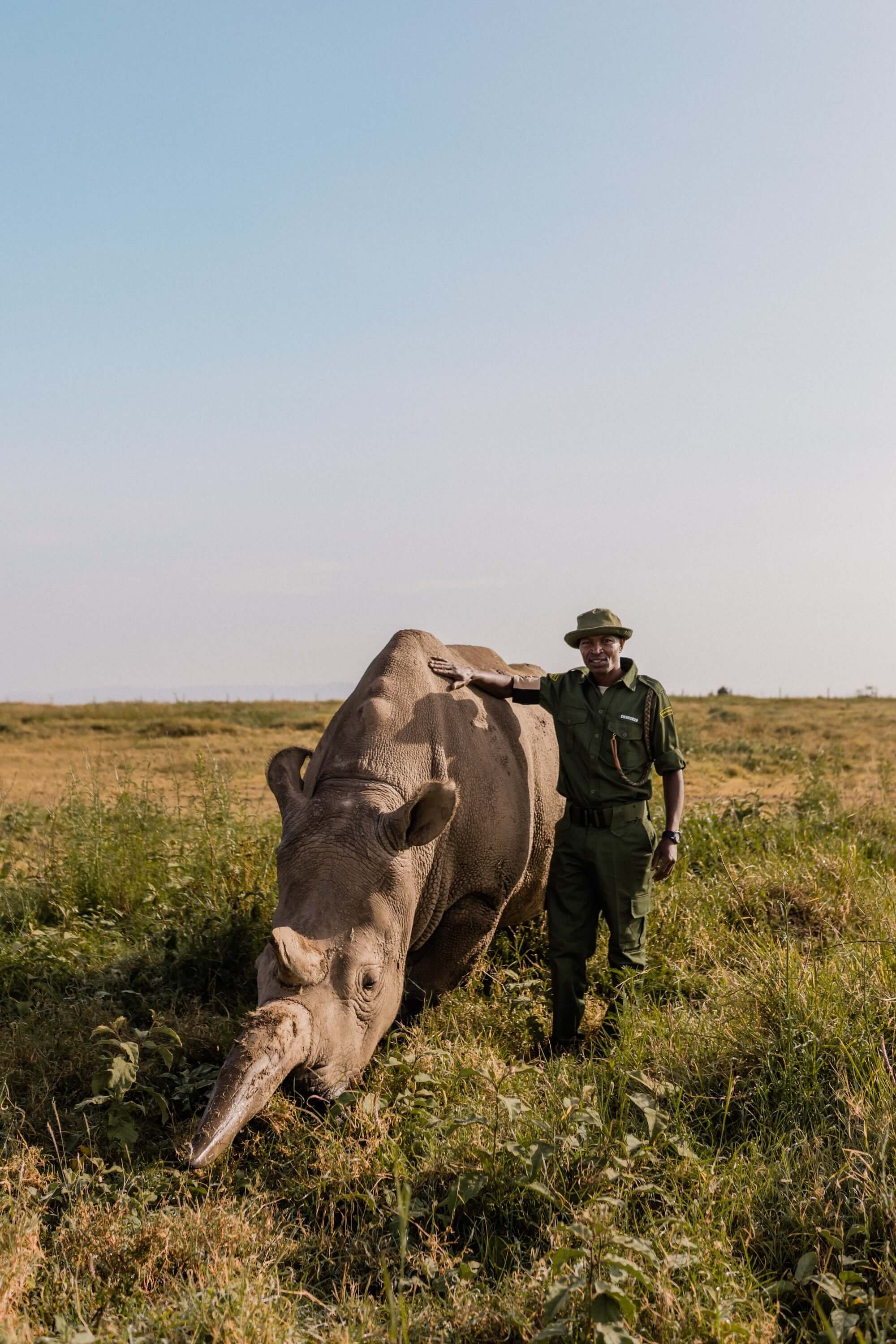
Najin - one of the last remaining Northern White Rhinos with head caretaker Zacharia Mutai
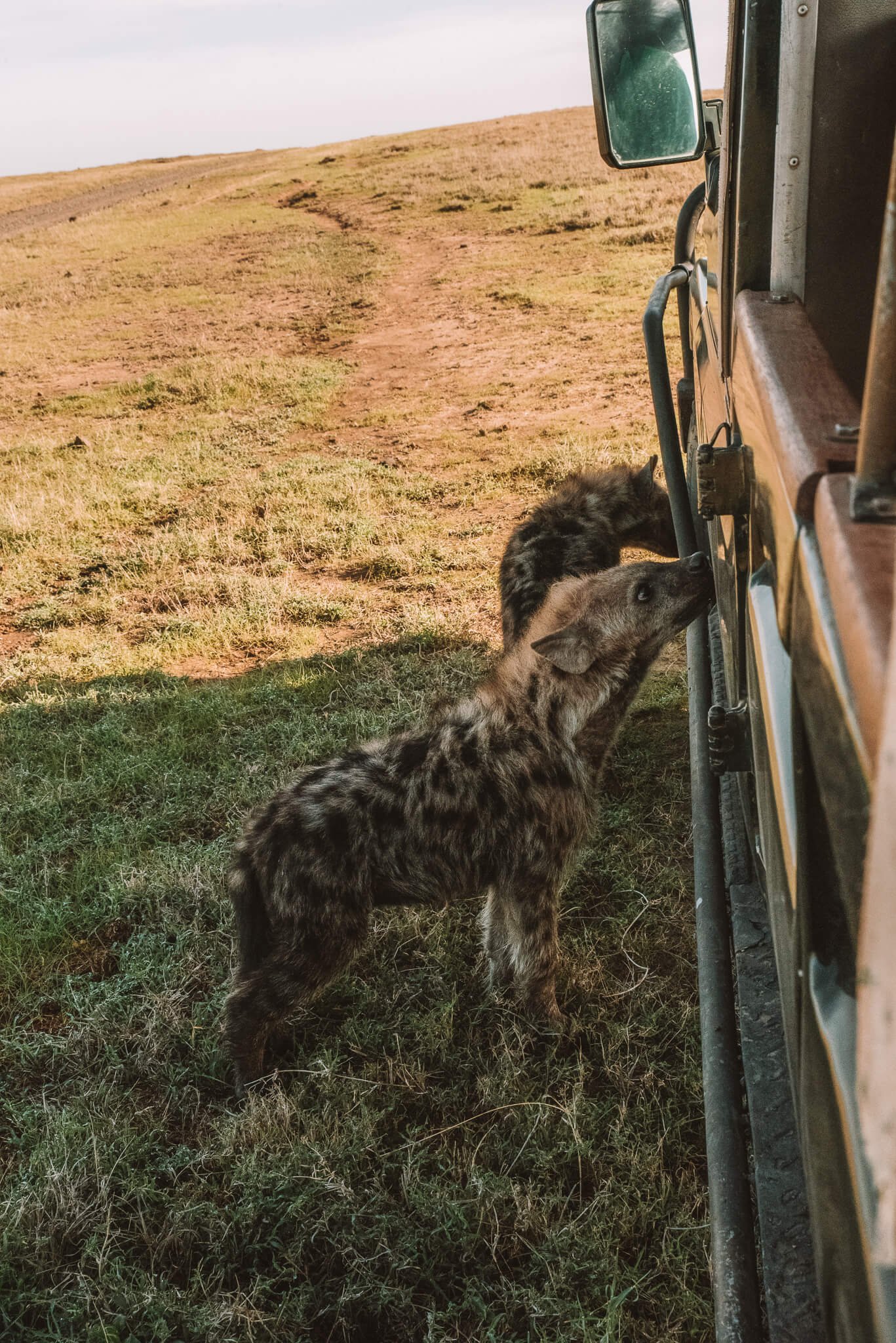
Curious hyena pups on a game drive on Ol Pejeta
Do You Have to Choose?
Not necessarily. Many Kenya itineraries combine time in a national park or reserve — typically the Masai Mara or Amboseli — with time in a conservancy like Ol Pejeta. Travellers often spend two or three days in a national park to see the wildlife spectacles or famous views, alongside a few days in a private conservancy for a quieter experience, night drives, and walking safaris.
If you're planning a longer Kenya trip, this combination gives you the best of both: the scale and spectacle of the parks, and the intimacy and flexibility of a conservancy stay. Ol Pejeta sits about four hours from Nairobi by road and 30 minutes by light aircraft — easy to include as part of a multi-destination itinerary (most of guests fly on to the Masai Mara from here) or equally satisfying as a standalone destination.
The Honest Summary
A national park safari gives you access to Kenya's most famous landscapes, wildlife spectacles and, in some cases, its most extraordinary single experiences. It is more accessible, often more affordable, and doesn't require the same level of planning.
A private conservancy safari gives you something different: control over your schedule, activities that don't exist in the parks, fewer vehicles, and the genuine sense that your visit is contributing directly to the land you're travelling to see. For guests who have done a park safari and felt the friction of crowds and fixed schedules, the shift to a conservancy tends to feel irreversible.
We're biased, naturally. But we also know that the guests who come to Ol Pejeta and then head to a park afterwards tend to notice the difference immediately — and not always in the park's favour.
Curious about what a stay at The Safari Cottages actually includes? Here’s a standard 3-night itinerary with prices.
Or if you're still planning your Kenya itinerary, our guide to getting here and our month-by-month seasonal guides are a good place to start.
Honeymoon Safari in Kenya: Planning Your Perfect Trip
Planning a honeymoon safari in Kenya? The Safari Cottages at Ol Pejeta Conservancy offers exclusive-use accommodation with private guide, private vehicle and private chef included. Discover the perfect Kenya honeymoon.
There's a reason so many couples choose Kenya for their honeymoon. It isn't just the wildlife, extraordinary as it is, or the landscapes, which are unlike anywhere else on earth. It's the feeling of being somewhere that genuinely slows you down — a place with no agenda except your own, where the moments that matter most tend to happen when you're not looking for them. It's the romance of untamed wilderness and vast open skies that ignites the romantic in us all.
A Kenya honeymoon safari, done right, is two people and a world that demands nothing of you except your presence. Here's why you'll find just that at The Safari Cottages on Ol Pejeta Conservancy.
Why Exclusive Use Makes All the Difference on a Kenya Honeymoon
Not all safari properties are created equal, and for a honeymoon in particular, the details matter enormously. At a shared camp, your day operates on someone else's schedule. Game drives depart when the camp decides, meals are at set times — you're a guest in someone else's itinerary.
At The Safari Cottages on Ol Pejeta Conservancy, the property is exclusively yours. Every morning, your private guide asks what you'd like to do. Your vehicle goes where you want to go. Your private chef cooks what you want, when you want it. If you want to stay at a cheetah sighting for two hours because neither of you can bring yourselves to leave, you stay. Nobody is waiting.
That's what exclusive use means in practice and, for a Kenya honeymoon, it makes all the difference.
We've hosted proposals, anniversaries, and more honeymoons than we can count. People come back for anniversaries after honeymooning here. We think that says something.
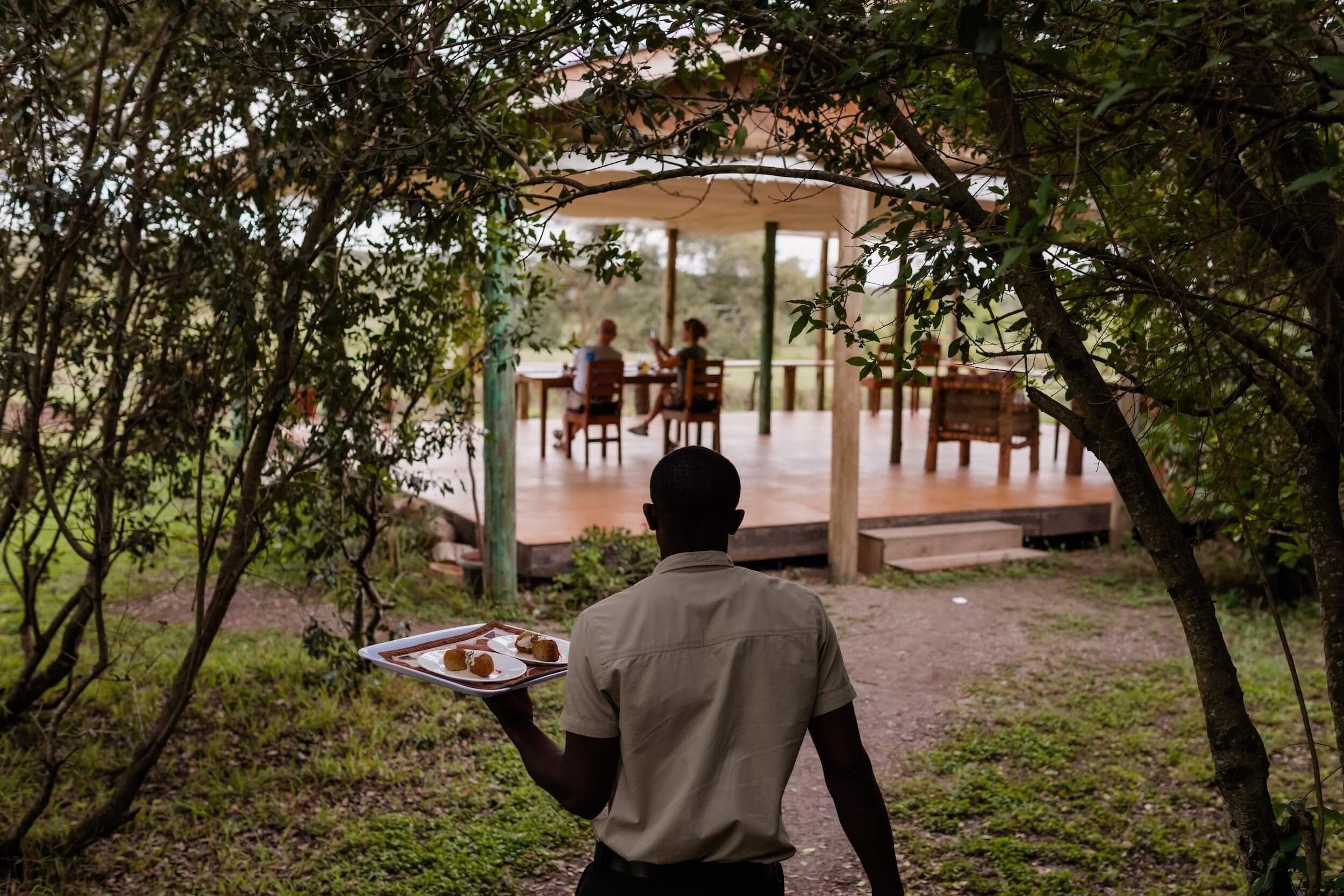
A private lunch on the deck at The Safari Cottages
When to Visit Kenya for Your Honeymoon Safari
Ol Pejeta Conservancy is rewarding year-round, but different seasons offer different experiences for honeymooners.
June to October — the dry season brings clear skies, thinning grass, exceptional wildlife viewing and golden afternoon light. This is Kenya's most celebrated safari window — classic safari conditions with the Big Five reliably visible on the open plains. July and August sit at peak season, when Ol Pejeta sees its highest visitor numbers, though your experience at The Safari Cottages remains entirely private regardless of the season.
November to March brings a greener, quieter conservancy at lower rates. Comfortable temperatures, more atmospheric skies, and a sense of having the wilderness to yourselves. The short rains in November are brief and refreshing; the long rains arrive in March and build through April.
April and May — the low season is Ol Pejeta's best-kept secret. Most Kenya safari camps close in these months, but we don't. Our all-weather roads run whatever the forecast, the lush green landscape is extraordinary, and April and May honeymooners have the conservancy almost entirely to themselves. For some couples, that sense of total privacy is exactly the point.
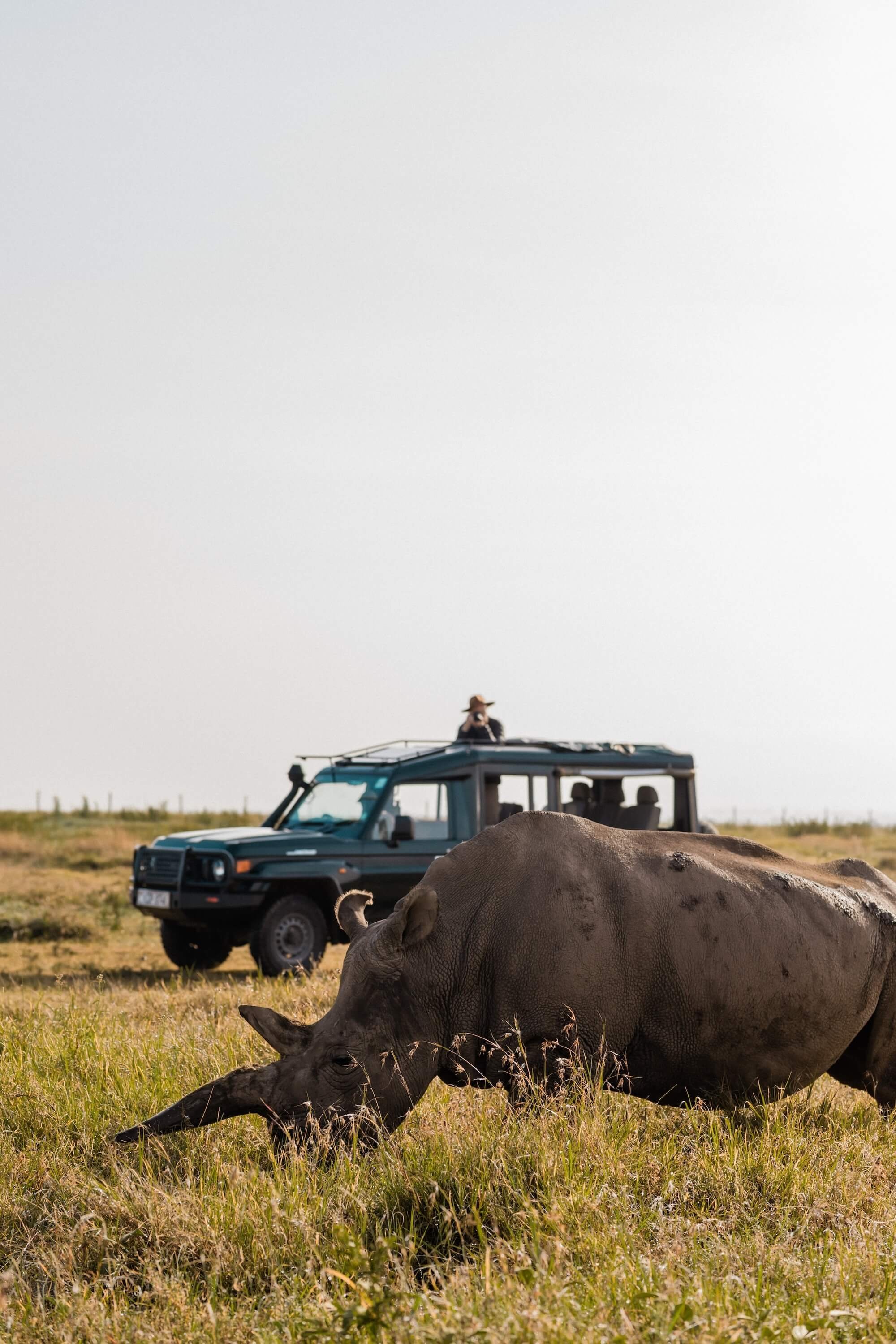
One of the last northern white rhinos left on the planet
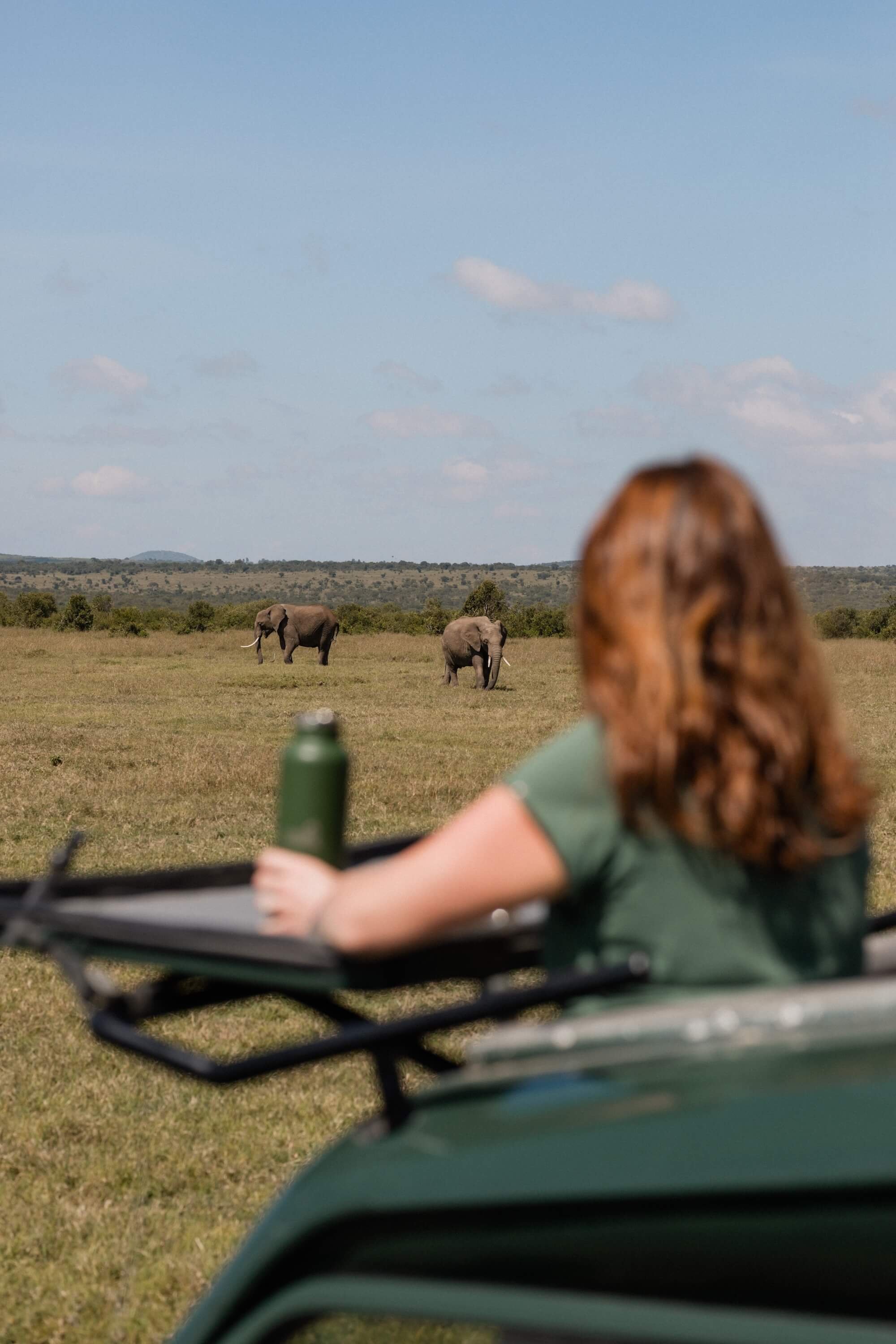
Unlimited daily game drives at The Safari Cottages
The Kenya Bush and Beach Honeymoon
Kenya's coast is often overshadowed by it’s well photographed neighbour, Zanzibar. But if you’re seeking respite from the crowds to relax after your safari then a few nights at Ol Pejeta followed by four or five nights on the Kenyan coast — warm Indian Ocean, white sand, complete contrast — is close to the perfect honeymoon itinerary.
Watamu is our preference: quieter than Diani Beach to the south, with a beautiful marine park, excellent snorkelling and cosy, boutique properties. Lamu Island is more remote and culturally rich — a UNESCO World Heritage Site with narrow Swahili streets, dhow trips at sunset and one of the most atmospheric places in East Africa. Both are an easy connecting flight from Nairobi.
A safari and beach Kenya honeymoon combines two entirely different kinds of extraordinary in a single trip.
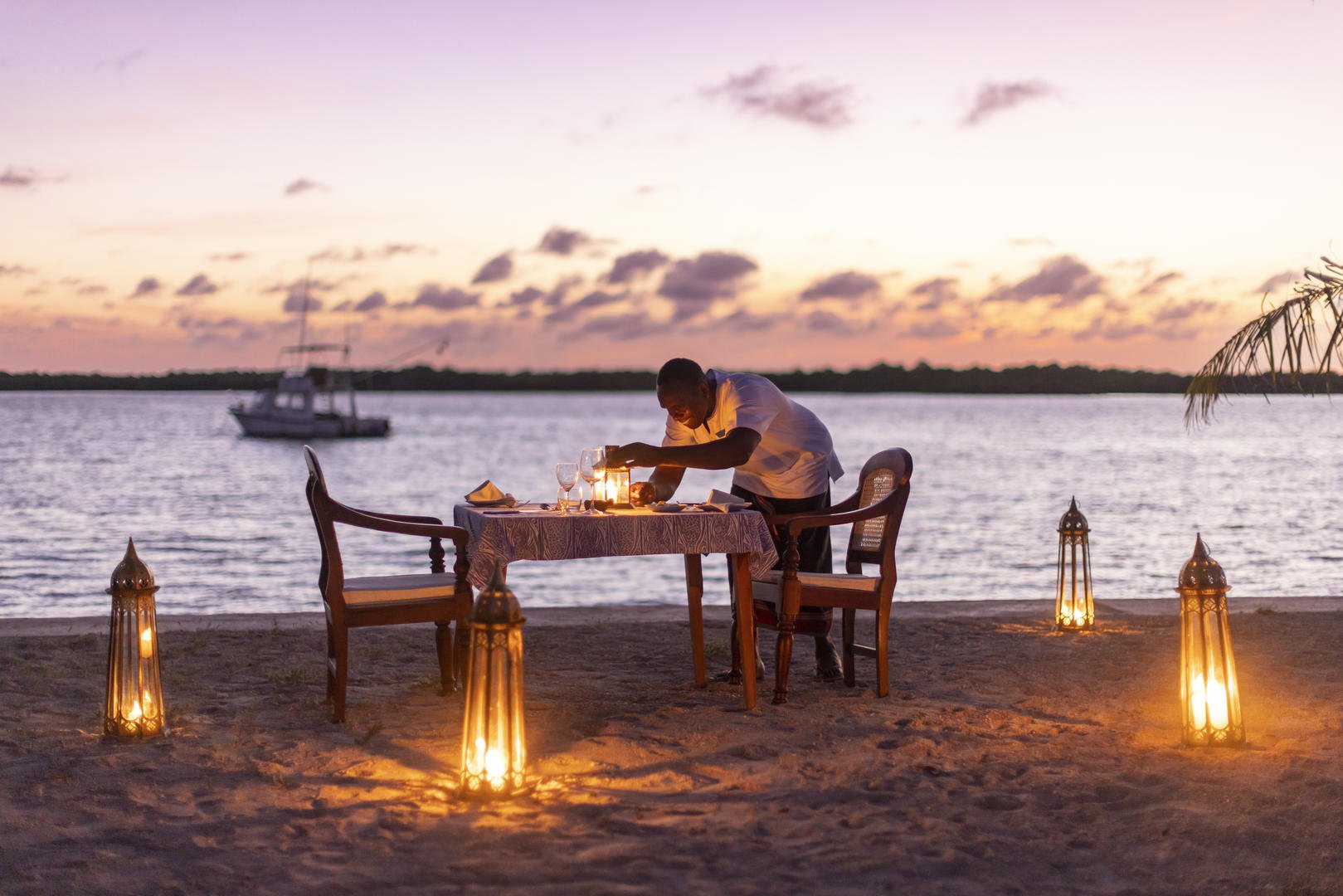
A romantic dinner for two at Manda Bay in Lamu
Planning Your Kenya Honeymoon Safari: The Practical Details
How long to stay: A minimum of three nights on the conservancy, four or five is better. By the third morning, you've properly settled into the rhythm of the bush. Most Kenya honeymoon itineraries combine three to five nights at Ol Pejeta with a few nights in the Masai Mara or other reserve and then finish up on the coast.
Getting here: Ol Pejeta Conservancy is 30 minutes by light aircraft from Nairobi Wilson Airport, or a scenic four to five hour drive through the Kenyan highlands. Air Kenya and Safarilink both fly into Nanyuki daily. Our driving guide covers the driving route in detail.
What's included: A fully inclusive stay with us includes private accommodation, conservancy fees, all meals cooked by a personal chef, your private guide, your dedicated vehicle, and all game drives. No hidden extras, no optional add-ons that inflate the final bill.
Tell us it's your honeymoon. We'll make sure dinner on the first night is set up the way it should be — fire lit, table on the verandah, stars overhead. These things don't need organising in advance so much as simply knowing. And we're good at knowing.
A Note on Proposals at Ol Pejeta
If you haven't proposed yet and you're wondering whether Ol Pejeta might be the place — it might. We've helped arrange proposals at sundowner spots, bush breakfasts, and dawn game drives when the light over the conservancy does something nobody can quite describe. We've never had one go wrong. Read about how Pete proposed to Rachel on their visit to us.

Pete proposing to Rachel at sunset on the plains of Ol Pejeta
Frequently asked questions
-
Kenya is one of the world's great honeymoon destinations — combining extraordinary wildlife, dramatic landscapes, warm hospitality and an easy safari-to-beach combination that few other countries can match. Private conservancy properties like The Safari Cottages offer the exclusivity and intimacy that a honeymoon deserves.
-
The dry season from June to October offers the most reliable wildlife viewing and classic safari conditions. However, the green season (November to March, and April to May) offers a more intimate, atmospheric experience at lower rates — and at Ol Pejeta, game drives run year-round on all-weather roads regardless of rainfall.
-
Most couples spend between seven and fourteen days in Kenya in total. We recommend a minimum of three nights on the conservancy (four or five is better) combined with four or five nights in another safari destination or on the Kenyan coast for the classic bush-and-beach honeymoon experience.
-
Ol Pejeta offers exclusive-use private safari accommodation (like us!), which means the entire property is yours for your stay — no shared game drives, no other guests, no communal dining. Your own private guide, private vehicle and private chef are included at no extra cost. It's also home to the last two northern white rhinos on Earth, making it one of the most extraordinary and singular safari destinations in Africa.
-
Absolutely! And, if you’re traveling in the dry season, we'd actively recommend it. The Kenyan coast (Watamu, Lamu, Diani) is an easy connecting flight from Nairobi and pairs beautifully with a conservancy stay. Most Kenya honeymoon itineraries combine safari and beach for the complete experience.
Safari Photography Tips for your visit to Ol Pejeta Safari Cottages - from a professional photographer
Get top tips for your safari to Ol Pejeta Conservancy from award-winning wildlife photographer and conservationist Margot Raggett MBE. Learn about cameras, lenses, the best time of day to shoot and everything you need to know to get the most out of your wildlife and safari photography.
We wanted to share some helpful photography tips for your next visit to Ol Pejeta but, whilst our team certainly can take a decent picture or two, we thought it would be best to get the low-down from a much-loved regular guest to The Safari Cottages and, ideally, an international, award-winning wildlife photographer to boot. Enter, Margot.
Margot Raggett MBE is a wildlife photographer and the founder of the wildly successful Remembering Wildlife conservation book project, which has raised over £1.26 million for endangered species protection worldwide. Through her photography, books and public talks, she hopes to inspire people to connect with wildlife and support conservation. We’re so thrilled she’s taken some time out of her busy schedule to share her best wildlife photography tips for your Ol Pejeta safari.
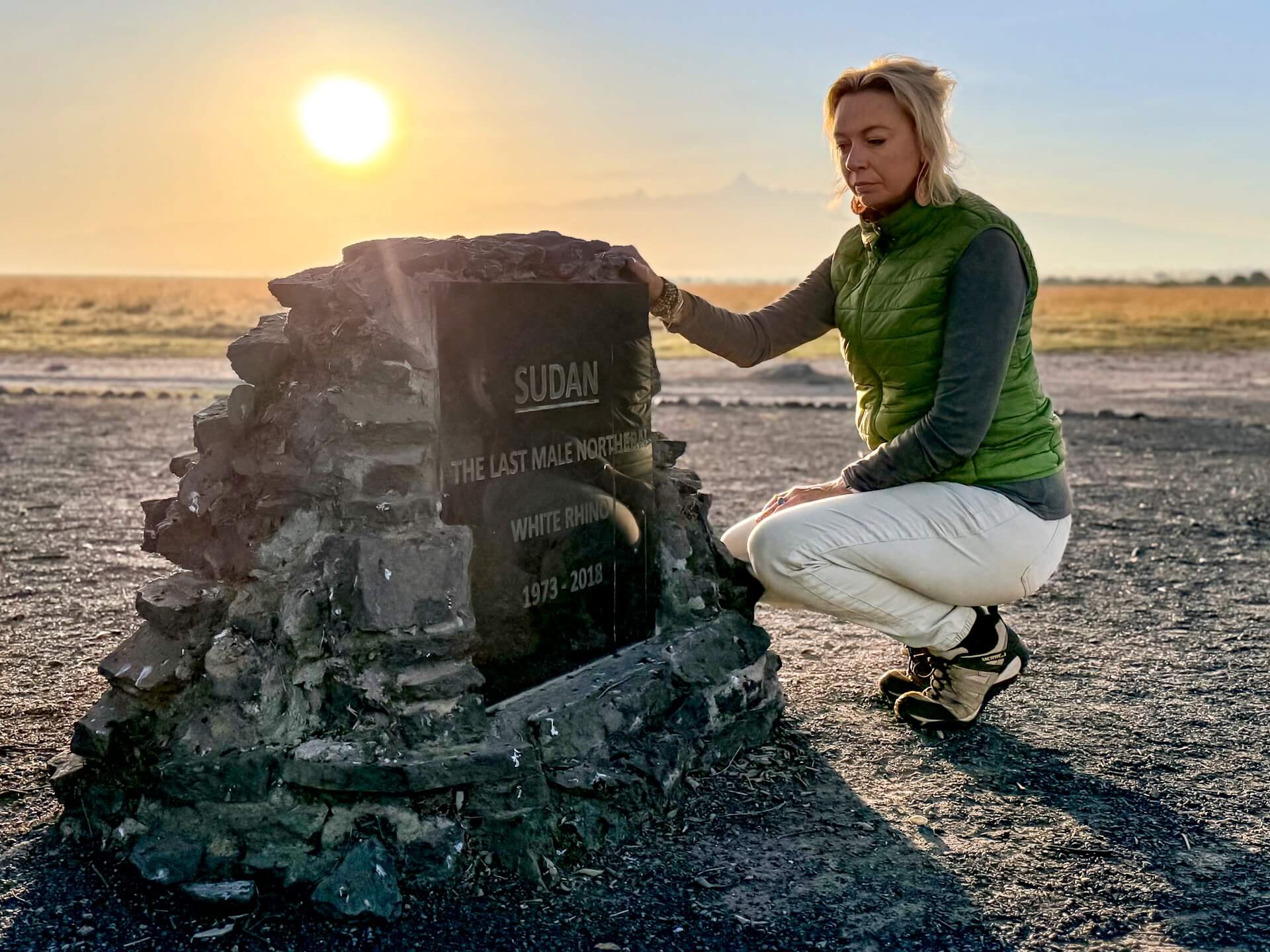
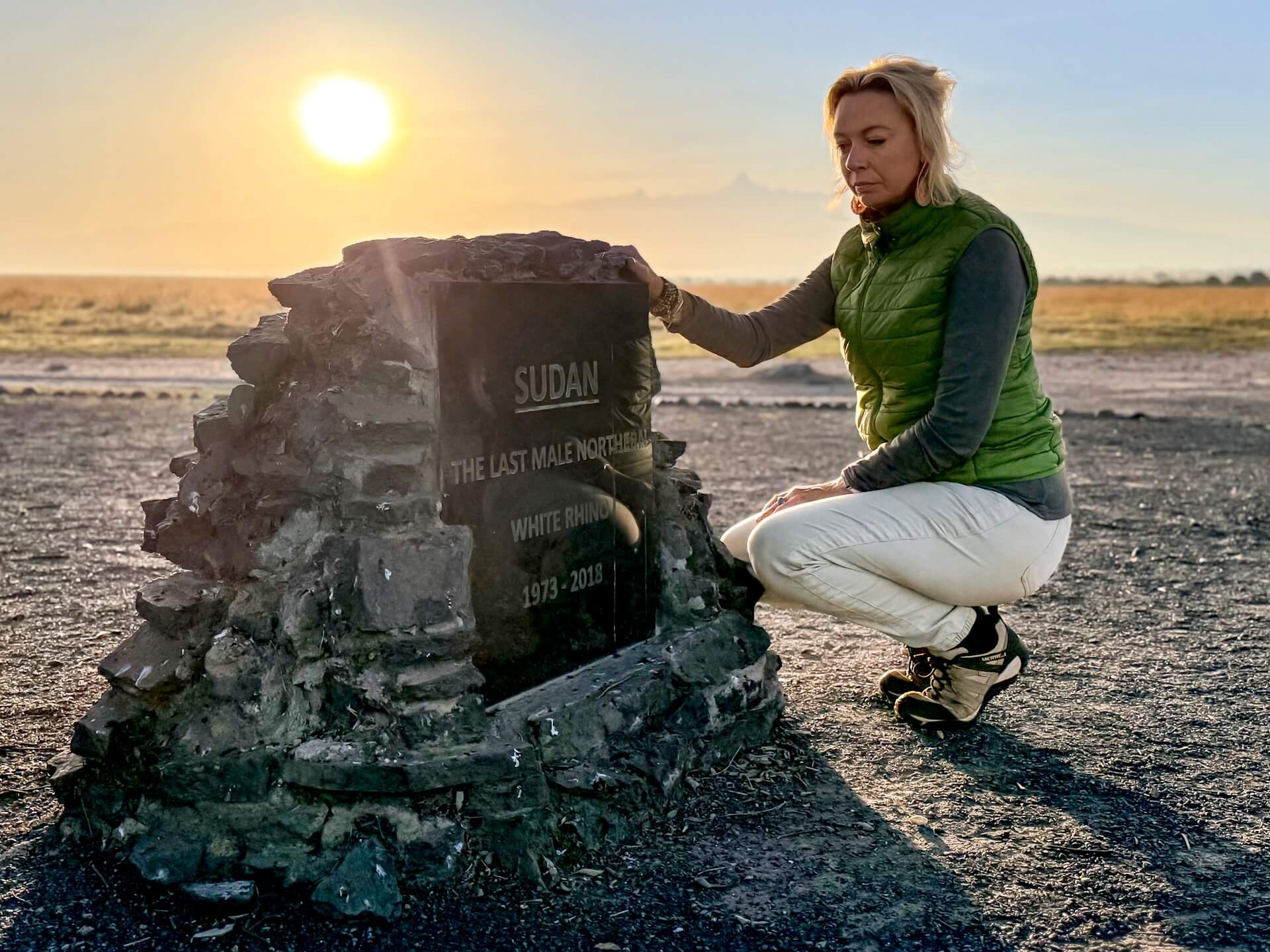
Conservationist and professional wildlife photographer Margot Raggett pays homage to Sudan, the last male Northern White Rhino who passed away from old age on Ol Pejeta in 2018
Best camera and equipment for a safari
Phones vs DSLRs? What lenses should you bring?
The most important piece of advice I can give anyone going on safari is actually not about cameras at all — it’s to remember to look up. Some of the most magical moments you will ever experience happen very quickly and if you spend the entire time buried in menus and settings, you can miss them. Your memories matter more than your photographs.
DSLRs: I would never recommend someone buying complicated camera equipment just before their first safari if they don’t really understand how to use it. Safari is not the place to be learning a new camera system from scratch — it can quickly become stressful rather than enjoyable.
Phones: Phones can take surprisingly good images these days, but they have one big limitation: reach. If you rely only on a phone, you often feel tempted to get too close to wildlife, which is neither safe nor respectful. Animals should never have to adjust their behaviour because of us.
As a professional photographer I use a long zoom lens (around 400mm), a 70–200mm lens and a shorter lens for wider scenes. However, for a typical safari guest I’d suggest something much simpler: A camera with a zoom lens in the region of 100–400mm (or 100–500mm) is ideal. It allows you to photograph animals from a safe and comfortable distance and gives you huge flexibility — elephants nearby and a leopard in a tree can both be captured with the same lens.
In short: you don’t need the most expensive camera — you need a camera you’re comfortable using.
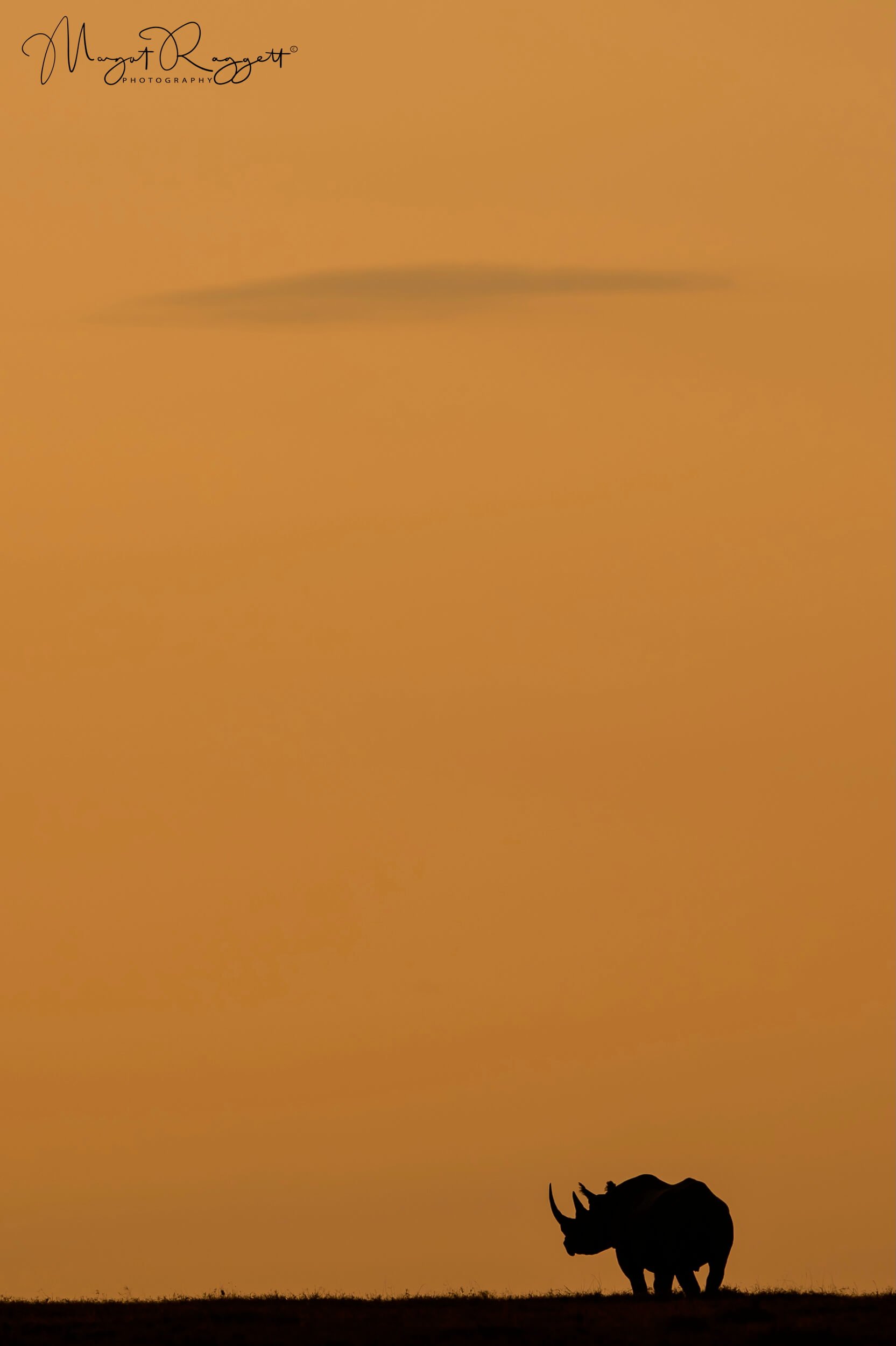
Rhino at Sunset on Ol Pejeta x Margot Raggett
Best times of day for photographs
Golden hour, midday light, cloudy and rainy days: photographers chase light more than animals.
The classic safari photography times are just after sunrise and just before sunset — the “golden hours.” The low sun creates warm tones, long shadows and beautiful atmosphere, and it’s also when animals tend to be most active. If you can face the early alarm clock on safari, it is absolutely worth it.
However, I always tell people not to ignore the middle of the day. While the light is harsher, some of my favourite images have been taken then because behaviour matters more than lighting. A dramatic interaction, a hunt, or playful cubs will always beat perfect light. Modern cameras and editing also allow us to work with much brighter conditions than in the past.
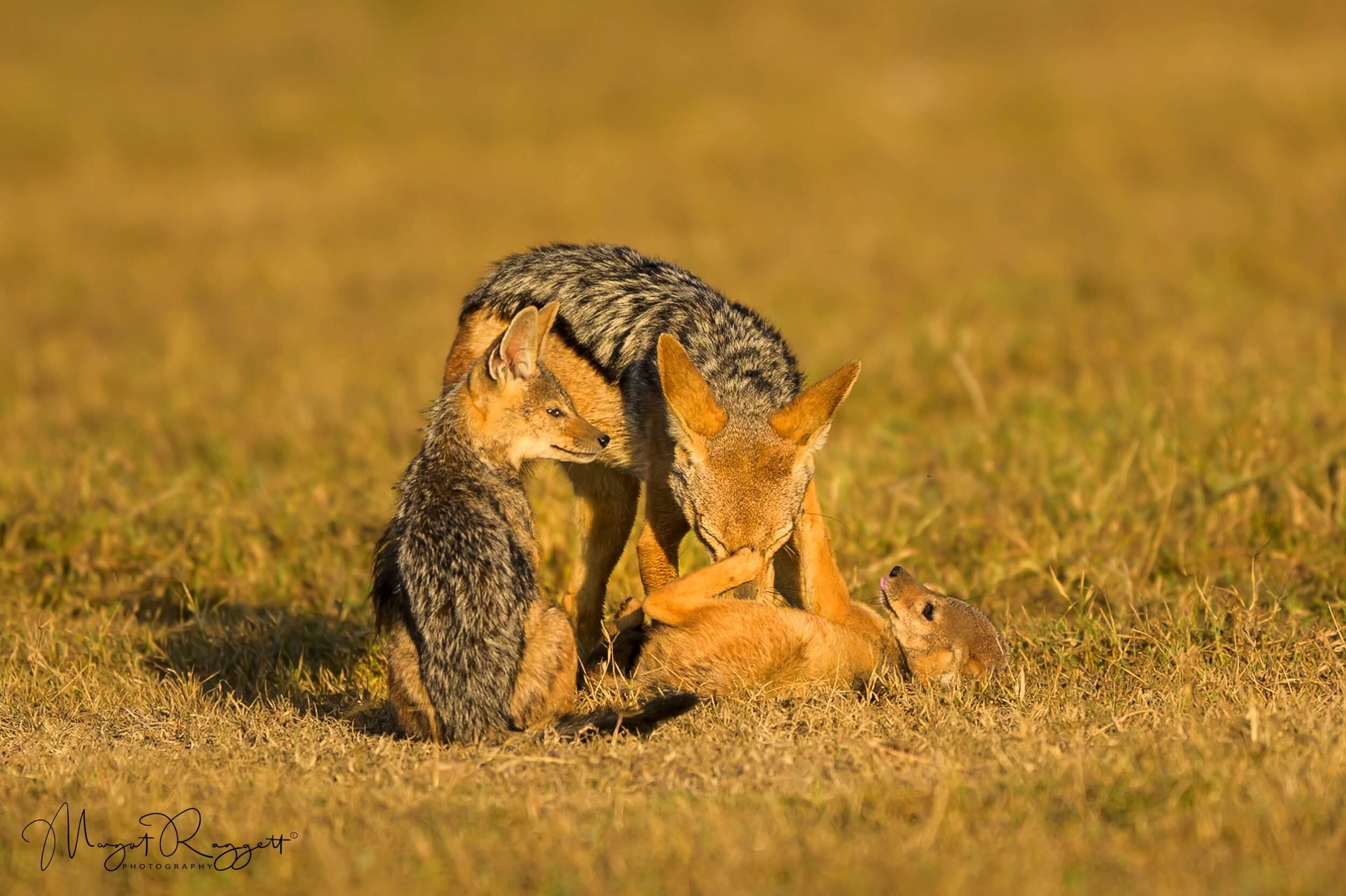
Playful jackal pups in the midday sun x Margot Raggett
No sunshine? No problem.
Cloudy days can actually be wonderful — the clouds act like a giant softbox, giving even light and lovely detail in fur and skin.
Rain is even better; I personally love photographing animals in rain or storms. The atmosphere, droplets, dark skies and mood can produce very powerful images — just make sure your camera is protected. A simple rain sleeve or even a plastic cover in your bag can save your equipment.
Composition, framing and patience
Photography is really about seeing, not equipment.
One simple starting point is the “rule of thirds.” Imagine your frame divided into a grid of three horizontal and three vertical lines. Placing the animal slightly off-centre — particularly allowing space in front of where it is looking or moving — usually creates a more pleasing image than putting it dead centre.
But rules are only guides. If you think the image works, it works.
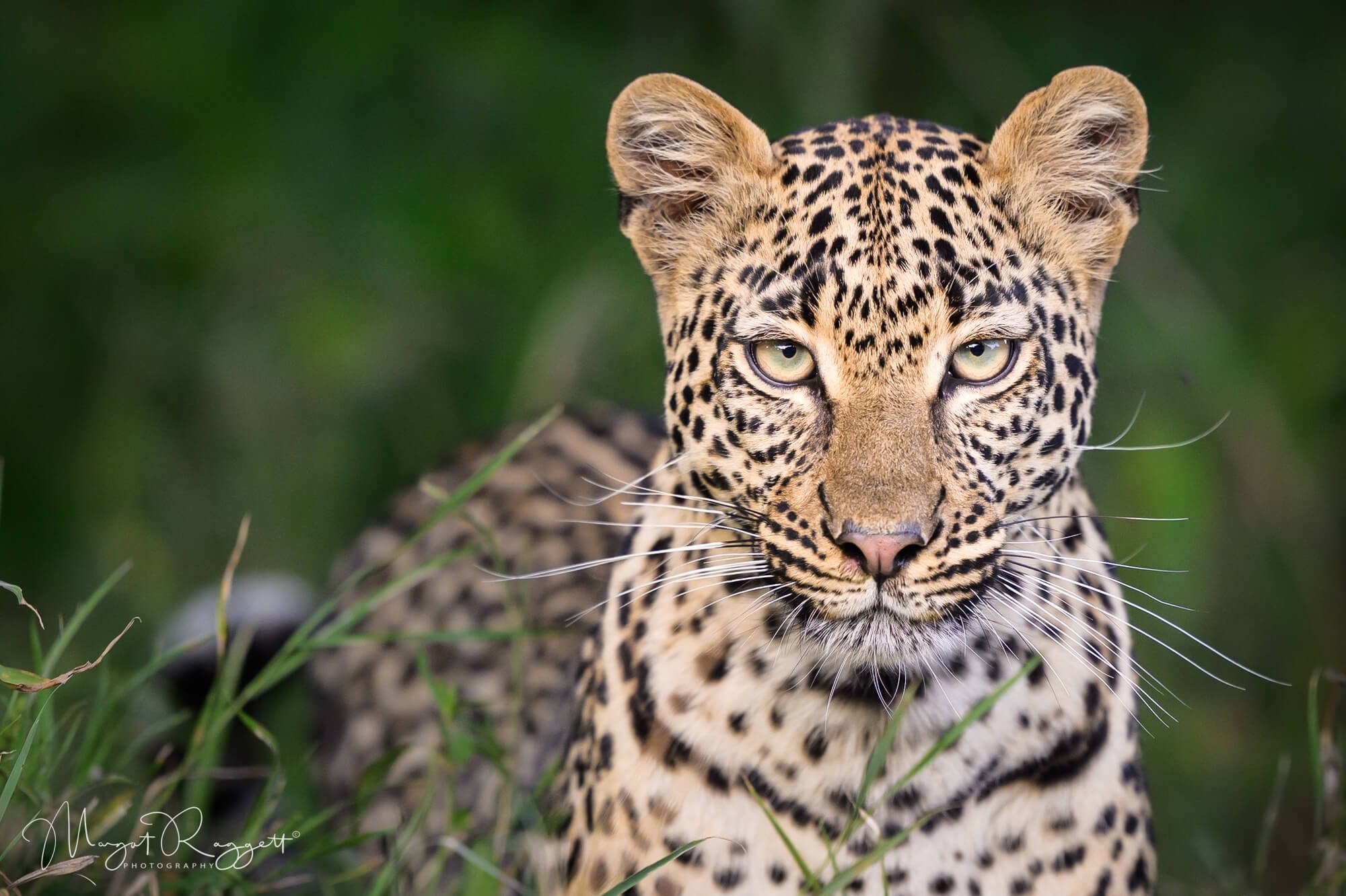
A leopard photographed on Ol Pejeta by Margot Raggett using the rule of thirds
Patience Pays.
More important than composition is patience. Many people arrive at an animal sighting, take a few pictures, and leave. The best photographs often happen over time. Animals relax, behaviour unfolds, interactions develop and the story appears.
Spend time with your subject. Watch before you shoot.
And of course, the Remembering Wildlife books are a wonderful source of inspiration — they show just how many different creative approaches to wildlife photography there can be.
Ethical wildlife photography
This is the most important subject of all - a good wildlife photograph should never come at the expense of the animal. If your presence changes the animal’s behaviour, you are too close.
Never try to attract an animal’s attention by making noises, clapping, whistling or throwing objects.
Never ask a guide to reposition a vehicle in a way that blocks an animal’s path or stresses it.
The welfare of the animal must always override the photograph. This is another reason long lenses are so useful — they allow you to observe and photograph from a respectful distance. Your guide is your partner in this. Communicate with them. Good guides understand positioning, light and animal comfort zones, and they want you to get great photographs without disturbing wildlife.
A truly successful safari photograph is one taken responsibly.

Ol Pejeta Safari Cottages guides observing wildlife from a respectful distance on a game drive
Tips for non-photographers (phone users & simple cameras)
If you’re not a photographer, my advice is very simple: don’t feel pressure to be one.
Sometimes people become so focused on getting the “perfect” image that they forget to experience what is in front of them. Seeing wild animals in their natural environment is rare and extraordinary — allow yourself to just watch.
That said, phones are wonderful for memories. I actually use my iPhone a lot on safari for short video clips and personal moments — the sounds of birds at dawn, elephants walking past camp, or the atmosphere around a sighting. These often become my most treasured memories.
A few simple tips:
Keep your phone steady (rest it on the vehicle if possible)
Tap to focus on the animal
Slightly reduce exposure if the sky is bright
Take short videos as well as photos
And most importantly: enjoy it.
You don’t need a portfolio — you need memories.
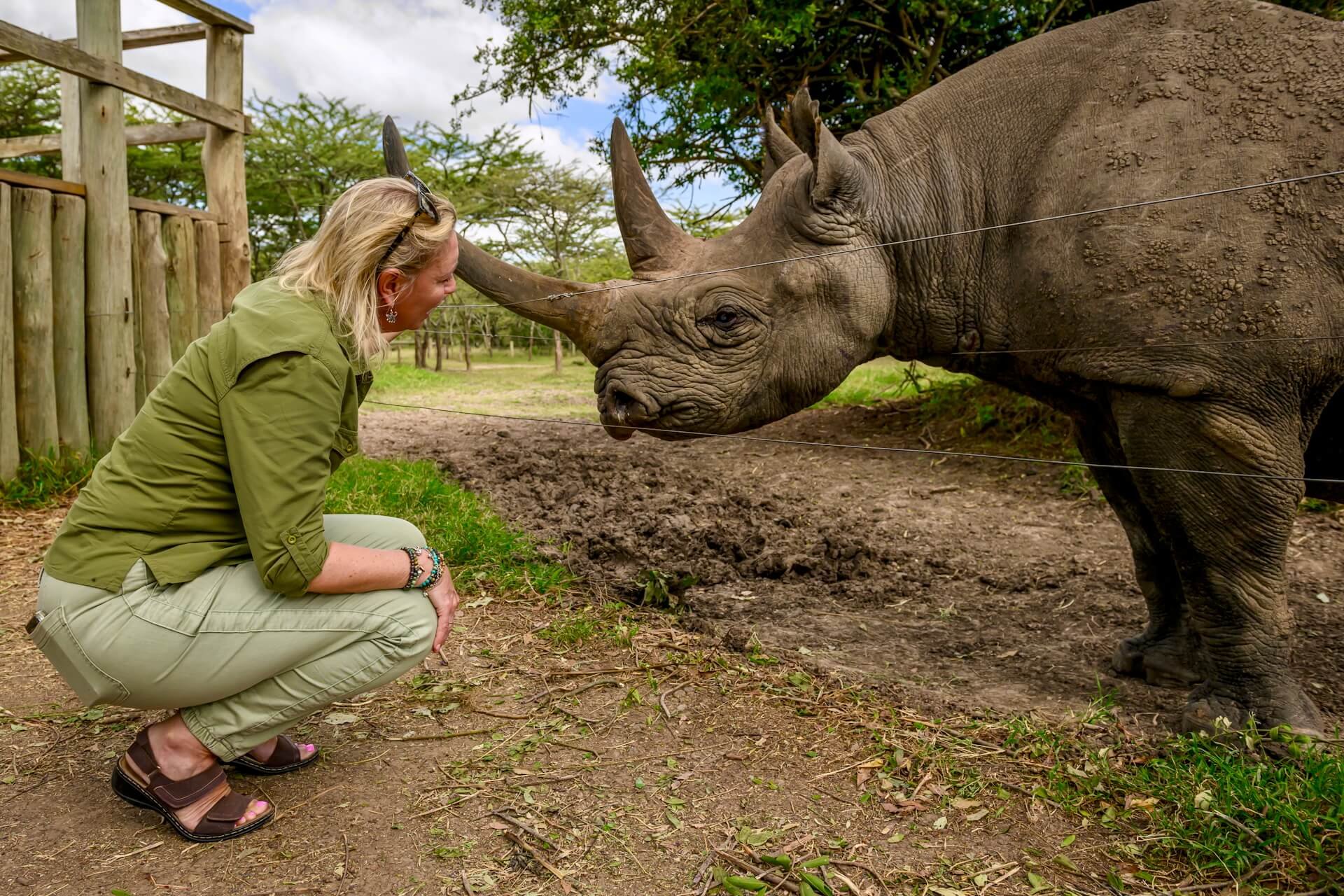
Making memories; Margot visits Baraka during her visit to Ol Pejeta Conservancy
Family Safari in Kenya: Visiting Ol Pejeta with Kids
Planning a family safari in Kenya? Discover why Ol Pejeta Safari Cottages is perfect for kids of all ages — private guides, flexible schedules & unforgettable wildlife.
The idea of a family safari often comes with a quiet hesitation. Will the children cope with early mornings? Is it safe? Will teenagers be bored, or toddlers overwhelmed? These are the kinds of questions and concerns we hear all the time — and they're completely understandable.
The truth is that a well-planned family safari isn't just possible. It's one of the most remarkable things you can do together. Watching your child see an elephant for the first time, or hearing them whisper as a lion walks past the vehicle, creates the kind of shared memory that stays with a family for a lifetime.
Ol Pejeta Conservancy, in the heart of Kenya's Laikipia region, is one of the most family-friendly safari destinations in East Africa. Here's everything you need to know before you book.
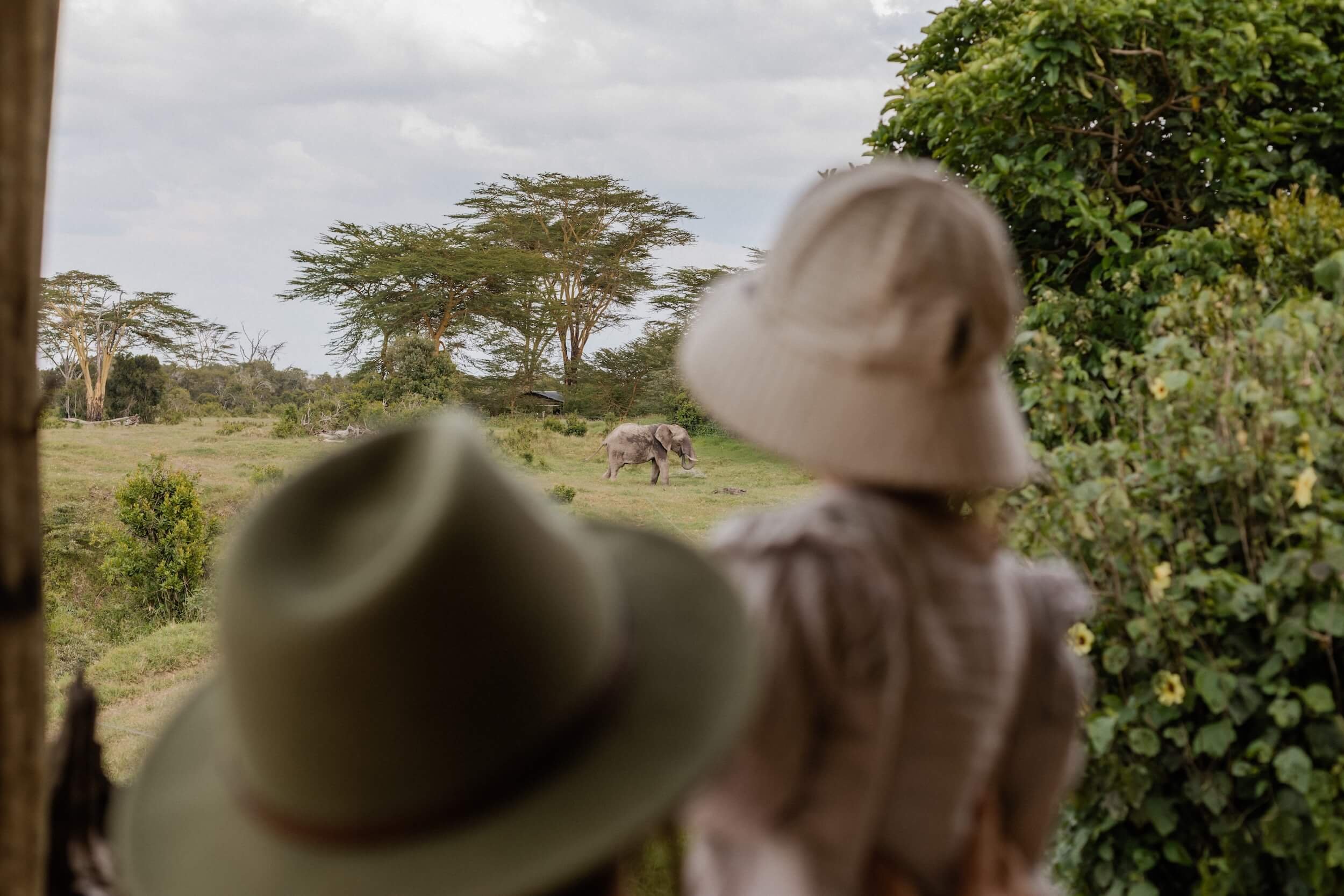
A guest at The Safari Cottages watches an elephant with her daughter over lunchtime
Is Ol Pejeta Suitable for Families?
The short answer is yes — we welcome families of all ages to The Safari Cottages year-round and, in many ways, Ol Pejeta is better suited to families than Kenya's busier national parks.
Safety comes first. Ol Pejeta is a fenced conservancy with strict wildlife protocols and highly experienced guides driving within strict speed limits on open terrain. Game drives take place in enclosed vehicles, and your guide will always brief you and your family before heading out. Children are safe, well-supervised, and — in our experience — far braver than their parents expect.
Shorter game drives are entirely possible. Unlike fixed itinerary tours, a private safari at The Safari Cottages means your schedule is yours. If younger children need to return home after two hours, that's exactly what happens. There's no pressure to stay out until everyone is exhausted. You go when you're ready, and you come back when you've had enough.
Private guiding makes all the difference. Shared game drives can be frustrating with children — especially if little ones need a snack, a wriggle, or a bathroom stop. With a private guide and vehicle dedicated entirely to your family, the pace, the route, and the conversation are all shaped around you. Your guide can adapt their storytelling to suit a six-year-old just as easily as a sixteen-year-old.
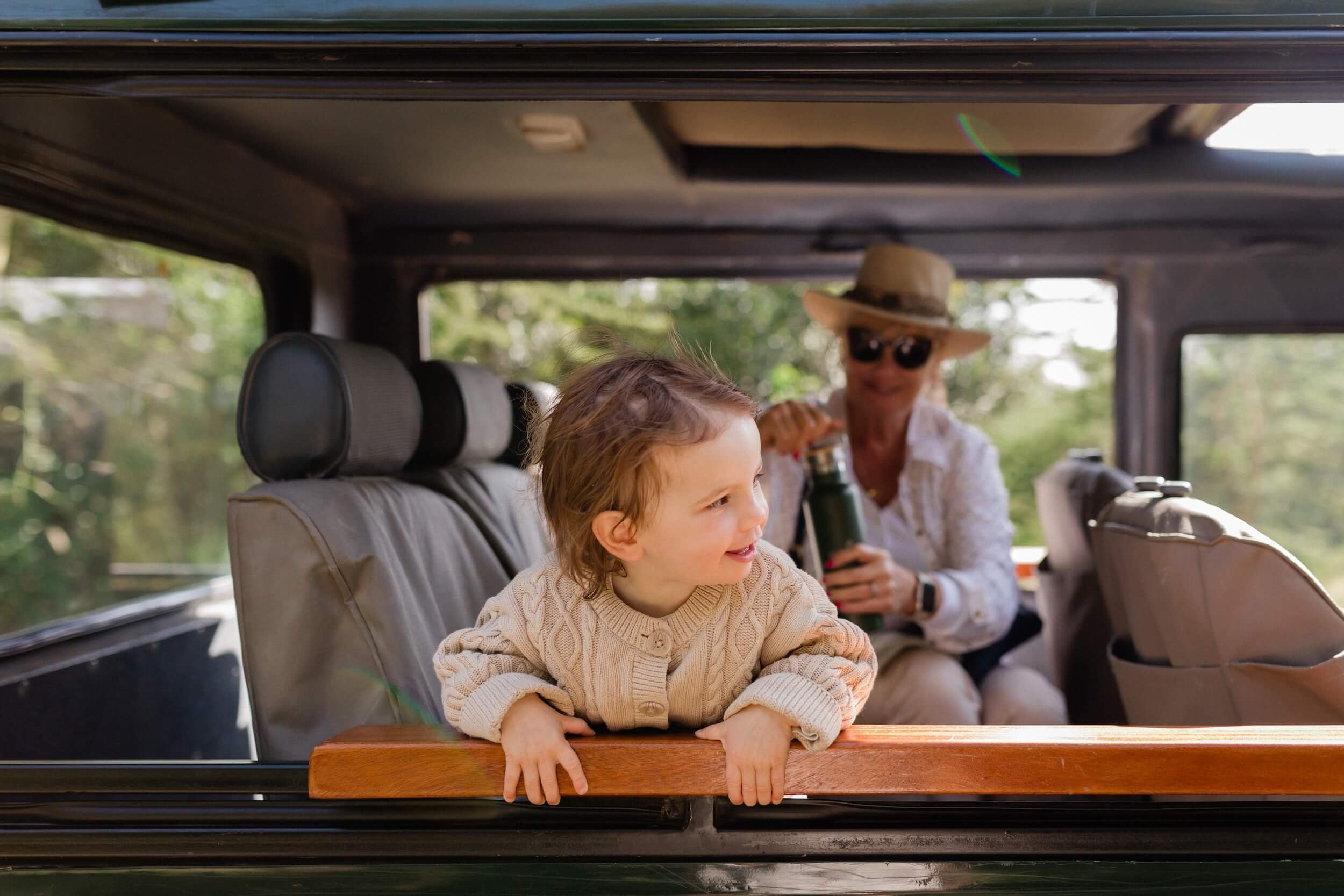
Runo (20months) on a game drive
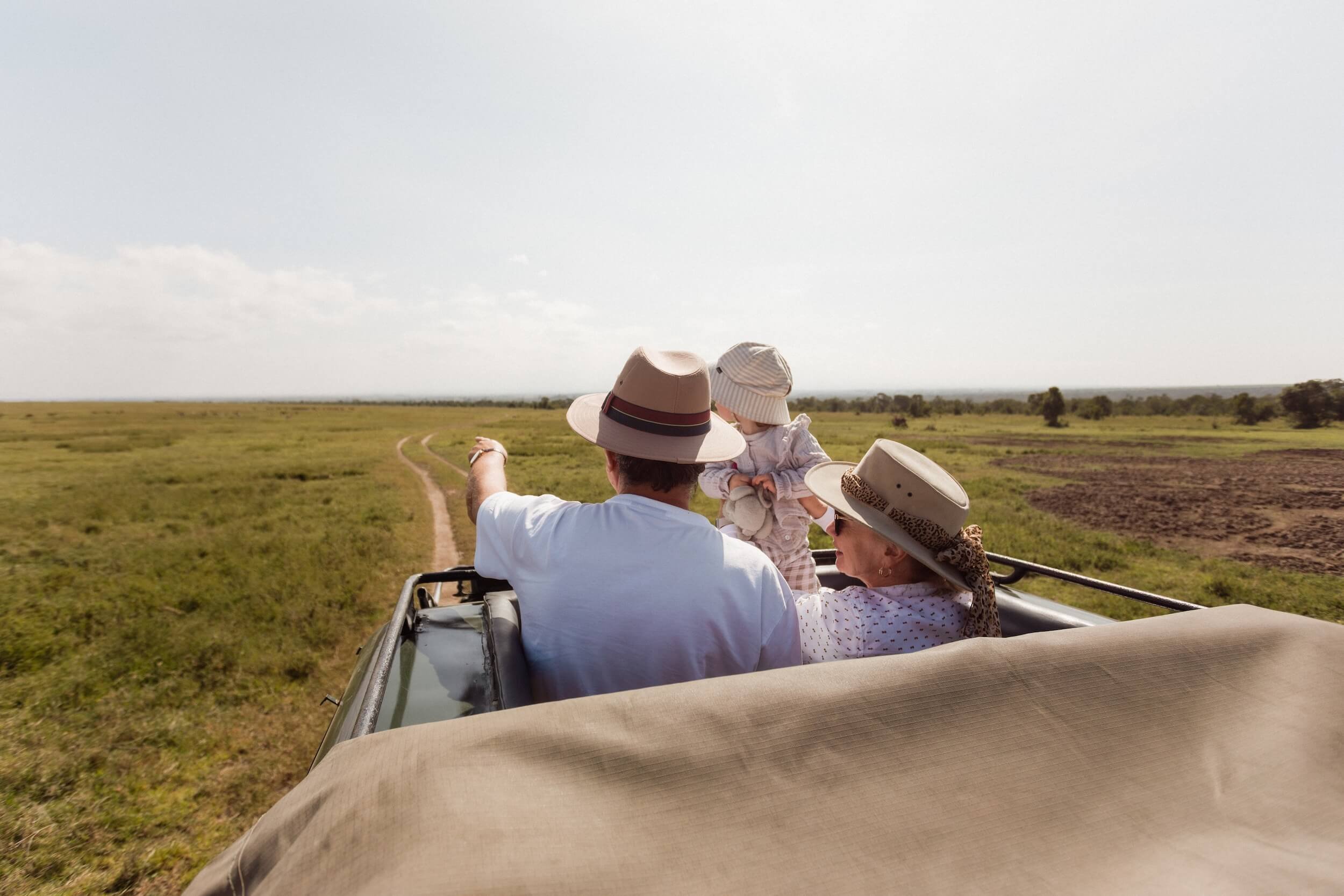
Spotting rhinos!
Best Safari Activities for Kids
Children experience a safari differently to adults — and often more vividly. The key is giving them ways to engage actively with what they're seeing.
Wildlife spotting games are a simple and surprisingly effective way to keep younger children focused and excited on game drives. Ask your guide to help set up a spotter's checklist before you head out — how many of the Big Five can the family find today? Who spots the first giraffe? Games like these give children a sense of agency and adventure, and they tend to produce a surprising level of concentration.
Nature walks offer a completely different pace from a game drive, and one that children often respond to with great curiosity. Walking focuses attention on the smaller details — tracks in the dust, insects, plants, bird calls — and opens up conversations about the ecosystem and gives them the chance to learn, touch and play. This is a great activity to do in camp with an askari or guide; we have several lovely walking trails around the property.
Learning about conservation is one of the most powerful things a child can take away from a safari at Ol Pejeta. The conservancy is home to Najin and Fatu, the world's last two northern white rhinos, and a visit to meet them — with an expert guide who can explain their story — tends to leave a deep impression on children and adults alike. Questions follow for days afterwards. That's exactly the point.
Campfire S’mores - chocolate biscuits and marsh mellows, what more can we say? The askaris love roasting marsh mellows with kids around the evening fire and showing them the stars.
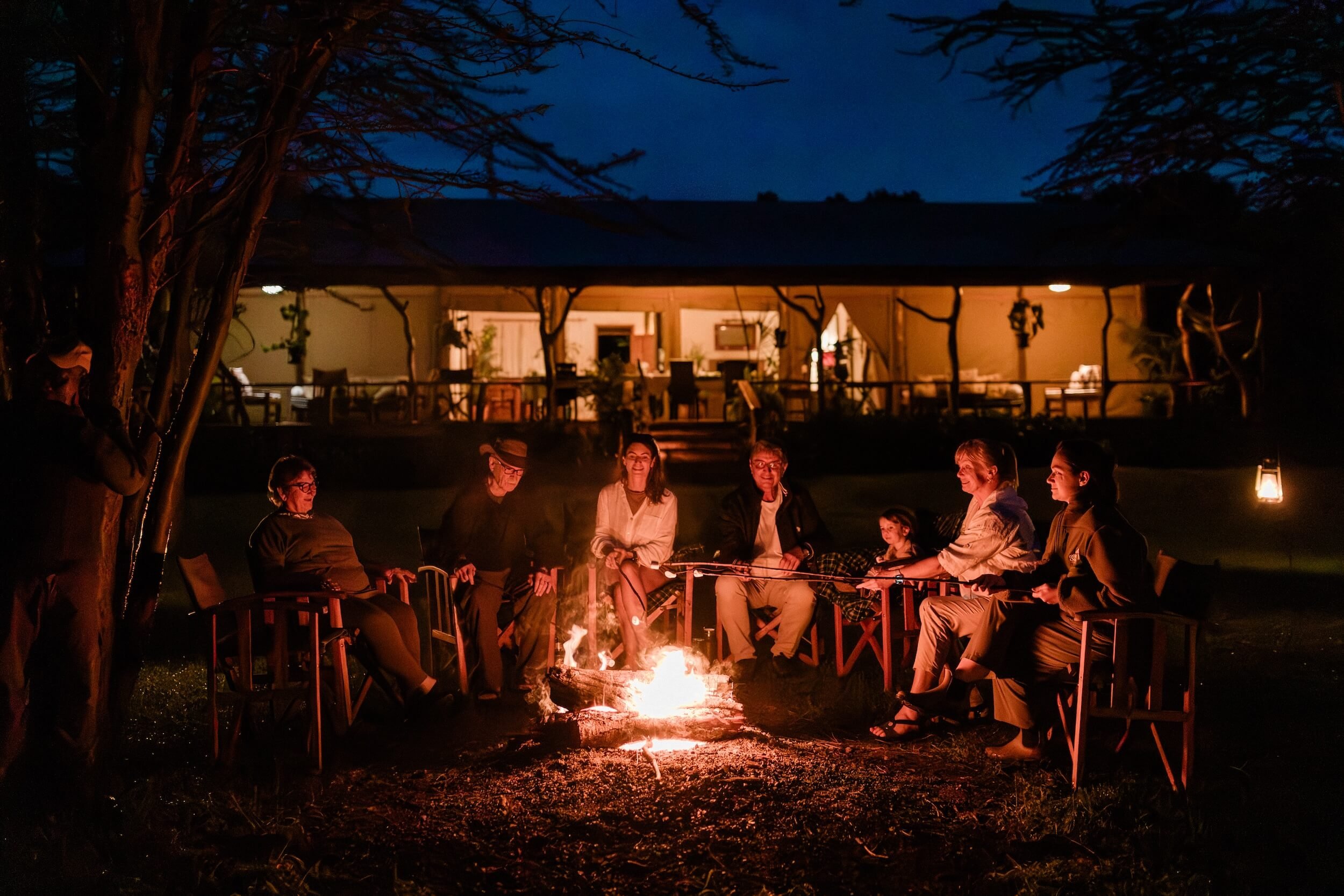
Roasting marshmallows around the fire at The Safari Cottages
Ideal Ages for a Family Safari
There is no single right age for a first safari, but there are some honest differences worth knowing about...
Toddlers and very young children can absolutely enjoy a safari experience — the sights, sounds, and general wonder of the bush are engaging at almost any age. The considerations are more practical though: nap schedules, short attention spans, and the need for flexibility. Private accommodation and a private guide make this far more manageable than it would be on a shared tour. If your family includes very young children, we'd simply suggest building extra downtime into each day and keeping drives relaxed in length.
Children aged six to twelve tend to thrive on safari. They're old enough to understand what they're seeing, young enough to be completely and unselfconsciously amazed by it, and at an age where the conservation story — the rhinos, the wildlife recovery projects, the ecosystem — genuinely captures their imagination. This is arguably the sweet spot for a first family safari.
Teenagers often arrive on safari with measured expectations and leave as genuine converts. Giving older children a camera, encouraging them to keep a wildlife journal, or asking the guide to talk them through tracking and navigation tends to unlock a level of engagement that surprises everyone. A safari that feels curated for adults can easily be shaped into something that feels genuinely exciting for a fifteen or sixteen-year-old — especially one who's accustomed to being the least interested person in the room.
A family with young teenagers on a game drive
Accommodation & Meal Considerations
One of the things that makes a family stay at The Safari Cottages particularly well-suited to parents is the degree of flexibility built into everyday life here.
Meals are prepared by your private chef, which means the menu adapts to your family rather than the other way around. Fussy eaters, dietary requirements, children who want plain pasta at 5pm — none of this is a problem. Your chef will talk through preferences on arrival and make sure every meal works for every member of the family. Breakfast can be a picnic in the bush or on the verandah. Lunch can be earlier, or later. Dinner can happen whenever the children are fed and the adults are ready, even if that means eating at different times and different meals entirely.
Schedules are entirely flexible. There are no set departure times, no shared dining rooms, and no need to coordinate with other guests. This matters more than it sounds when you're travelling with children. The freedom to adapt the day in real time — to extend a morning game drive, to cut a picnic short, to let a tired child sleep in — changes the entire experience of travelling as a family.
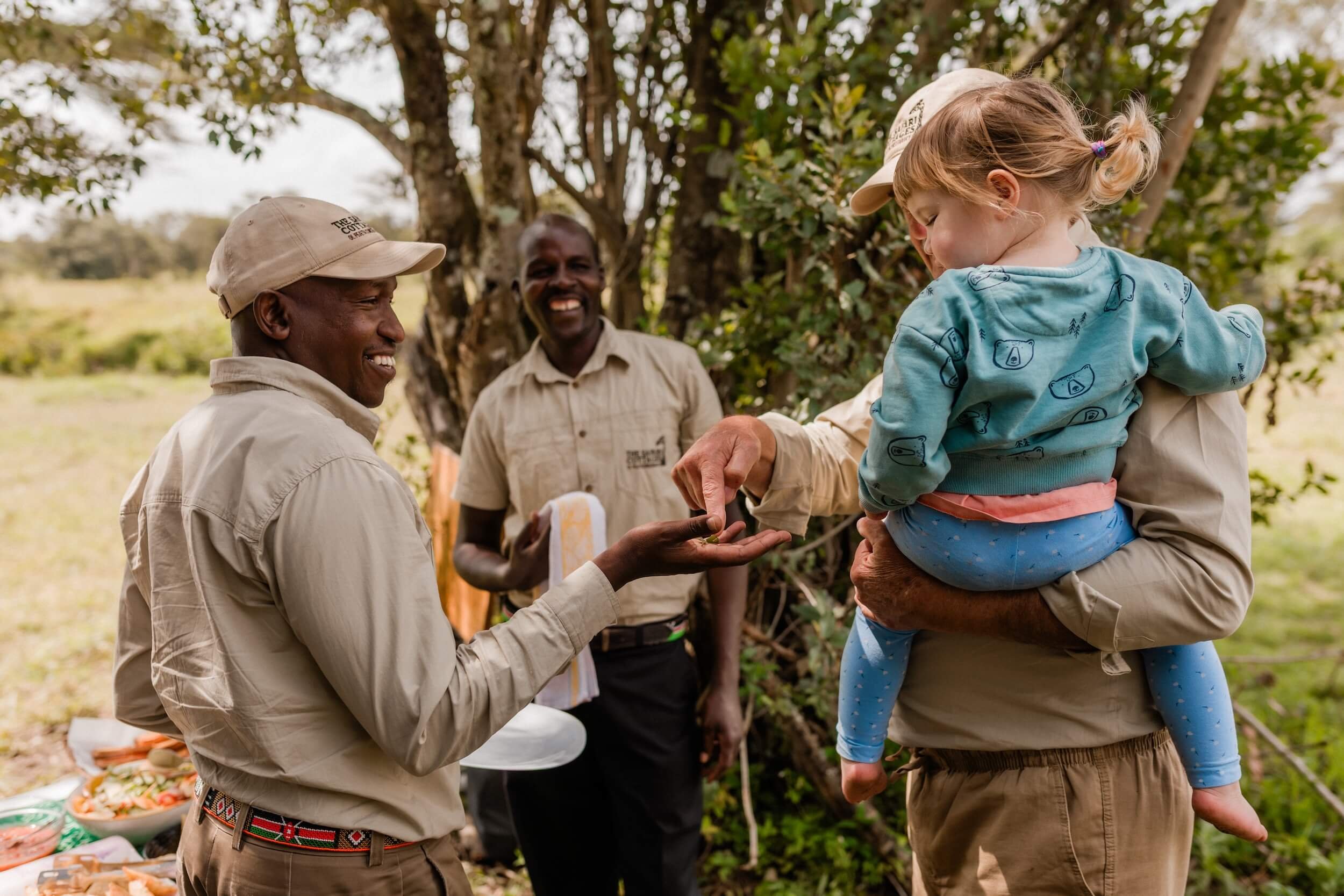
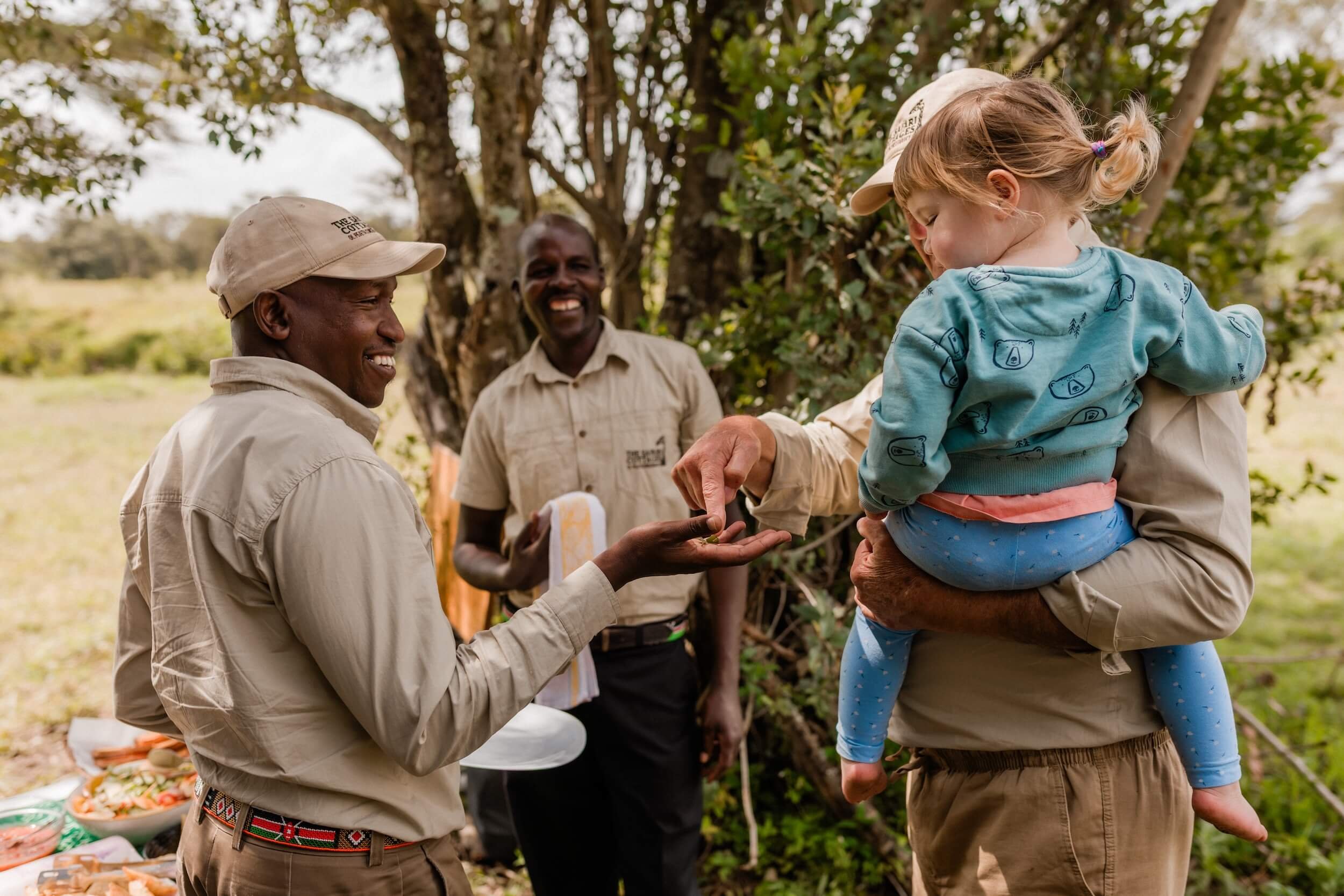
Addie (2yrs) enjoying brunch in the bush with The Safari Cottages team
Tips for a Stress-Free Family Safari
A few practical notes from years of welcoming families to Ol Pejeta:
Pack for the temperature range, not just the heat. Early morning game drives can be genuinely cold, even in the warmer months. Children feel the chill more quickly than adults, so pack a fleece or light jacket for every member of the family regardless of the time of year. Layers are your friend.
Bring binoculars for the children. This sounds small, but it transforms a game drive. Giving a child their own pair of binoculars — even an inexpensive set — makes them feel like an active participant rather than a passenger. Wildlife becomes something they're finding and focusing on themselves.
Let the days breathe. The temptation on a family holiday is to fill every hour. On safari, the opposite approach tends to produce the best results. A slow morning, a long lunch, an afternoon rest, then an evening drive — this rhythm suits children well, and it suits the wildlife too. The bush rewards patience, and children learn this faster than most adults expect.
Talk to your guide. Before each drive, spend five minutes with your guide letting them know the mood of the group, what the children are most interested in, and what the family's energy levels are like that day. A great guide will shape the entire experience around this — and your guide at The Safari Cottages will have the experience and the instinct to make it work beautifully.
A family safari on Ol Pejeta isn't a compromise on the adult experience. It's a different kind of experience entirely — one where wonder is shared, where questions multiply, and where the bush reveals itself through the eyes of people seeing it for the very first time.
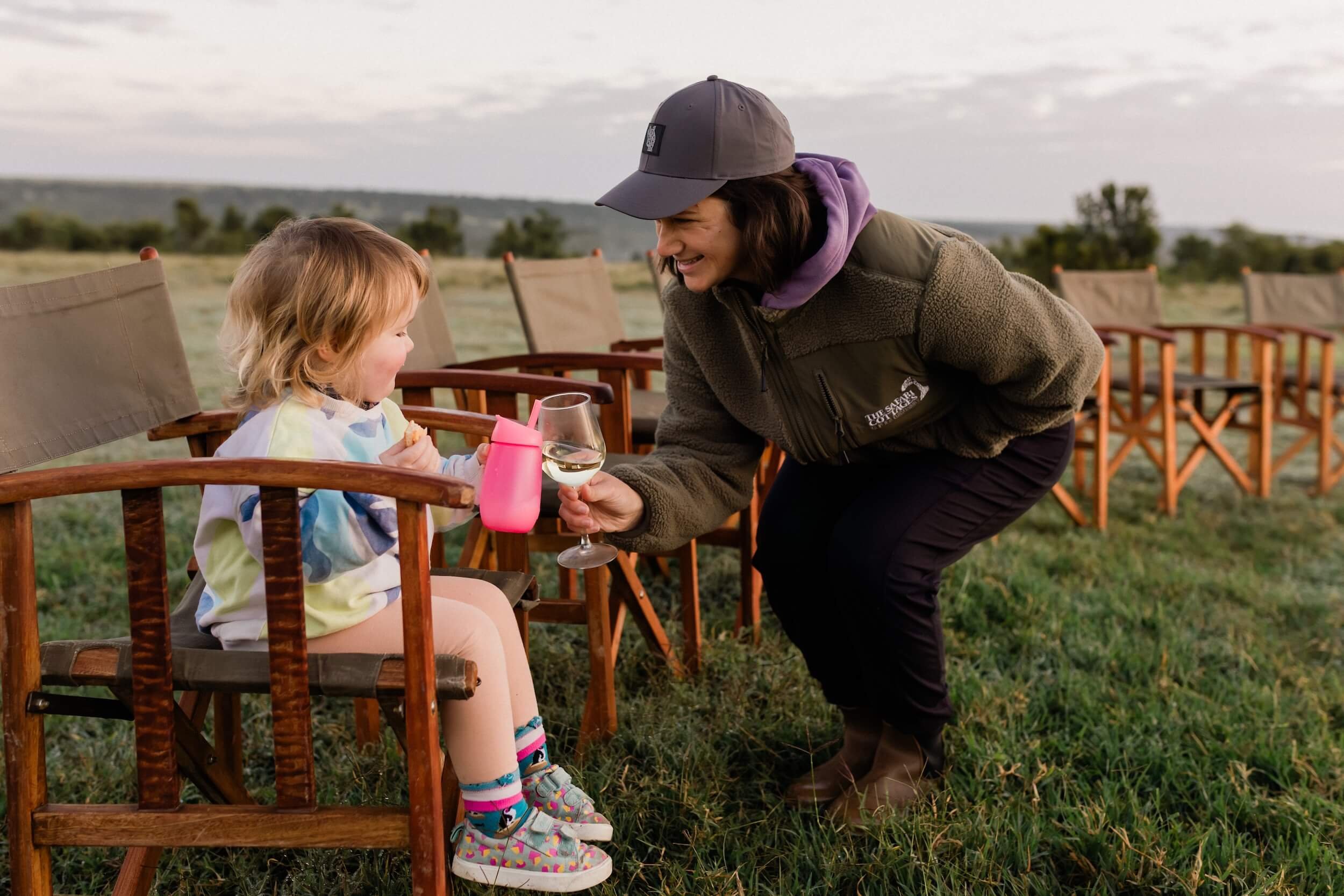
Sundowners with warm milk and a cookie
Driving to Ol Pejeta: A Scenic Safari Road Trip Guide
A road trip to Ol Pejeta allows you to experience Kenya at ground level; you travel through changing landscapes, pass local towns and farmland, and watch the scenery slowly transform into open savannah, turning the journey itself into part of the adventure. Here’s what you can expect from the drive…
For many travelers, the journey to a safari destination is just as memorable as the safari itself. Flying into conservancies is common in Kenya and both Air Kenya and Safarilink offer a number of flights a day into Nanyuki and Kamok Airstrip from Nairobi’s Wilson Airport and other popular locations like Samburu and the Masai Mara. Flying is a fantastic way to see the country from the air, not to mention quick and convenient; the flight from Nairobi Wilson Airport to Nanyuki is just 50 minutes! It’s important to bear in mind though that local flights in Kenya come with strict weight restrictions and allow passengers a maximum of 15kgs in soft bags only. If you’re traveling lightly and staying just a week or so this might be the perfect option for you. If you have suitcases or are staying longer you might opt to drive instead. If you’re planning on driving to Ol Pejeta, this blog is for you!
Why Some Travellers Prefer Driving Over Flying
Driving to Ol Pejeta Conservancy offers scenic landscapes, cultural encounters, and a gradual transition from city life into the calm rhythm of the bush. A road trip safari allows you to experience Kenya at ground level; you travel through changing landscapes, pass local towns and farmland, and watch the scenery slowly transform into open savannah, turning the journey itself into part of the adventure. This is a great way to see the country really authentically; watching farmers in their fields, shop keepers rolling out their goods for the day and passing waving children on their way to school.
It’s a beautiful way to ease into the rhythm of your safari; to take things a little slower and enjoy the countryside from ground-level, rather than arriving all at once.
Route Options from Nairobi
Most travellers begin their journey from Nairobi where inter-city highways and main roads are busy but work very well and, following the right route, you will be traveling up the Thika highway toward Nyeri pretty quickly.

The highway through Nairobi city centre
Travel Time
The drive typically takes approximately 4 to 5 hours, depending on traffic, road conditions, and stops along the way. We recommend guests staying at The Safari Cottages on Ol Pejeta leave Nairobi no later than 8AM to allow enough time for an unhurried drive up North, arriving in time for lunch and an afternoon activity. It’s important to note that the conservancy gates will shut at 7PM so arrivals later than this will not be permitted entry.
Road Conditions
The road from Nairobi to Nyeri is now a major highway and it’s pretty well maintained all the way up until Karatina where it narrows from multiple lanes to two lanes (in February 2026 - this road will be expanded into a dual carriage-way all the way until the Nanyuki turn turn-off before Nyeri), but it is still tarmaced and of good quality. Infact you’ll only say goodbye to the tarmac a few hundred metres from the Ol Pejeta Rongai entry gate, where the final section of the route transitions to smaller roads as you approach the conservancy. While most of the journey is on tarmac, some access roads may be gravel where road works are in effect and especially closer to the Ol Pejeta entry gate.
A standard vehicle can manage the drive in dry conditions, though a higher-clearance vehicle offers added comfort and if you plan to self-drive in Ol Pejeta you will need a 4WD vehicle with high clearance.
Thika highway
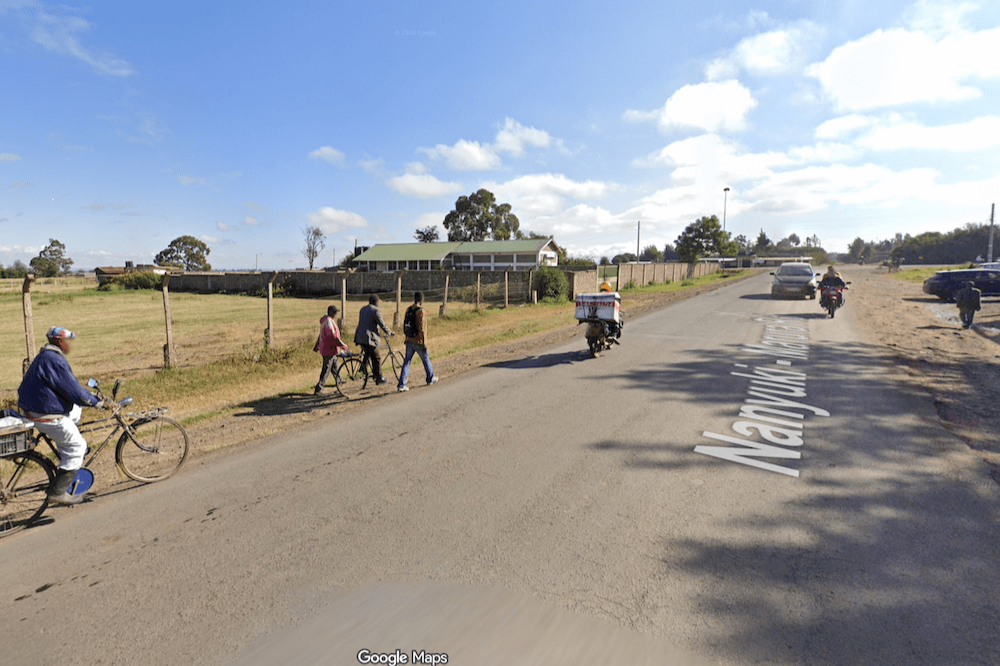
The road from Nanyuki to Ol Pejeta
Scenic Stops Along the Way
One of the joys of driving is the ability to pause and explore. As you travel North, landscapes shift from urban Nairobi to rolling farmland, forested hills, and open plains. Certain viewpoints along the route offer beautiful photo opportunities and panoramic views of central Kenya. The journey takes you through several charming places to stop for refreshments — from roadside cafés, curio shops bursting with hand crafted goodies to small towns where you can enjoy local food and coffee. These breaks provide you with a chance to stretch your legs they also aadd some colour to the journey, making the drive feel like part of the experience rather than just transport.
If you’d like to stop for lunch there are a number of excellent restaurant in and near Nanyuki town but our favourite is by far is The Trout Tree Restaurant; a unique eatery suspended in a giant fig tree along a riverline. Colobus monkeys are famous for visiting diners here and, as the name suggests, this is a trout farm so you can enjoy fresh trout from your perch in the trees.
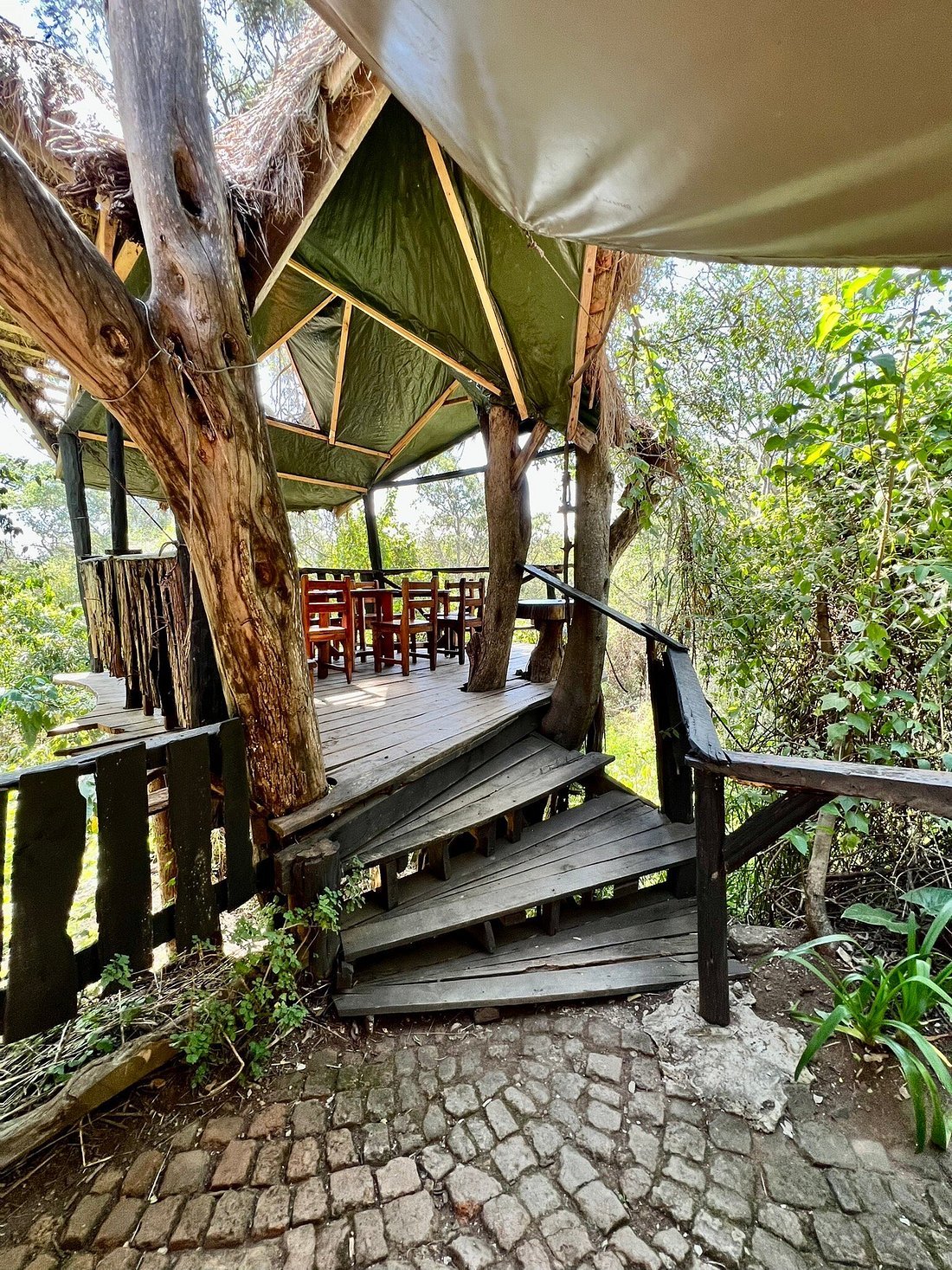
The Trout Tree Restaurant Dining Area
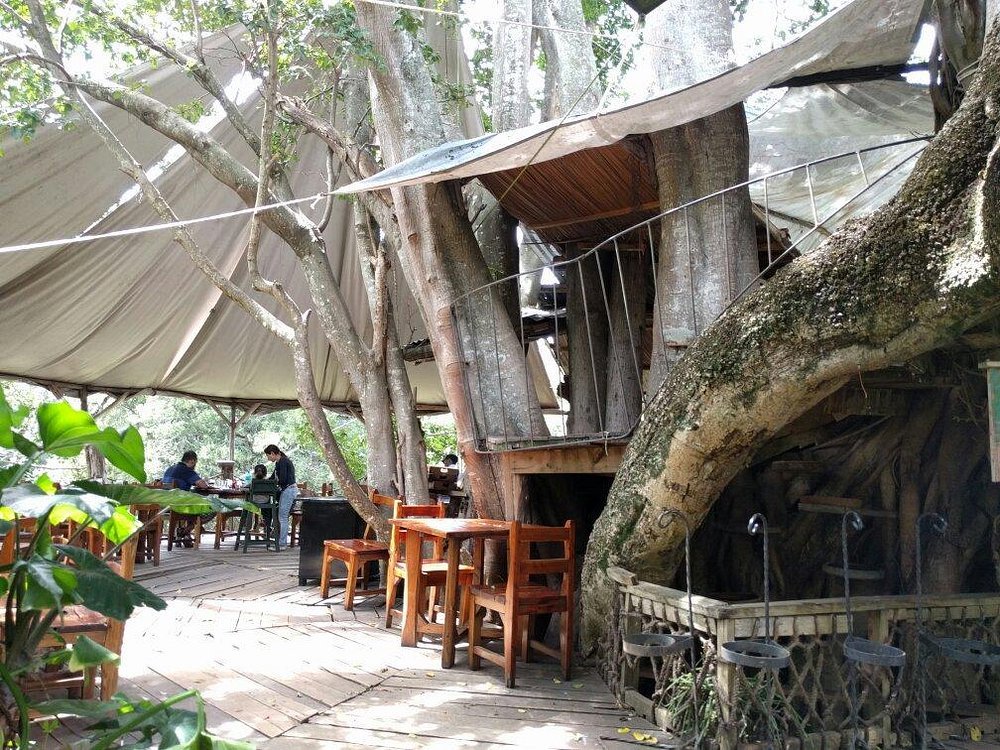
Entrance to The Trout Tree Restaurant
What to Expect at the Conservancy Gate
Arriving at Ol Pejeta’s entrance marks the beginning of your safari and the entry process is seamless and simple.
Entry Process
At the gate, you’ll complete a simple online registration form and pay the conservancy entry fees depending on your residency status (if this is not already included as part of your stay). If you are self-driving in the conservancy you will also be required to register your vehicle and pay a daily vehicle entry fee. Staff are helpful and efficient, and the process is generally quick. The entry gate also has clean toilets.
Navigation Inside the Conservancy
Once inside, roads in the Eastern sector of the conservancy are gravelled, clearly marked, and signage helps guide visitors to their respective lodges and accommodation areas. If you are staying in a camp in the wilderness area and are self-driving in Ol Pejeta you’ll need clear driving instructions to get to your accommodation from the camp manager, as these roads are not well signposted and can get tricky to navigate in wet weather. Wildlife sightings often begin almost immediately after entry, making the arrival itself feel like the start of your safari experience.
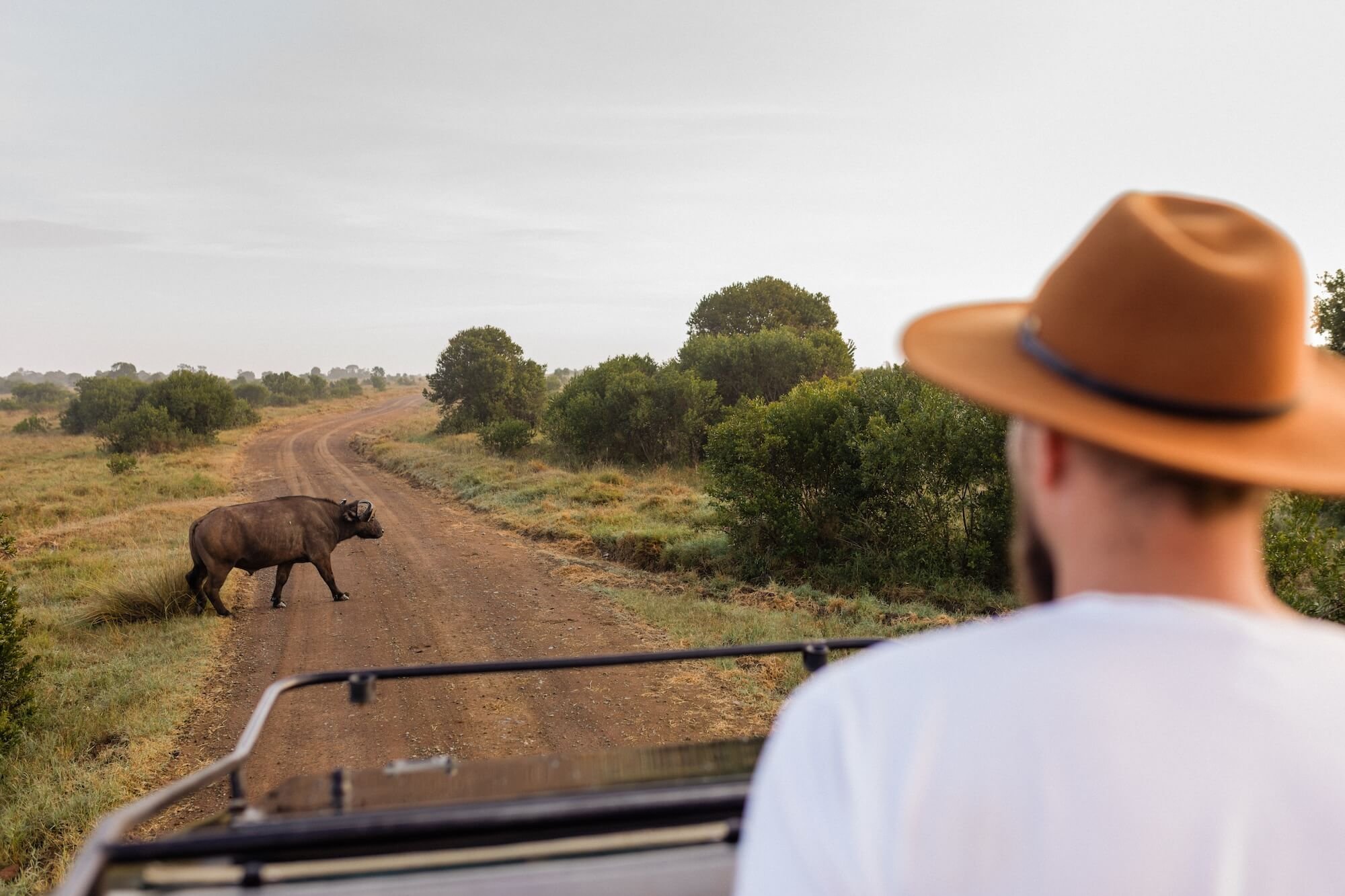
Gracvel roads in the Eastern sector of the conservancy (suitable for self driving)
Self-Drive vs Guided Safari
Both self-drive and guided safaris can offer wonderful experiences, depending on your travel style and how comfortable you are driving in safari areas and around wild animals.
Self-drive: travellers exploring Ol Pejeta in their own vehicles are required to stick to the Eastern Sector of the conservancy where roads are well-maintained and clearly indicated on maps, and we only recommend you drive yourself if you know the conservancy well and know how to conduct yourself safely and respectfully around wildlife.
Guided Safari: for the most part though visitors driving up to Ol Pejeta and staying at The Safari Cottages will wave their driver off at the gate and stay with us on a guided, fully inclusive package where your guide will have access to the wilderness area. They know the road networks like the back of their hand, have insight on where wildlife was last seen or might be heading next and know how to show you the animals in a professional manner so you can really get the very best out of your experience.
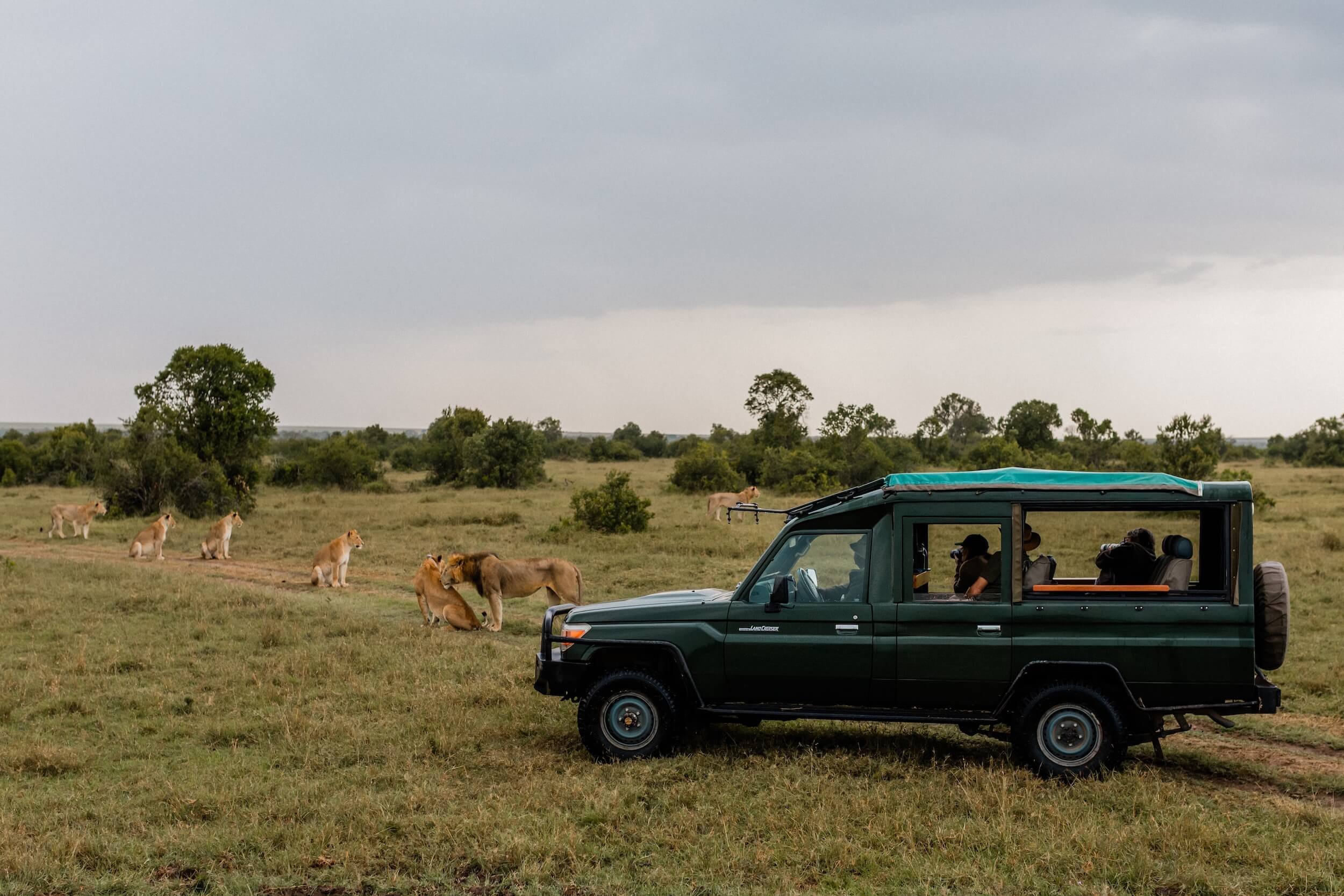
Guests on a guided safari with The Safari Cottages; an unmarked track in the wilderness area
Tips for a Comfortable Road Trip
Here are a few tips and ideas for simple preparations that can make your journey smoother:
What to Pack
Water and snacks; of course! You’ll find hawkers selling fruit and nuts and other goodies on the way too though we recommend only buying peeling fruit like bananas and mangoes.
Sunglasses and sun protection, especially if you’re traveling in the heat of the day - if your vehicle has air-conditioning but your exposed to the sunshine on your journey you might not realise how hot the sun is.
Offline maps or GPS - depending on where you’re traveling to or from Google Maps can sometimes lead you astray so a back up, good-old-fashioned paper map is always a good idea to keep on hand
Camera and binoculars - you never know what you’re going to see along the way!
Fuel and Timing
Fill up in Nairobi before you depart or in major towns along the way
Avoid night driving when possible and be sure to arrive at Ol Pejeta Rongai Gate well before the 7PM cut off time
Allow extra time for stops and photo breaks on your journey
Get off nice and early to enjoy cooler temperatures and quieter roads
Drive safely and slowly, keep an open mind and stay flexible so that the journey is part of the adventure rather than a rush to your destination.
Arrive by Road and Settle into Your Safari Home
Driving to Ol Pejeta offers more than just transport — it’s an introduction to Kenya’s landscapes, cultures, and rhythms. By the time you arrive, you’re already immersed in the safari experience and eager for more. It’s a wonderful way to experience Kenya! Whether you’re traveling independently or with a guide, a road journey allows you to arrive gently, ready to relax and enjoy the wildlife, the scenery, and the stillness of the conservancy.
Birdwatching at Ol Pejeta Conservancy: A Seasonal Guide
The Ol Pejeta Conservancy is one of central Kenya’s most rewarding destinations for birdwatching. With diverse habitats ranging from open savannah to riverine woodland and acacia groves, the conservancy supports an extraordinary variety of birdlife throughout the year including endemic and migratory species. So whether you’re a dedicated birder with an extensive birding list, the birder who loves to obsess over the LBJs (little brown jobs) or simply someone who enjoys spotting wildlife in all its forms, birdwatching at Ol Pejeta offers all safari-goers a peaceful, immersive bird watching experience.
While Ol Pejeta Conservancy is best known for its rhinos, elephants, lions and big game, a lesser known boast is that it’s also one of central Kenya’s most rewarding destinations for birdwatching. With diverse habitats ranging from open savannah to riverine woodland and acacia groves, the conservancy supports an extraordinary variety of birdlife throughout the year including endemic and migratory species.
Whether you’re a dedicated birder with an extensive birding list, the birder who loves to obsess over the LBJs (little brown jobs) or simply someone who enjoys spotting wildlife in all its forms, birdwatching at Ol Pejeta offers all safari-goers a peaceful, immersive bird watching experience.
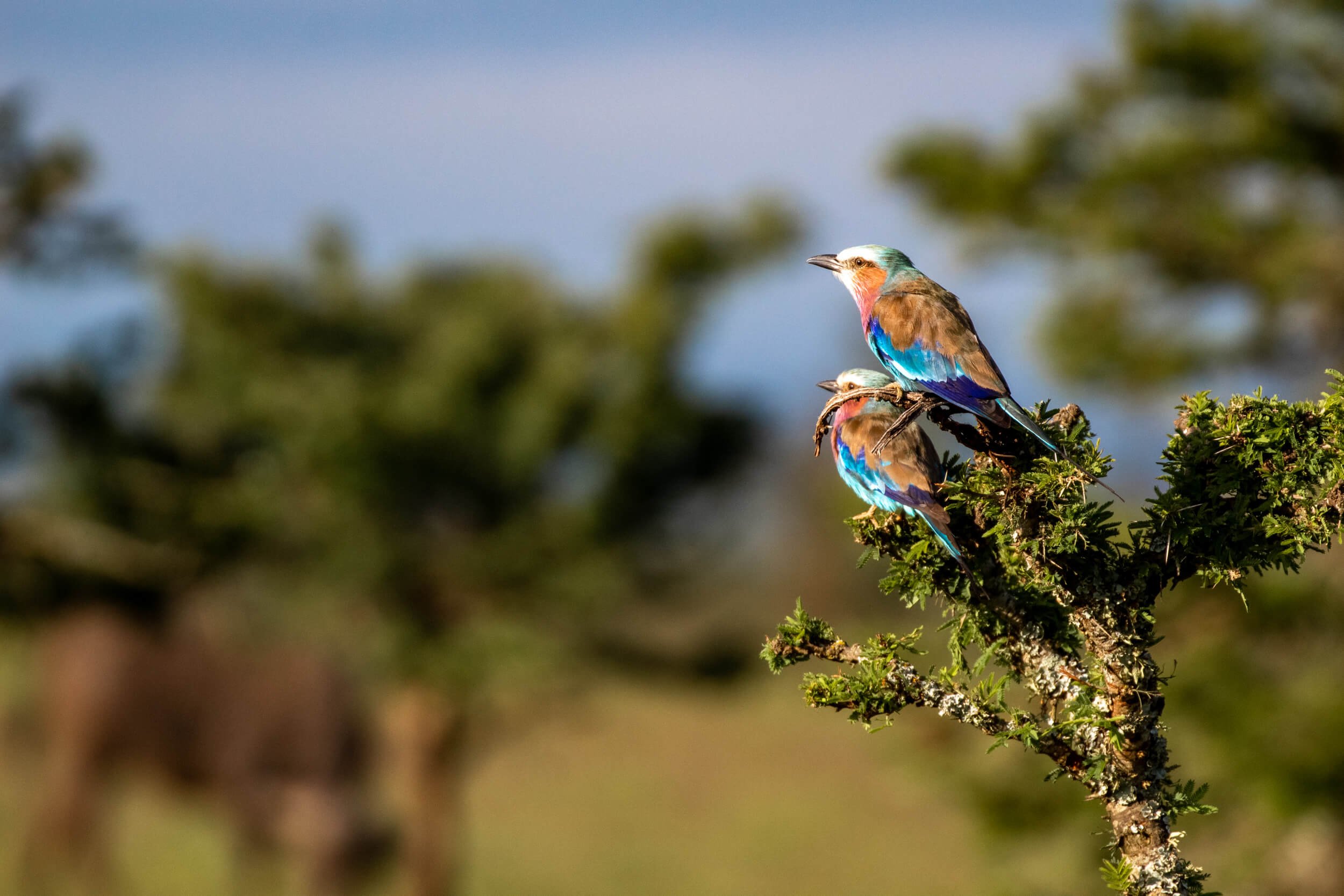
Why Ol Pejeta Is Special for Birdwatching
Ol Pejeta’s varied ecosystems create ideal conditions for both resident and migratory bird species. The vast open grasslands attract raptors and ground birds, while rivers and acacia woodland areas support a multitude of songbirds, waterbirds and forest species including rarer species like the Abyssinian scimitarbill and Blue-naped mousebird.
Our guides are all keen birders and having a private vehicle use for your safari at The Safari Cottages means there’s time to stop, observe, and listen. This sort of flexibility breaths glorious life into “a slow safari” and allows guests to enjoy our colourful birdlife as part of the living landscape and not just as another mark on a tick list.
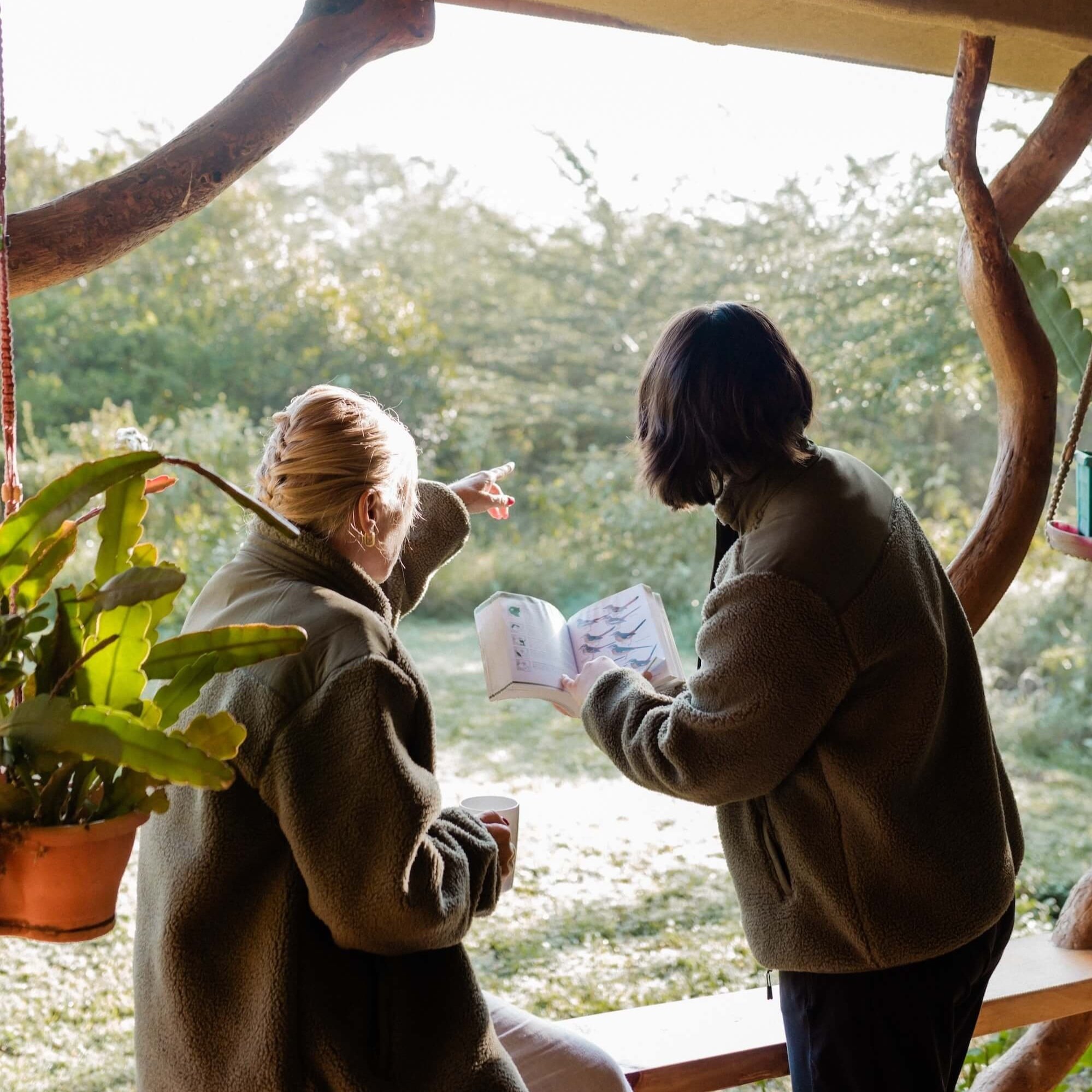
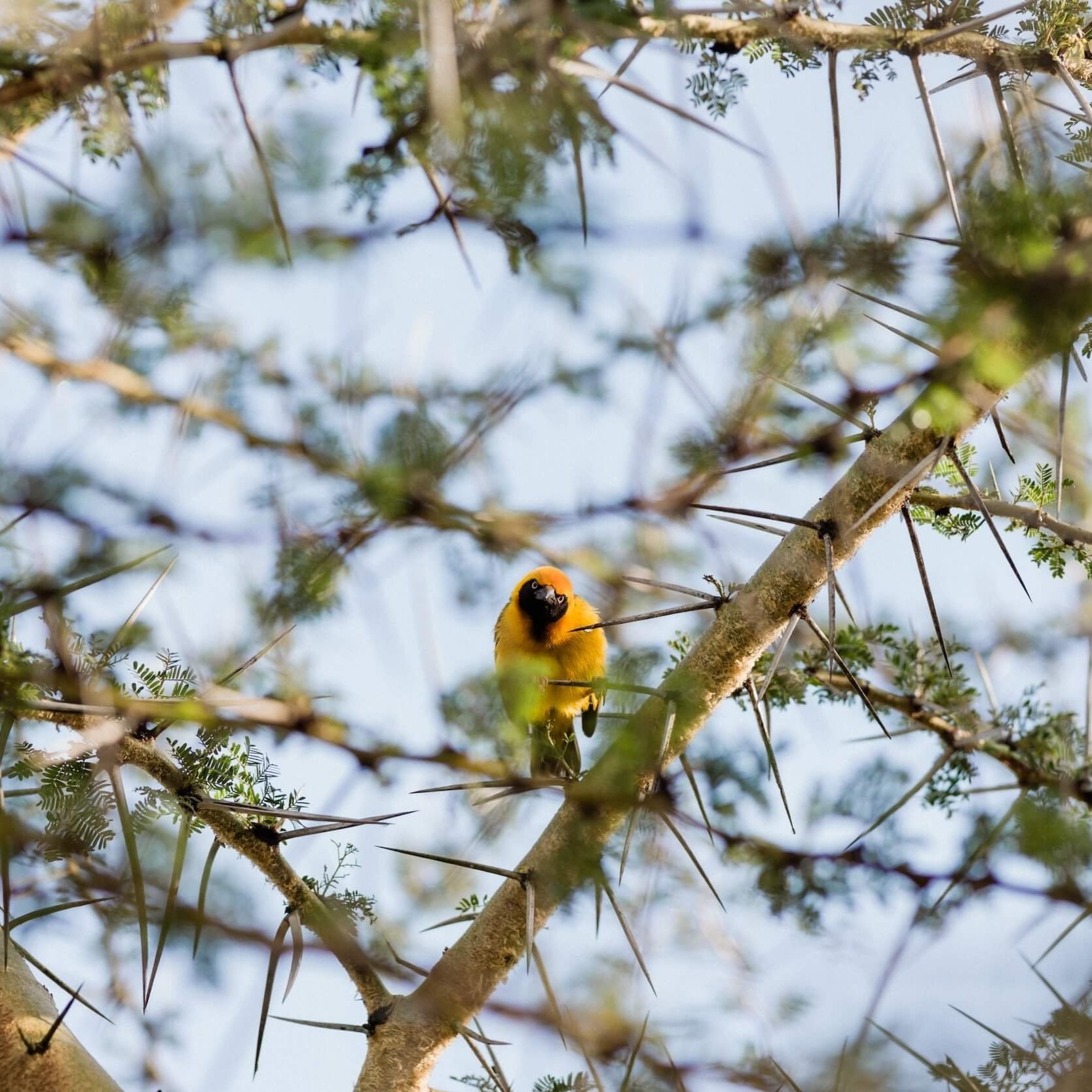
Resident Birds You Can See Year-Round
One of our favourite things about our days at The Safari Cottages is the cacophony of birdlife that pulls you from the depths of your slumber at dawn each day; a riot of babblers, starlings and bulbuls to name a few. You don’t need to wander too far from your safari cottage find come of the more commonly spotted bird species on Ol Pejeta. These include…
Glossy and superb starlings eyeing up any crumbs left on the lunch table
Secretary birds striding across open plains, they are incredible but it’s the Kori bustards who truly rule the open grassland areas
Hornbills, kingfishers and weavers chattering in woodlands and river systems
Eagles and vultures soaring above the savannah in search of their next meal
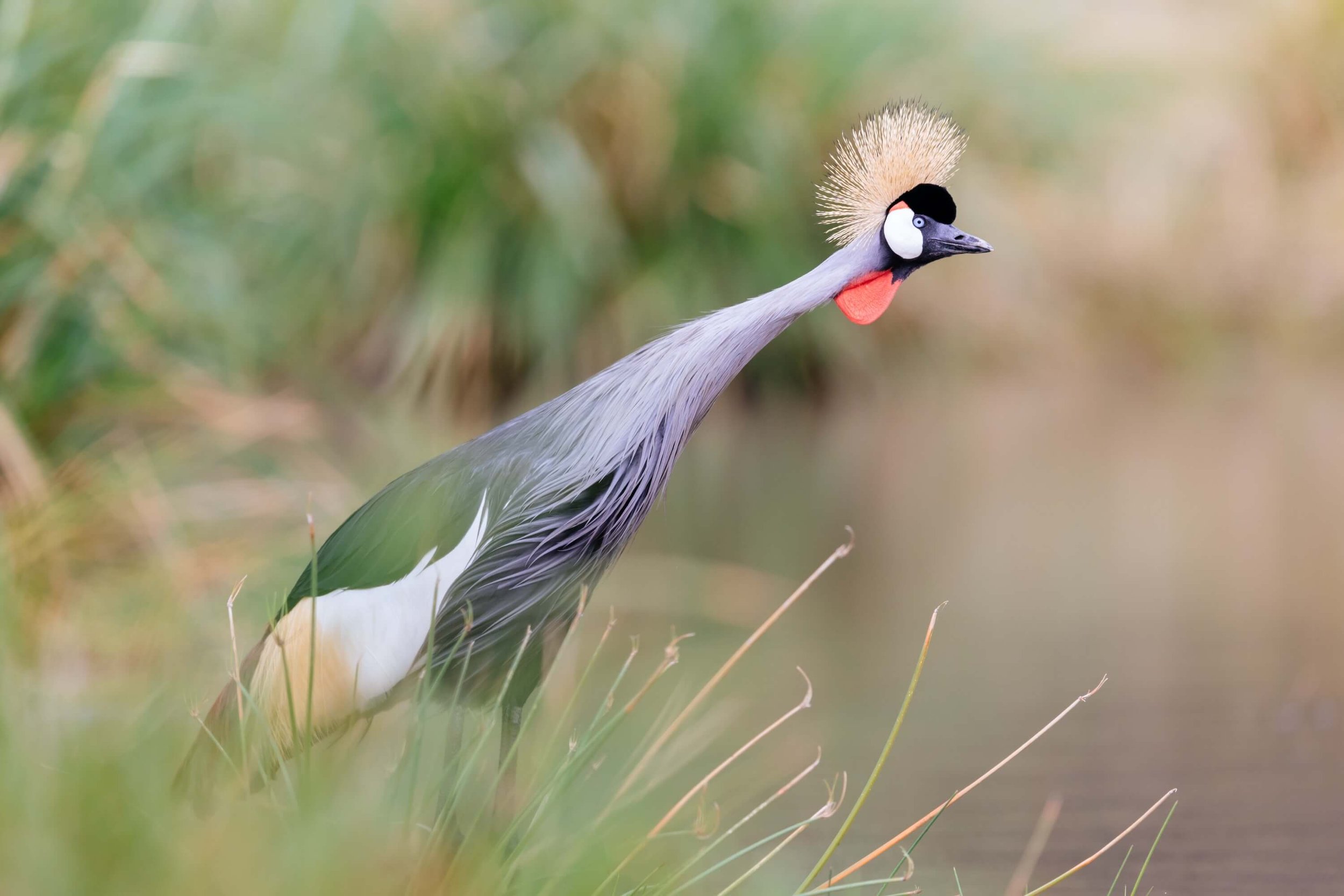
Seasonal Migratory Birds at Ol Pejeta
If the plethora of birdlife already on offer isn’t enough to satisfy your very fascination in Kenya’s birdlife then you’ll be thrilled to hear that there are also certain times of year that migratory birds appear in the skies and trees of the conservancy, adding even greater diversity to Ol Pejeta’s bird population.
November to April is the main migratory season in Laikipia, when birds from Europe and northern Africa arrive in Kenya. During these months, birdwatchers can enjoy increased species diversity and vibrant breeding plumage. Keep your eyes peeled for European bee-eaters, Montagus and Marsh Harriers, Abdims storks and Steppe eagles.
Best Habitats for Birdwatching at Ol Pejeta
Different habitats attract different species, making exploration part of the experience and Ol Pejeta makes such a wonderful birding location with thanks to the diversity in its landscapes.
Riverine areas: park up with a cup of coffee and look out for kingfishers, herons and waders
Open plains: you’ll find secretary birds, crowned cranes, bustards, larks, pipits and raptors in abundance
Woodland: sunbirds, hornbills, weavers and hoopoes flitter in the foliage
Wetlands and water points: ideal spaces to spot storks, ibis and ducks
**Moving between different habitats on game drives allows for varied and rewarding bird sightings throughout the day, but remember to take your time and linger at each location; when you slow down you see so much more.
Tips for Beginner Birdwatchers on Safari
You don’t need to be an expert birder to enjoy birdwatching at Ol Pejeta, but a few simple tips can really help enhance the experience:
Bring binoculars for better viewing; your guide will carry a pair which they are happy to share but it’s always helpful to have your own on hand for quick and easy access
Use a basic bird guide like a book or an identification app. The ‘Birds of East Africa’ book by Terry Stevenson and John Fanshawe is Andy’s pick, or The African Bird Club; Birds of Africa app is a good start for beginners/one-time safari visitors
Take time to listen — many birds are heard before they’re seen and your guide can help you identify bird calls
Ask your guide questions — local knowledge adds depth and perspective to every sighting; a great chance to understand the circle of life and just how intricately involved it in birds are (click here to meet our guides)
Plan a Birdwatching Safari at Ol Pejeta Safari Cottages
Whether you’re a passionate birder or simply someone who appreciates nature’s quieter moments, The Safari Cottages offer a birdwatching experience on Ol Pejeta that feels immersive, peaceful, and deeply rewarding. Plus private vehicle use means you can take your time at special sightings, or get stuck in and search for that one species that continues to evade you!

Wildlife You Can See at Ol Pejeta Conservancy (Beyond the Big Five)
When most people think of a Kenyan safari, they think of the famous Big Five — lion, leopard, elephant, buffalo and rhino. While our wonderful home on Ol Pejeta Conservancy is easily one of the best places in Africa to see these iconic animals (if we do say so ourselves), what truly sets it apart is the extraordinary diversity of wildlife you’ll encounter beyond these more famous species.
When most people think of a Kenyan safari, they think of the famous Big Five — lion, leopard, elephant, buffalo and rhino. While our wonderful home on Ol Pejeta Conservancy is easily one of the best places in Africa to see these iconic animals (if we do say so ourselves), what truly sets it apart is the extraordinary diversity of wildlife you’ll encounter beyond these more famous species.
Located in the Laikipia region of central Kenya, just a four-hour drive or a 50-minute flight from Nairobi, Ol Pejeta often offers its visitors a quiet, intimate safari experience where wildlife sightings feel personal and unhurried. Whether you’re visiting for the first time or returning for another safari, there’s always something new to discover.

A birds-eye view of The Safari Cottages on Ol Pejeta
Exploring The Ol Pejeta Conservancy Wilderness Area
Ol Pejeta is one of Kenya’s most important and famous wildlife conservancies; combining conservation with community engagement, ranching and tourism. Its varied landscapes — open savannah, acacia woodland and riverine habitat — create ideal conditions for a wide range of animal and bird species. Perhaps most famously, Ol Pejeta is home to the largest population of black rhinos in East Africa and plays a critical and inspiring role in global rhino conservation through it’s world-renowned Northern White Rhino IVF program. But if you’re looking for a private, authentic safari experience then you’ve opened the right blog post today; the secret to experiencing that best that Ol Pejeta has to offer is by booking a fully inclusive safari, so you can have access to The Wilderness Area.
What is The Ol Pejeta Conservancy Wilderness Area? So glad you asked! This vast tract of land is off limits to self drives and visitors not staying overnight. Only a handful of high quality camps and lodges, like The Safari Cottages, with professional guides and well maintained vehicles have game viewing rights in the Ol Pejeta Wilderness Area where, with fewer vehicles at sightings, you have the space and time to observe animal behaviour naturally.
Iconic Wildlife You’re Likely to See at Ol Pejeta
Rhinos (Black and White): Ol Pejeta is one of the most reliable places in Kenya to see both black and white rhinos. Sightings are a daily occurrence and it’s not unusual to see multiple individuals in a single game drive. During your stay you can also visit the last Northern White Rhinos in existence to learn more about how Ol Pejeta is bringing this species back from the brink of extinction and making waves in the conservation world. When you visit the Northern White Rhino don’t forget to pop in and see Baraka; a rescued black rhino that is cared for by Ol Pejeta and has grown very fond of his human caretakers.
Hyenas: you’ll likely encounter many spotted hyena’s on your game drives as they are doing so well on the conservancy and frequently den close to the road, making spending time with them easy and rewarding. Stripped hyenas are around too though harder to spot.
Elephants: Large elephant herds roam freely across the conservancy. Watching them interact — from playful calves to protective matriarchs — is a highlight for many guests. At The Safari Cottages a wildlife trail meanders along the riverline in front of our property so we’re often visited by these wonderful creatures as they come down to the river to drink and play each day.
Plains wildlife: We refer to all herding animals who prefer the vast open plains over thick bush as “plains wildlife” and Ol Pejeta is abundant with them. Plains wildlife, in prolific numbers, include zebra, buffalo, gazelles, impala and eland as well as the endangered Jacksons hartebeest and reticulated giraffe.
Big Cats:
Lions of all size and ages can be found resting in the shade in the heat of the day or on early morning / evening hunts. The conservancy is home to around 80 lions spread out between 8-10 prides and they are spotted regularly.
Leopards are still rather elusive in our wild little corner of the world, but a few individuals are becoming more comfortable with vehicles and they are being seen every week or so. We hear them calling most nights and see their footprints all around the camp in the mornings.
Cheetahs thrive in the open plains, where their speed is best observed. Cheetah populations have previously struggled on Ol Pejeta, like much of Africa, but they are making a slow comeback and, at the time of writing (2026), the conservancy is now home to 10-15 individuals.
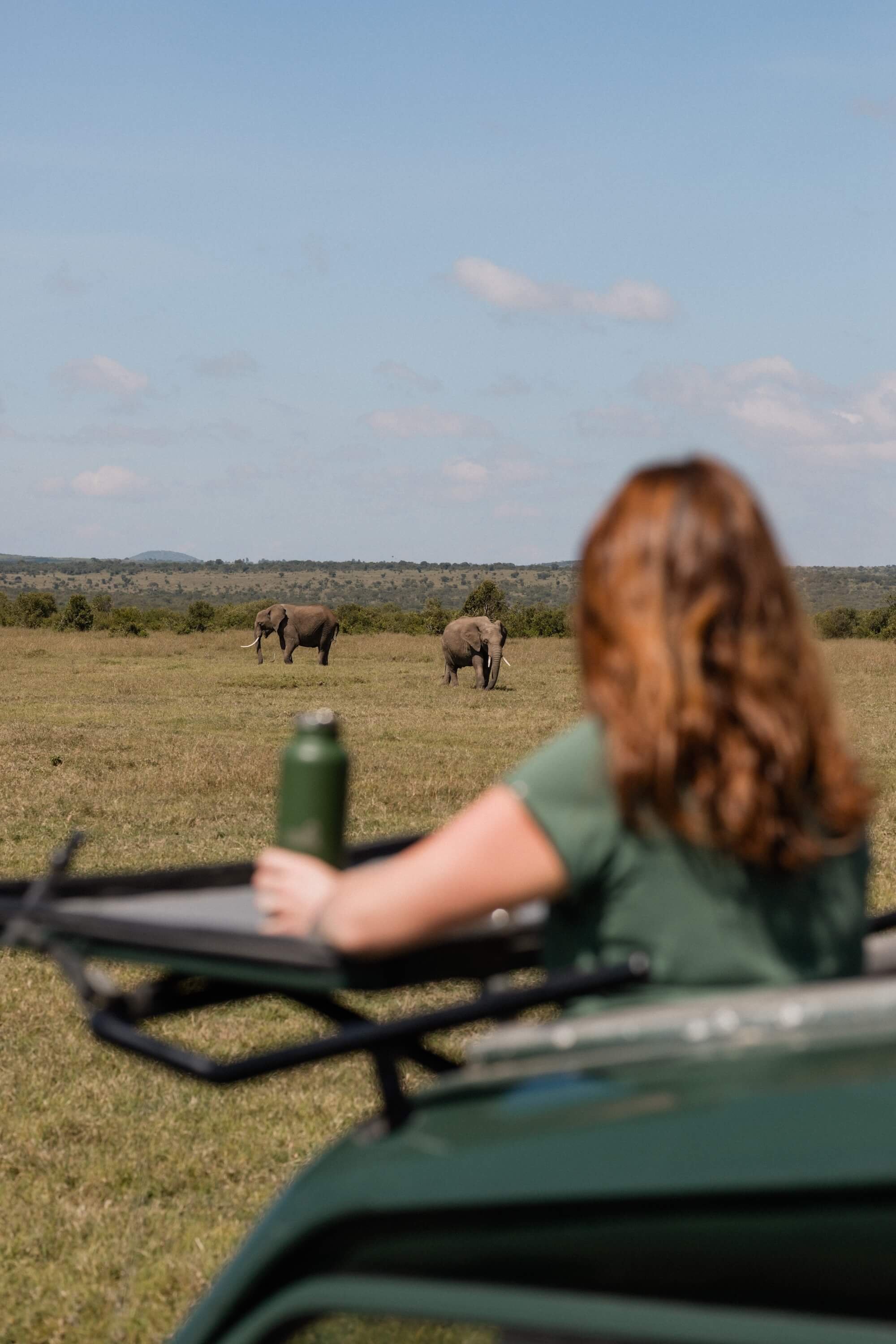
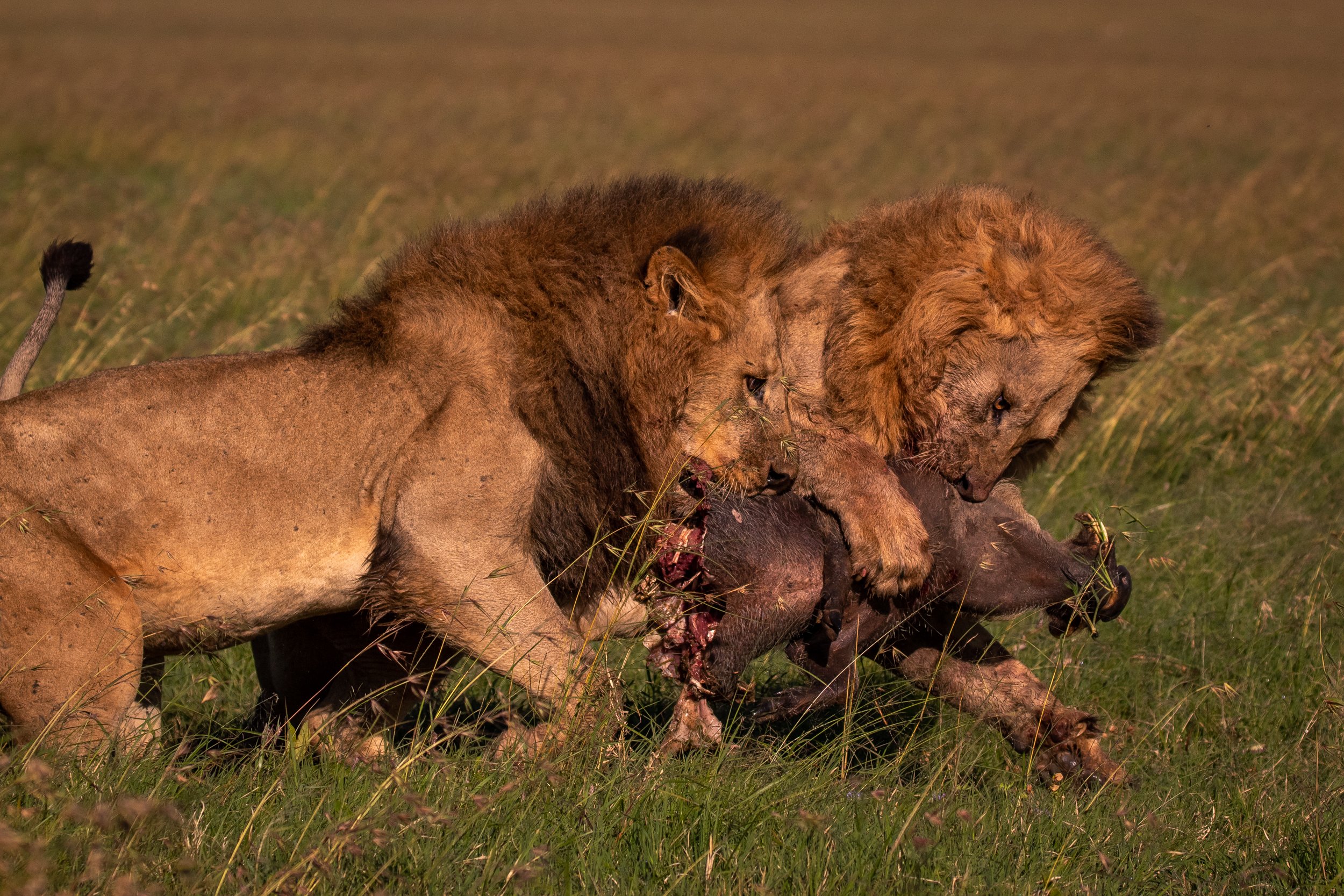

Birdlife at Ol Pejeta Conservancy
With over 300 recorded bird species, Ol Pejeta is a rewarding destination for birdwatchers, and even non-bird watchers have found themselves entranced watching a spoonbill wading through the shallows or a superb starling glittering in the light of the day.
On Ol Pejeta you can expect to see…
Raptors such as eagles and vultures: marshy eagles, tawny eagles and fisheagles are regularly spotted here. Vulture species are more secretive but do come out for meals!
Colourful bee-eaters, kingfishers, starlings and weavers
Large ground birds like secretary birds, bustards (including the impressive kori bustard) and storks

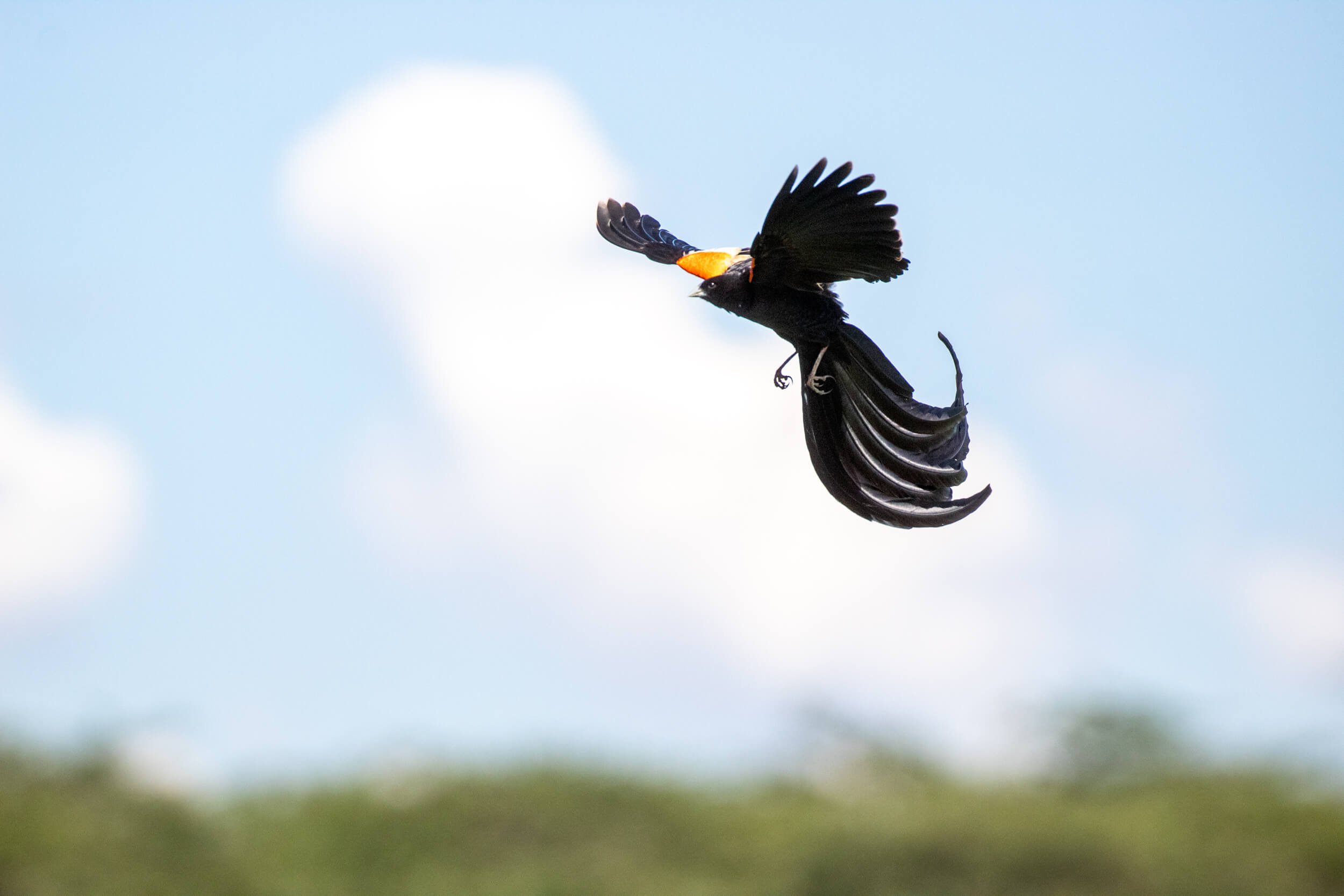
Best Time of Day for Wildlife Sightings
Wildlife at Ol Pejeta can be seen throughout the day, but some times are especially rewarding:
Early morning: we encourage our guests to head out as early as possible because this is when predators are the most active, and the soft light is ideal for photography. We’ll send you off with a thermos of hot tea of coffee and a blanket for the car to keep you toasty warm on chilly mountainous mornings.
Late afternoon / evening: you’ll rest in the heat of the day, just as all animals do. Then you’ll head out again when temperatures cool again in the late afternoon/evening.
Midday: you don’t always have to be out and about though. In the heat of the day elephants, giraffe, buffalo and gazelles will wander infront of The Safari Cottages so you can enjoy game viewing from the comfort of your verandah.
With your own private vehicle and a dedicated guide, game drives at Ol Pejeta Safari Cottages are flexible; you can adjust your schedule to match wildlife movement rather than racing against the clock.
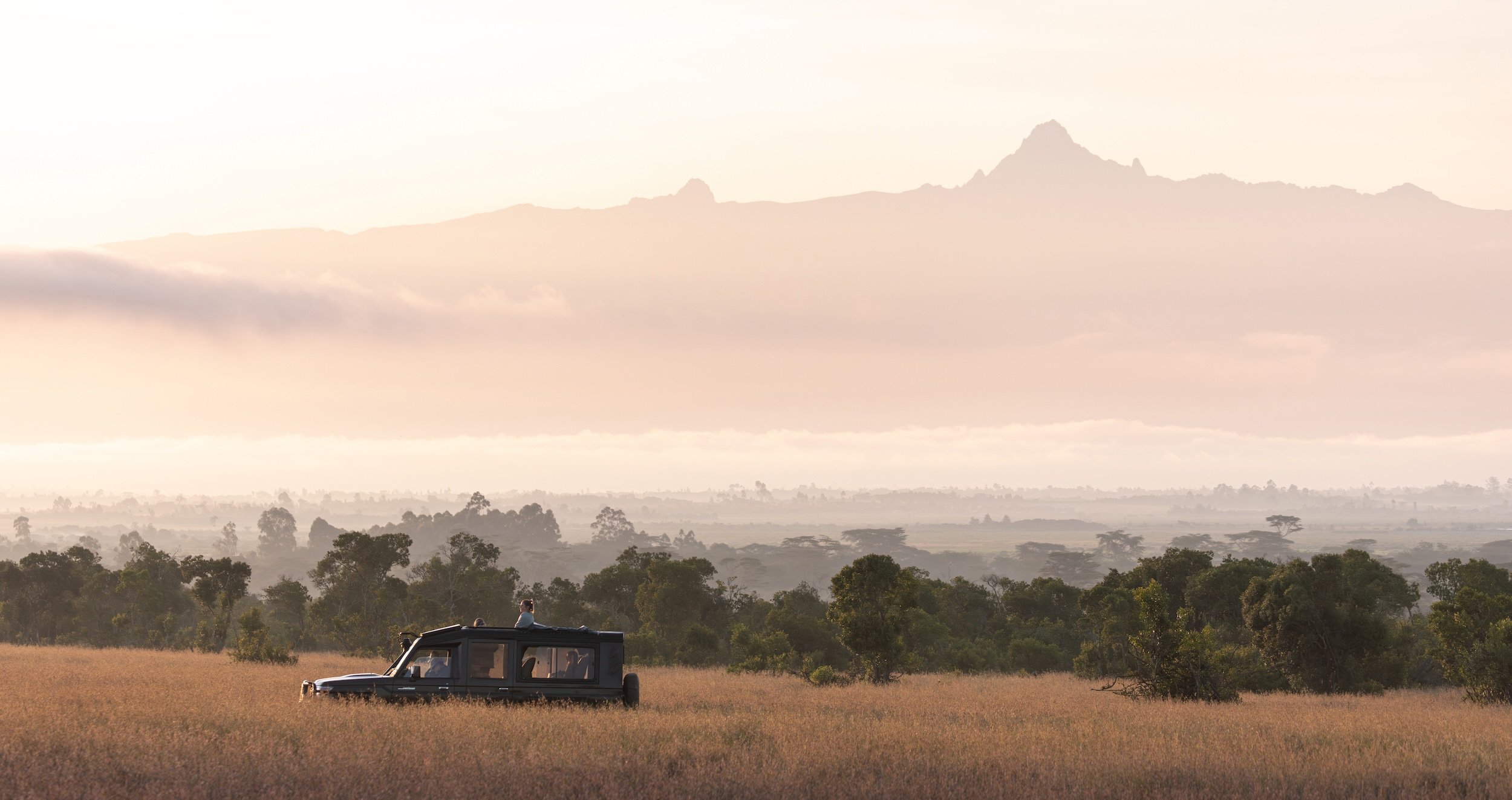
Experience Ol Pejeta’s Wildlife Firsthand
Staying within the conservancy, and especially within the wilderness area, allows you to experience wildlife at your own pace — from early morning game drives to peaceful evenings listening to nature from your safari cottage. If you’re dreaming of a safari where wildlife encounters feel natural, uncrowded and deeply memorable, The Safari Cottages on Ol Pejeta Conservancy is an exceptional place to begin.
View our rates and start planning your wildlife-rich safari experience.
What to expect on a day trip to Mt Kenya
Here’s what your day looks like when you book a day trip to Mt Kenya for a mini mountain hike, taking in the unique flora and fauna and astonishing views!
Our central location means we’re able to offer our guests the opportunity to stay a little longer and spend some time exploring Laikipia beyond the conservancy. A day trip to Mt Kenya offers you the chance to see the mountain’s alpine wilderness without committing to a gruelling 5-day hike to the summit. Here’s what your day trip to Mt Kenya can look like…
Good morning!
You’ll wake up with the sunrise this morning, enjoying a cup of freshly brewed Kenyan tea or coffee on your verandah along with a light breakfast to get you going. After breakfast you’ll head off for your day of adventure. You’ll drive through the conservancy, keeping an eye out for any exciting wildlife activity, then pass through local villages and towns before turning right and entering into Mt Kenya Forest reserve.
Open plains give way to montane forest as you pass through the Sirimon entry gate and proceed to Old Moses base camp; the first overnight stop for those hiking to the summit. The drive takes you through farmland into rain forests, bamboo forests, cedar and yellow wood forest and across the moorland to Old Moses. Enroute you have the opportunity to see monkeys, baboons, buffaloes and bushbuck as well as a colourful array of birdlife.

Arriving at Old Moses image x Marcelo Ramella
Old Moses hike & picnic lunch
You’ll park up at Old Moses and explore the mountain’s unique, equatorial afromontaine moorland vegetation and incredible views across the surrounding Laikipia county and mountain foothills. You choose your distance; most enjoy an easy amble to the met station (around an hour’s hike) at around 3300m above sea level, and back again in time for lunch but you can follow the trail as far as you’d like. Weather depending you can wrap up and enjoy the views with a picnic at Old Moses or descend into the cedar forest and relax beneath the canopy of trees here for a leisurely picnic lunch.
Featured images below kindly shared by Ol Pejeta Safari Cottages guest Marcelo Ramella on their recent family safari.


Nanyuki & return home
You’ll pass through Nanyuki town on the drive back so, if you still have some energy after your morning out, you’re welcome to stop by and wander through the shops or local markets. We also recommend visiting the Spinners & Weavers; a local woman’s group that hand crafts beautiful woven rugs.

Nanyuki Spinners & Weavers Womens Group
If you prefer to head back to the bush you’ll have a game drive back to camp, arriving late in the afternoon to put your feet up and have a sundowner around the fire whilst the stars unravel overhead. What a day!


KEEP READING
More from the Ol Pejeta Safari Cottages blog


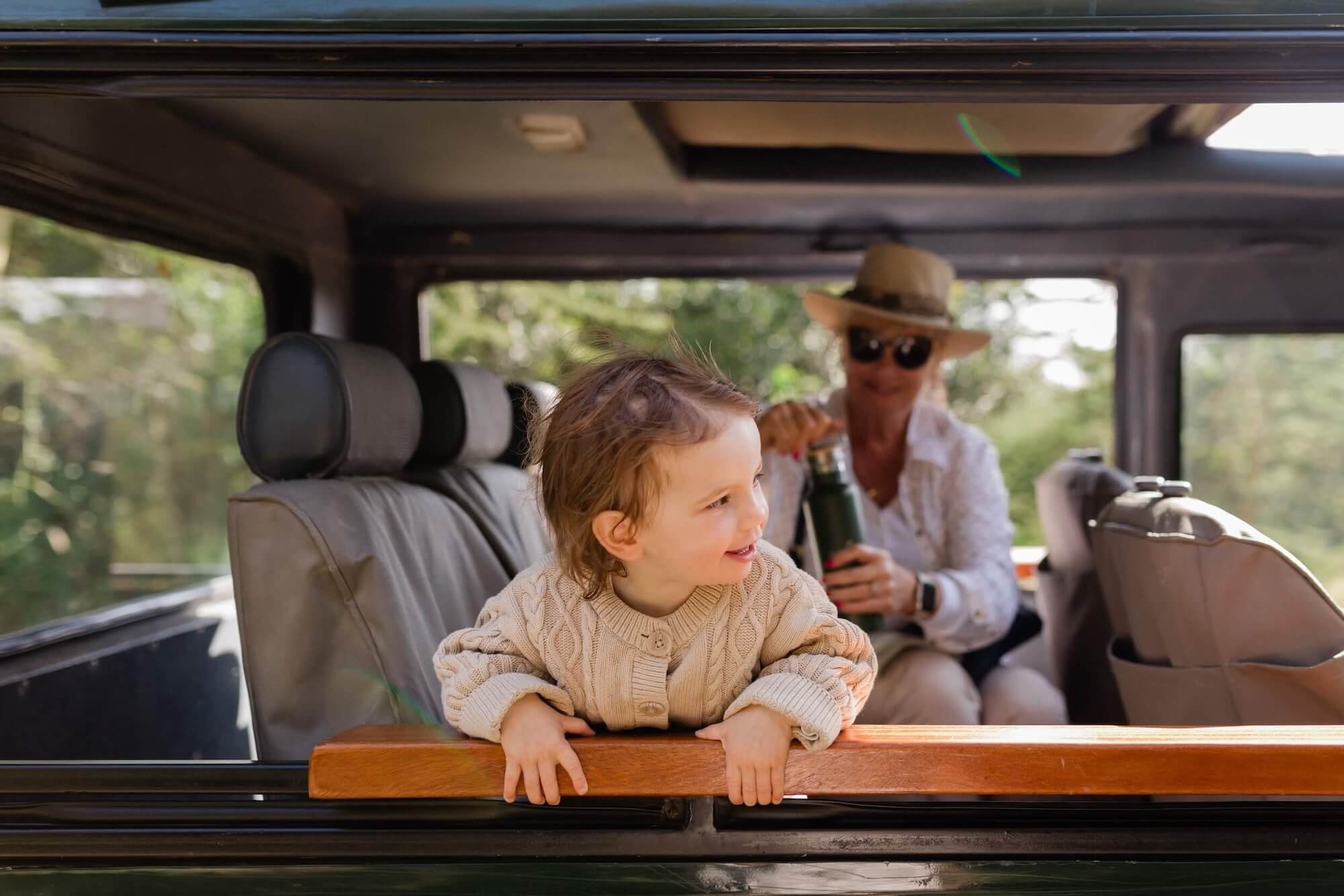
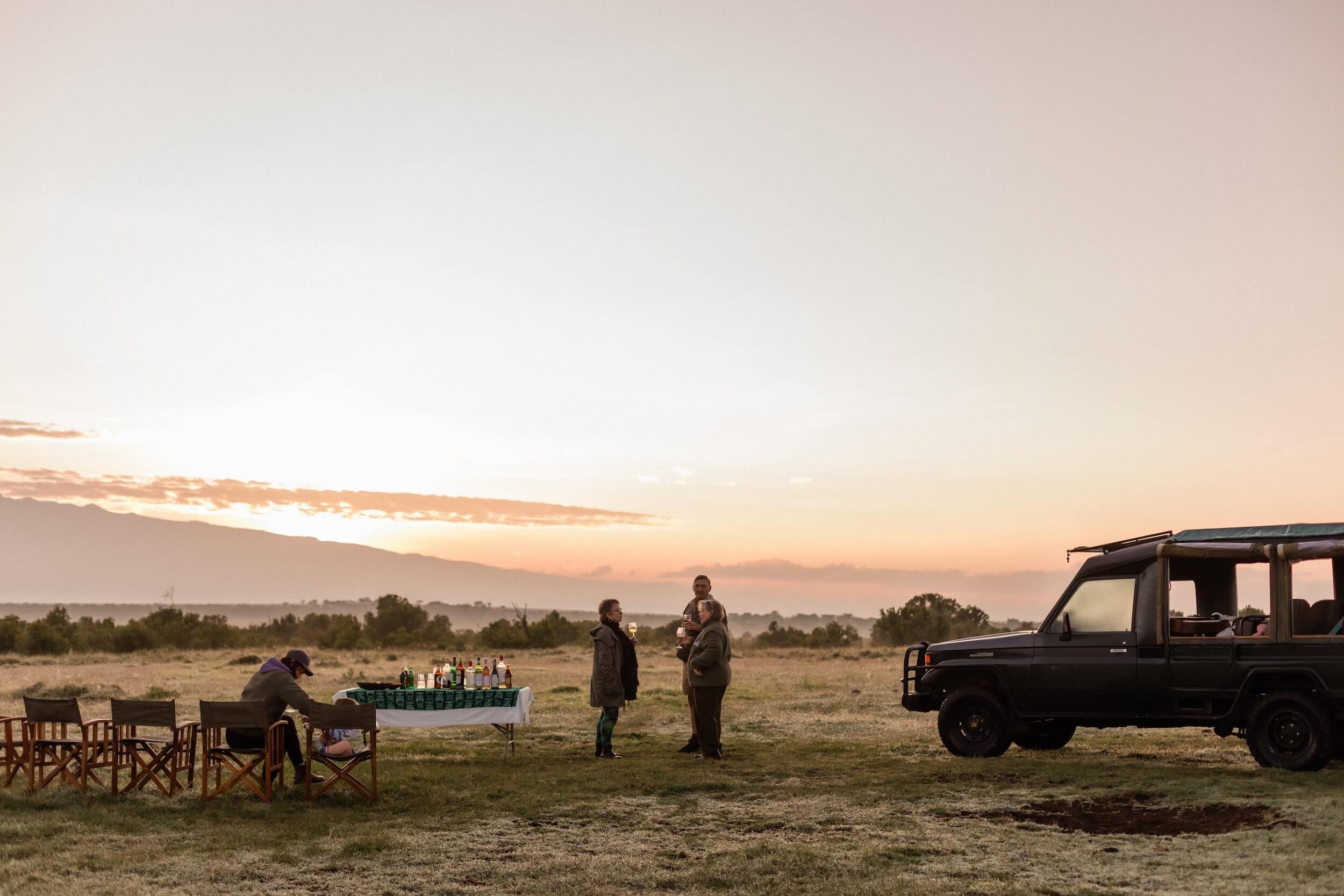

Kenya Safari Packing List: What to Pack for Your Ol Pejeta Safari
Here’s what you need and what you can leave behind on your holiday. Our top tips for packing for a Kenya safari.
Jetting off on your Kenya safari and wondering what to pack? You're not alone. An African safari is unlike any experience you've had, and getting your packing list right makes all the difference between comfort and frustration. Here's exactly what you need to bring to Kenya for a safari at Ol Pejeta — and what you can safely leave at home.
Safari Clothing: Colors, Layers & Footwear
Choose Earth Tones Over Bright Colors
If you're wondering whether you need full khaki gear for safari, the honest answer is: mostly yes. Bright colors can distract wildlife, especially during bush walks when the goal is to blend in quietly. That said, you don't need to look like a full cowboy.
Pack neutral earth tones: khaki, tan, olive, muted brown, grey. These work for both game drives and looking reasonably put-together at dinner. If you're heading to the Kenyan coast before or after your safari, bring lighter, breathable clothes and reef-friendly suncream for beach time.
Layers Are Essential
Kenya's elevation varies dramatically — from the coast to the highlands to open plains. Temperatures shift from cool mornings to warm afternoons to cool evenings. Layers are your solution.
Pack:
Light cotton shirts or t-shirts
One fleece or lightweight layer for mornings and high altitude
One warmer jacket or light coat (you might never need it, but it's small enough to bring)
Leggings and shorts (mornings are chilly; by 10 AM it's warm)
This simple combination works across all seasons and all elevations at Ol Pejeta.
Footwear: Comfort Over Fashion
Hiking boots seem logical for safari, but unless you're traveling in the rainy season or planning significant hiking, they waste valuable baggage space and weight. Comfortable trainers (sneakers) are sufficient for game drives and daily activity.
For game drives: Bring closed-toe shoes and thick socks — they help ward off mosquitoes nipping at your ankles in the evening too.
For around camp: Pack sandals or relaxing footwear for moving between your cottage and common areas.
For rainy season (April–May, November): Lightweight waterproof boots or shoes help, but honestly, an old pair of trainers you don't mind getting muddy works just fine.
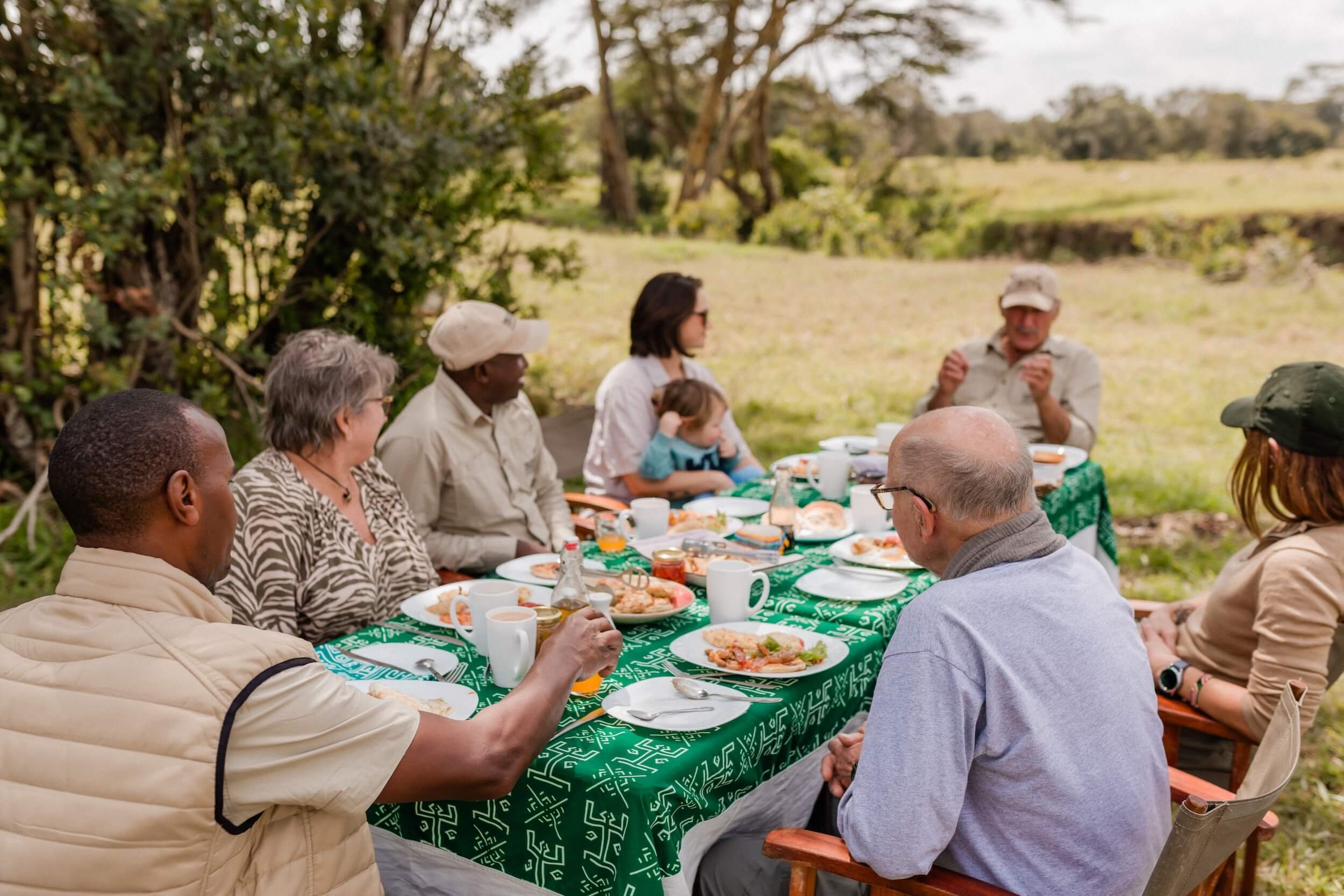
Brunch in the bush with The Safari Cottages on Ol Pejeta
Pro Packing Tip
Beyond your main suitcase, bring a smaller backpack or tote bag for game drives. Use it to carry spare clothes, sunscreen, your phone or camera, and a water bottle. This keeps essential items accessible without dragging your entire suitcase around.
Cameras & Photography Gear
What Camera Do You Actually Need?
We get this question constantly, and the answer is: it depends entirely on your goals.
If you want professional wildlife photographs that you can print and frame, your smartphone won't cut it. You'll need a DSLR or mirrorless camera with a good zoom lens (at least 100–200mm reach). Budget accordingly.
If you want to enjoy the experience and capture memories to share with family, any decent camera — including modern smartphone cameras — is perfectly fine. You don't need to invest in expensive gear.
Critical tip: If you're bringing a new camera, test it thoroughly before your trip and get comfortable with the settings. Spending your safari fiddling with manual controls means missing the actual wildlife moments.
Camera Accessories to Pack
Memory cards: If you're taking hundreds of photos (which is likely — most guests come home with 2,000–3,000 images), bring multiple memory cards. You'll fill them faster than you expect.
Charging cables & adapters: Our Safari Cottages and most lodges around Kenya have British 3-pin power sockets in rooms or main areas, but pack all your cables and adapters. A portable charging unit is helpful for long days out.
Lens cleaning kit: Dust and moisture are inevitable on safari. Bring a small microfiber cloth and lens cleaning solution to keep your equipment functioning properly.
If you’re interested in wildlife photography you might enjoy this guest blog post from Remembering Wildlife founder, professional wildlife photographer and long-standing guest of The Safari Cottages, Margot Raggett MBE. She shares her tips on what to pack and how to work with what you’ve got.

A note on binoculars: Don't Leave Home Without Them
Bring binoculars. Yes, they add weight to your baggage. Yes, they take up space. But no guest has ever regretted bringing binoculars on safari — while dozens regret leaving them behind. Binoculars transform your safari experience. They let you see details of distant wildlife. They help you spot birds in trees. They let you watch predator behavior without disturbing animals. Our guides carry spare binoculars incase you’ve forgotten your own but they are so worth the weight!
First Aid, Toiletries & Essentials
Toiletries & First Aid
Check with your accommodation about what toiletries they provide. Most safari lodges and cottages supply basic items (shampoo, soap, lotion), so you can leave bulky bottles at home. At The Safari Cottages your private safari cottage is stocked with locally made soaps, hair shampoo and conditioner and washing powder for delicates.
Essential first aid items to pack:
Antihistamine (for insect bites and reactions)
Paracetamol or ibuprofen (for headaches or aches)
Rehydration salts (for dehydration at altitude)
After-sun lotion (you'll need it)
Any personal medications
Most camps can arrange visits to a nearby doctor if needed, but they may not be able to supply medications due to liability restrictions so it’s important you bring what you know you'll need.
Electronics & Charging
All charging cables and power adapters
Universal power adapter (British 3-pin is standard)
Portable battery pack or power bank for extended days out
Headlamp or small flashlight (helpful in camp after dark)
*A note on luggage. If you are flying locally be sure to check baggage restrictions as most bush flights will be operated by small aircrafts that have strict baggage limits.
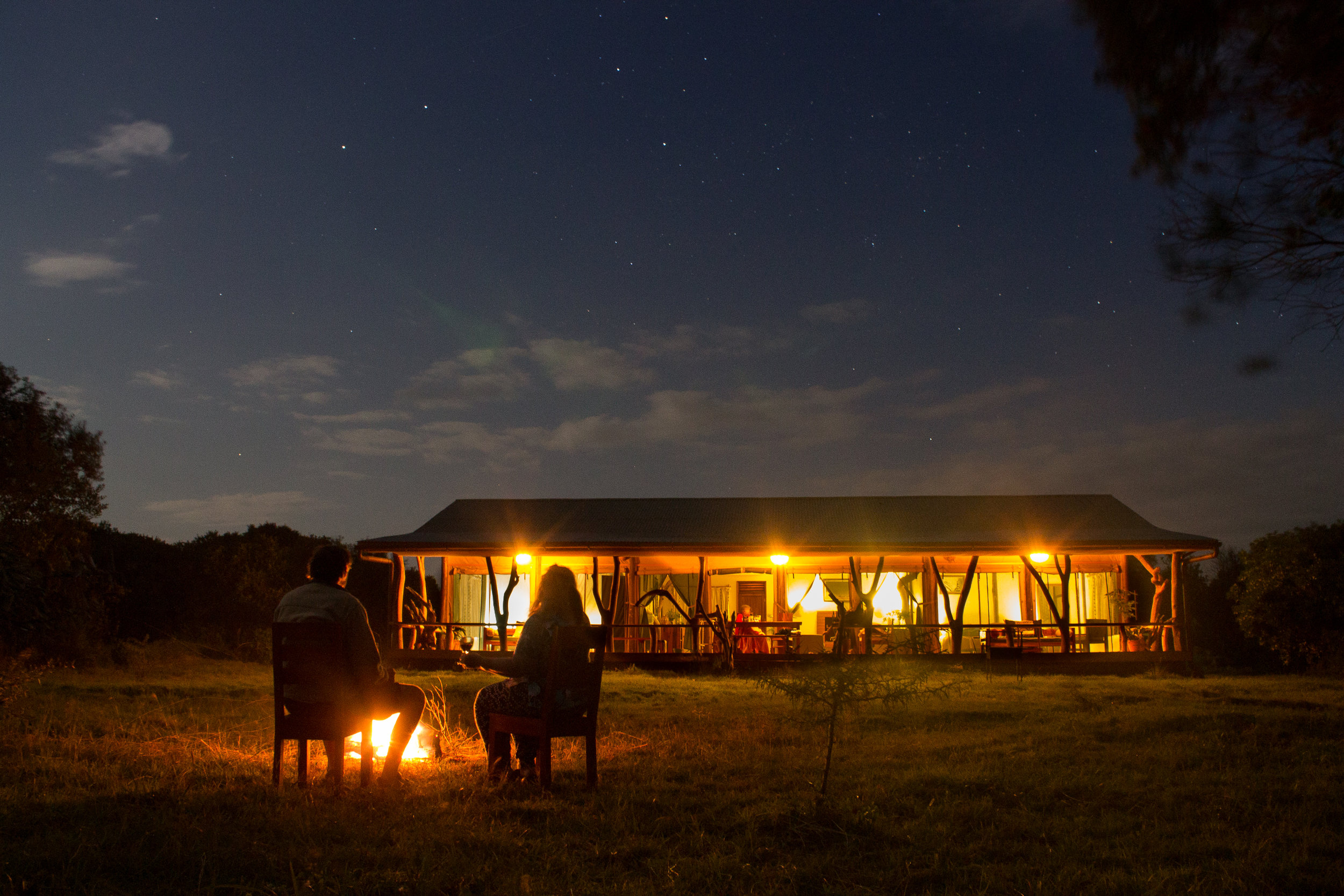
Practical Packing Checklist
Before you leave home, confirm you have:
Passport (valid for 6+ months beyond your trip)
Flight tickets and booking confirmations
Visas (if required — check before booking)
Travel insurance documents
Emergency cash and credit/debit cards
Travel health documents (vaccination records if required)
For your safari, pack:
Neutral-colored clothing (khaki, tan, olive, grey)
Layers (shirts, fleece, light jacket)
Closed-toe shoes and thick socks
Sandals for around camp
Camera (phone is fine; DSLR if serious about photography)
Binoculars
Sunscreen & lip balm with SPF
Hat or cap
Light rain jacket
Toiletries & personal medications
First aid basics (antihistamine, paracetamol, rehydration)
All charging cables and adapters
Leave behind:
Heavy hiking boots (unless rainy season or planned mountain hiking)
Formal clothing (safaris are casual)
Multiple pairs of shoes (3 pairs max: closed shoes, hiking shoes if needed, sandals)
Excessive luggage (you'll only use 20% of what you pack)
High heels or dressy shoes (impractical and unnecessary)
Anything you're precious about (dust and mud are inevitable)
Ready to Pack?
You're not overthinking this. A well-planned packing list makes your safari more comfortable and enjoyable. Stick to neutral colors, bring layers for temperature changes, pack binoculars, and bring whatever camera matches your photography ambitions.
That's it. You're ready.
Safari njema (good travels)!
KEEP READING
More from the Ol Pejeta Safari Cottages blog
Kenya Safari in September: Peak Season Wildlife & Dry Weather (Without the June Crowds)
If you’re considering booking your safari to Kenya in September then here are five reason why this is your best idea yet!
September in Kenya is considered peak season — but don't let that scare you away. Yes, it's busier than shoulder months. But September offers something special that most travelers don't realize: peak wildlife viewing combined with adult-friendly travel after families return to school. If you're considering a Kenya safari in September, here's why it might be exactly the right time to book.

1) The Perfect Time for Couples and Adult Travellers
The September Advantage: Kids Go Back to School
By early September, schools in most countries have reopened after summer holidays. This means families stop traveling. The result? Better accommodation availability, more airline seat options, and competitive pricing — even during peak season.
If you're traveling as a couple, this is particularly valuable. Our one-bedroom safari cottages are designed for couples seeking privacy and exclusivity. You'll have a private chef preparing meals specifically for you, and a dedicated guide with a private vehicle. No shared experiences. No group schedules. Just you, your partner, and the African bush.
For solo travelers or adult friends traveling together, September offers peak season conditions without feeling crowded. You get the best wildlife viewing of the year with the personal attention of a cottage designed for your group.
2) Excellent Game Viewing Conditions
Dry Landscapes and Concentrated Wildlife
By September, the dry season is in full swing. The grass is short and sparse. Water sources have become scarce and concentrated. This combination creates ideal game-viewing conditions.
Short grass means predators (lions, leopards, cheetahs) are visible lounging on open plains: you'll see them hunting, you'll see them resting. You'll actually see them, which is the entire point of a safari.
Concentrated water sources also mean guides know exactly where wildlife will gather. Animals must come to water to drink. Your guides know which waterholes are active, which herds are moving through, which predators are hunting nearby. Wildlife becomes a little more predictable and reliable.
At The Safari Cottages, we watch elephants, giraffes, rhinos, and buffalo visiting the river during meals. Wildlife isn't hidden in green vegetation — it's visible across the landscape.
3) Reliable Weather and Minimal Rain
Nearly Guaranteed Clear Skies
While September can see occasional afternoon showers, the month is typically very dry. The risk of being rained in and unable to explore the bush is extremely low.
You can plan your activities with confidence. Early morning game drives happen in cool, clear conditions and afternoon drives have predictable weather. If you're combining a bush safari with beach time on the Kenyan coast, expect warm, dry days with minimal cloud cover.
**Pack sun protection and layers for cool mornings, but leave your umbrella at home. Weather is your ally in September, not an obstacle.


4)The Great Wildebeest Migration (July–October)
One of Nature's Seven Greatest Spectacles
Many travelers visit Kenya between July and October specifically to witness the great migration of wildebeest and zebra from Tanzania's Serengeti into Kenya's Masai Mara. September sits squarely in the migration window, offering excellent chances to see this remarkable event.
Here's our recommendation: start your safari at Ol Pejeta Conservancy in Laikipia (where you'll have quiet, personal game viewing if you choose to stay with us). Then fly directly to the Masai Mara to witness the migration spectacle. This approach gives you the best of both worlds: intimate wildlife viewing in the highlands, then the drama and scale of the migration.
The migration is one of the seven natural wonders of the world for good reason. If seeing it is on your bucket list, September is your window.
5) See Whales Sharks on The Coast
Start of the Gentle Giant Season
For travelers doing a "bush and beach" safari combination, September is ideal timing. Not only is weather excellent across East Africa, but September marks the start of whale shark season in the Indian Ocean off Kenya's coast.
Whale sharks migrate into the region during this period and if seeing these incredible gentle giants is on your list, September offers a strong chance of ticking that off. The clear, warm waters of September make spotting and swimming near these creatures possible (with proper guides and protocols).
BOOK YOUR SEPTEMBER SAFARI TO KENYA
Wildlife is abundant year-round in Ol Pejeta but there is something really wonderful about September; the lions are thriving and baby animals are popping up at every turn. We also tend to conduct our safari activities primarily in the wilderness area of the conservancy at this time, which has restricted access and means that game viewing isn’t as the mercy of big crowds of vehicles, as it is in the country’s national parks and reserves. It’s such a treat to have such privacy on your safari despite traveling during one of the busiest months of the year!
WHEN TO BOOK A SEPTEMBER SAFARI
Book now if September works for your schedule. Peak season accommodation fills months in advance. Early September (1–15) often has better availability than late September as travelers spread their bookings across the month.
Our one-bedroom cottages for couples are particularly popular in September — private, exclusive, intimate. If you're traveling as a couple, early booking is essential.
KEEP READING
More from the Ol Pejeta Safari Cottages blog

What to expect on a day trip to Ngare Ndare
Explore more of Kenya’s hidden gems on a day trip to Ngare Ndare forest: wander along the Ngare Ndare canopy walkway and take a dip in the crystal clear falls.
Ngare Ndare Forest is a bit of a hidden gem. This is a community owned and run trust tucked away in the foothills of Mt Kenya that forms part of the wildlife corridor between the northern wilderness of Laikipia and Mt Kenya. Whilst this is not necessarily a safari experience you’ll likely spot bushbuck, warthogs and elephants on your day trip to Ngare Ndare as they pass through this corridor and the best place to spot them is from the forest’s suspended canopy walkway.
Your day out at Ngare Ndare
You’ll be woken early with a fresh, steaming cup of Kenyan coffee or tea delivered to your Safari Cottage and a delicious breakfast of hot food, baked goods and fresh fruit with Sonja’s famous homemade granola to get you going for the day. After a hearty breakfast you’ll head out on your adventure, looking out for wildlife on the way out of the conservancy. Your journey continues through nearby Nanyuki town and the surrounding farmland and villages, giving you an insightful glimpse into life in rural Kenya, before you arrive at Ngare Ndare in the mid-morning.
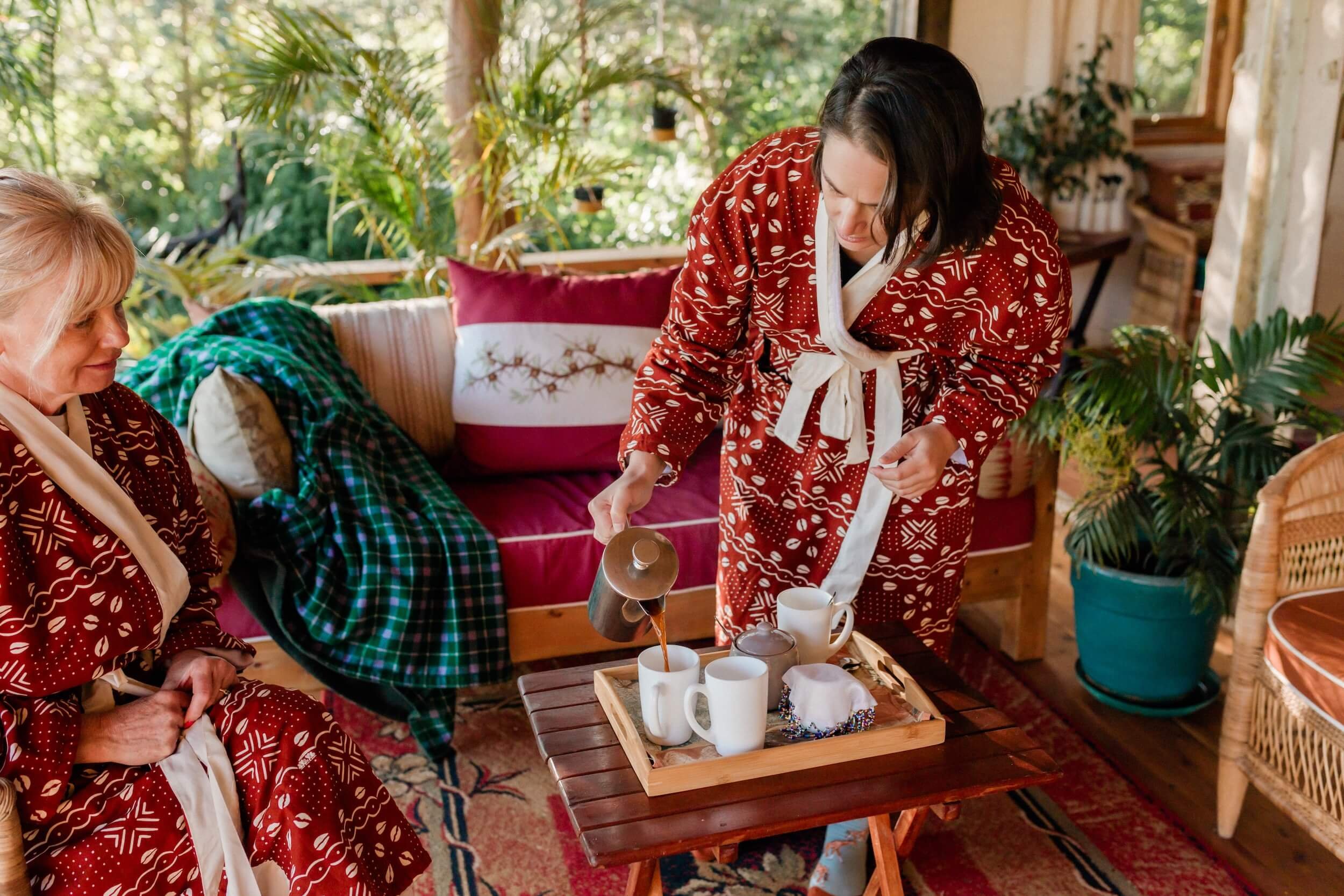
Ngare Ndare Waterfalls
You’ll be met by a local ranger and begin the 45-90 minute hike up to the falls stopping enroute to learn about the trees, flowers and footprints you’ll find along the way. This forest is also filled with incredible birdlife including Hurtlabs turaco, the Narina trogon and paradise flycatcher. You’re at altitude so remember to stop frequently to catch your breath and take a full bottle of drinking water. You’ll clamber down to the river for the final part of the hike; following the waterways to find Ngare Ndare’s crown jewel - an enchanting waterfall that descends into an azure blue swimming hole (if you’re traveling in the rainy season though be aware it may be a little browner than you might expect). It’s chilly but if you can brave the cold a refreshing dip might be just what the doctor ordered on a hot day!
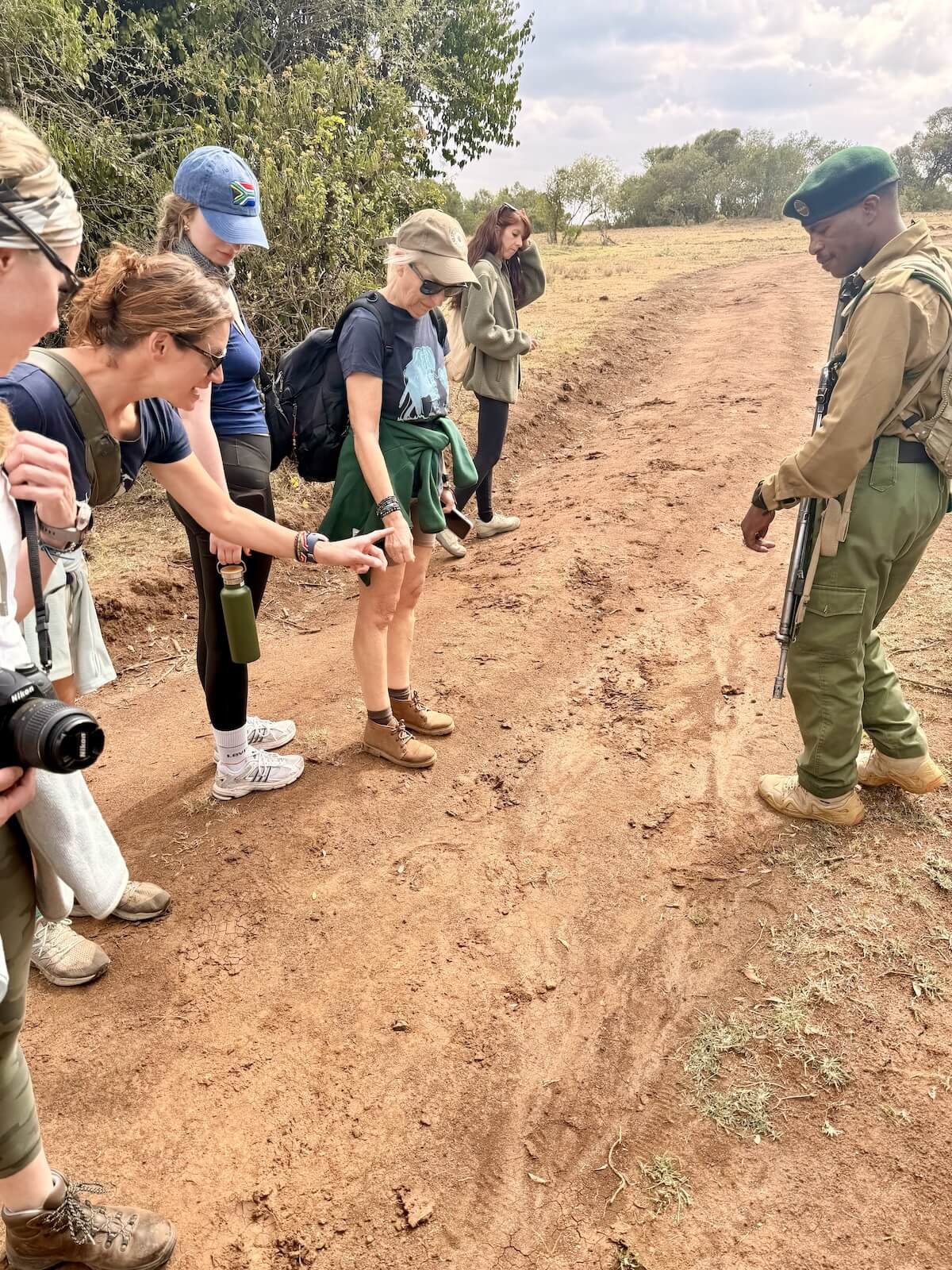
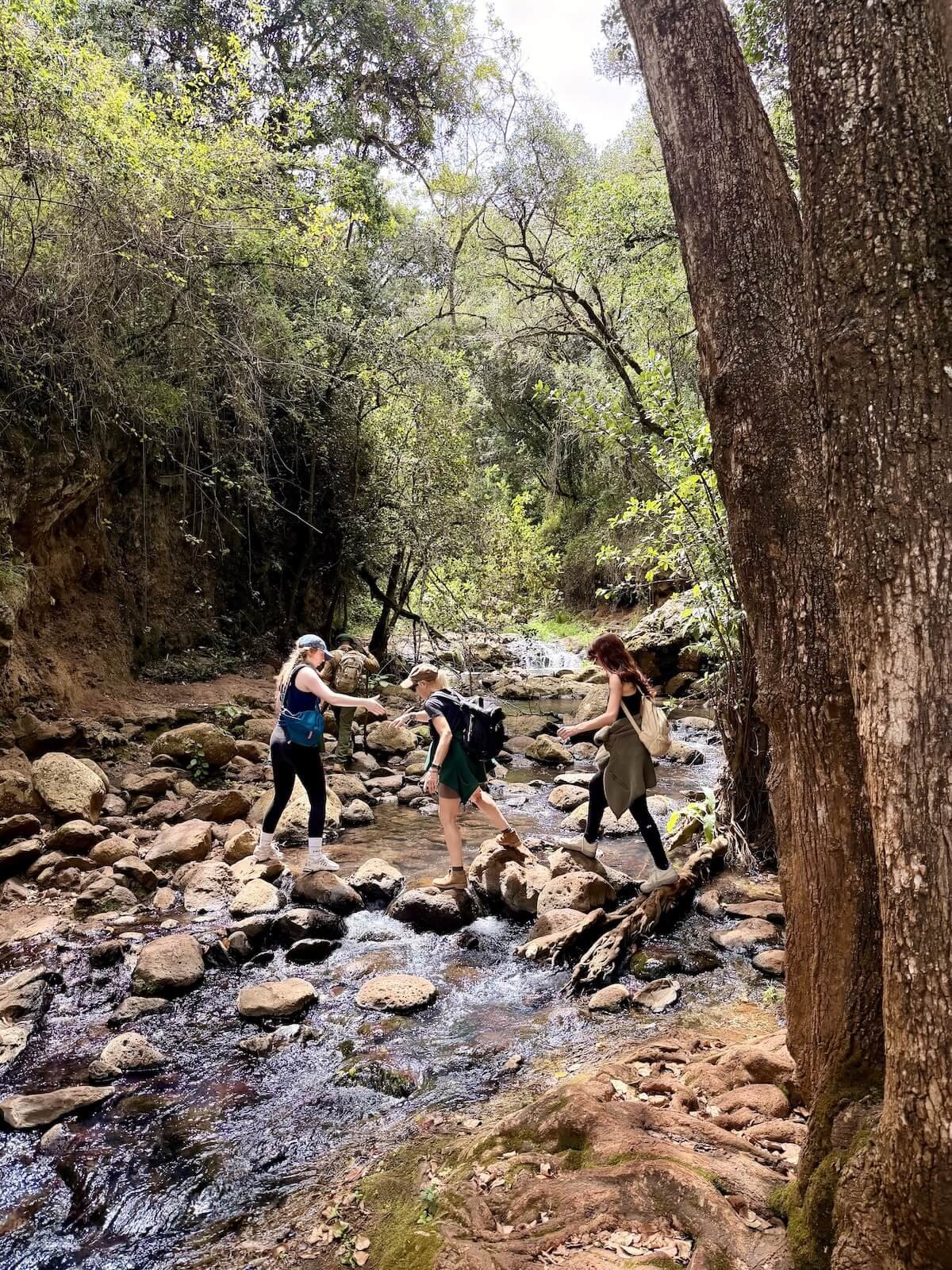
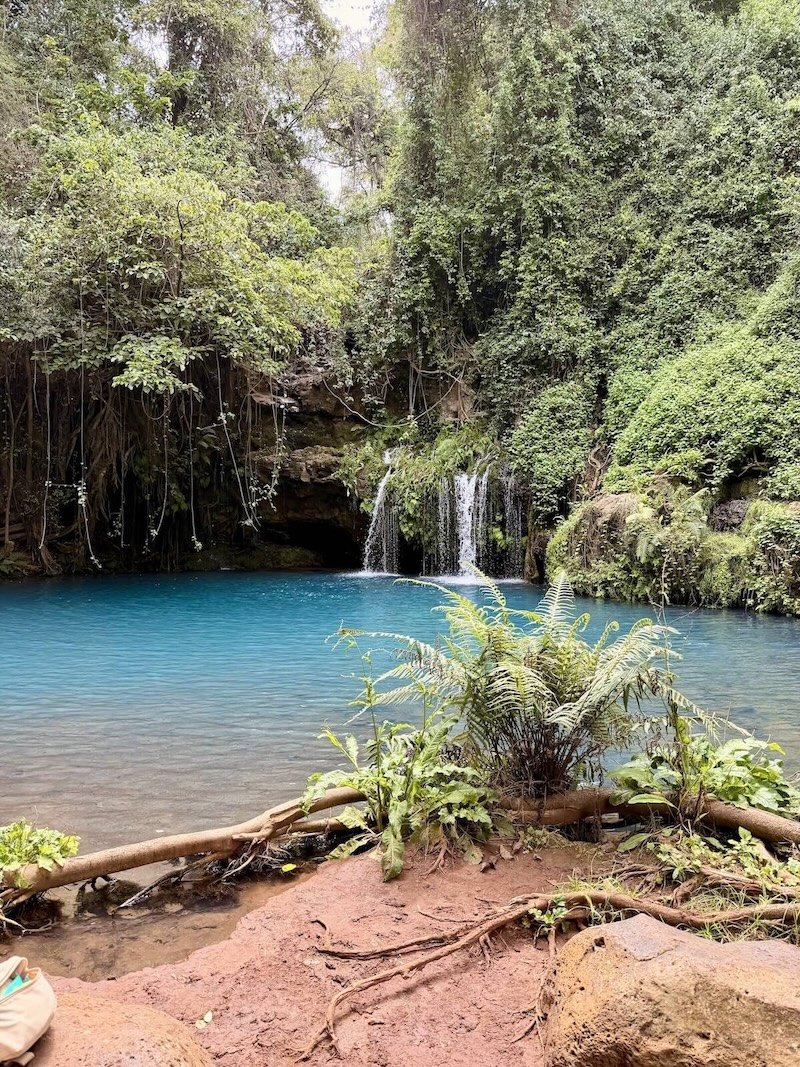
Ngare Ndare Canopy Walkway
You’ll wander 30-45minutes back down the hillside to find the start of the canopy walkway. This is a 450m long bridge elegantly suspended through the trees and where you can wander at leisure looking out for big wildlife like buffalo, giraffe and elephant, birds or just enjoying the views across the forest. The walkway ends at a platform overlooking a swamp below where you may be able to spot resident bushbuck or other wildlife. Descend from the canopy to a picnic lunch with your guide, soaking in this magical, wild forest for a few final moments before your journey home.


Game driving home
The day is far from over! On your drive back you’ll pass through Nanyuki once again and then return through the conservancy gate, stopping to enjoy the wildlife on the way and watching the sun drop below the horizon and lighting up the sky overhead. You’ll arrive for a drink around the fire, unwinding after your adventures and tuck into a delicious hot dinner under the stars. What a day!

Does a day our exploring the beauty of Ngare Ndare sound like just what you need? Read more about our activities and day trips here and let us know you’d like to add it to your stay when you enquire.
A map of Kenya + choosing the best route for your safari
A map of Kenya’s most popular regions and understanding the logistics of getting between them. This blog will help you plan your Kenya safari holiday.
The 582,646sqm beautiful and diverse land of Kenya ranges from the barren wastelands and turquoise waters of Turkana and Sibiloi, to the lush forests and farmlands that surround Mt Kenya, endless plains in the Masai Mara and Amboseli and a sparkling Indian Ocean coastline. The country is rich with culture and history; home to an astonishing 42 tribes including the most famous, Masai tribe and the beautiful Samburu. But access and planning can be tricky across such huge areas, especially when you have limited time for your Kenya safari holiday and what to make the most of every day.
Here's a map of Kenya and some suggestions on how to route your trip, so that you can spend more time enjoying all that Kenya has to offer and less time in transit…
MAP OF KENYA


KENYA SAFARI ROUTE PLANNER
Option 1 (flying): Laikipia – The Masai Mara – Amboseli (for the wildlife lovers)
This is a flying only route and, with limited time, flying really is the best way to get around the country. Just bear in mind that you’ll have strict baggage limits on local flights (usually 15kgs in soft bags only), but don’t let that deter you; you’ll be surprised how much you can squeeze into your luggage limit.
Start by flying North to Laikipia, there are a number of excellent properties in this area offering a range of different experiences. Ol Pejeta (that’s where you’ll find The Safari Cottages) is most famous for it’s prolific wildlife and it is home to the Big Five including the last two Northern White Rhinos on the planet. Samburu and Lewa are also excellent locations for wildlife lovers.
You can fly directly to the Masai Mara from Nanyuki and, depending on the time of year and your interests and preferences, there are a number of excellent properties in the reserve itself and the surrounding conservancies. Your plane will stop at all the airstrips where passengers are hopping on and off, so expect this flight to work like a bus service and listen out for your stop. Our favourite spots in the Mara are Serian, Spekes Camp and Kicheche Bush Camp.
You’ll then fly directly to Amboseli from the Masai Mara. Another of Kenya’s most famous wildlife areas and by now elephants will feel like family and the call of lions will be just another normal sound in your day! We love Tawi Lodge and Ol Donyo. You can then catch your return flight to Nairobi to board your international flight home.

Option 2 (flying): Laikipia – The Masai Mara – Diani (safari & beach)
If you’d like to finish your safari with a beach holiday then you’ll be happy to hear that Kenya has incredible, beautiful beaches (the white sands of the South coast easily rival those of Zanzibar), rich culture (check out Lamu) and incredible food (the Swahili/Italian fusion restaurants of Watamu are incredible!). This route is much the same as the above but you will fly to the coast (direct from the Mara) to relax; the perfect finale to your Kenya safari holiday. On the coast, we love Kizingo (Lamu), Kobe Suite Resort (Watamu) and Waterlovers (Diani).
*If you’re short on time and want to skip the Mara you can fly to Nairobi from Nanyuki late morning, and connect with an afternoon flight to Diani in the South Coast.

Option 3 (driving): Laikipia – The North (for the Wild Souls)
For those who are more adventurous at heart, it’s an easy four hour drive to Ol Pejeta where you can tick off the Big Five and ease into your safari. Then, once you’ve got your wildlife fix (because who goes on a Kenya safari holiday and doesn’t see lions and elephants?) it’s a beautiful drive across the hills and farmlands of Laikipia and down the rift valley escarpment into Samburu to seek out more endangered, Northern species such as generuk, oryx and the beautiful Vulturine guinea fowl. This is also a great spot for leopards so keep your eyes peeled.
You’ll then continue driving further into Kenya’s more secretive Northern frontier to soak up this untouched wilderness and meet the Samburu people who call this land home. In Samburu we love Elephant Bedroom Camp and, in the North, Sarara or Saruni Rhino.

Option 4 (driving): Laikipia – The Lakes – The Mara (a Classic Kenya road trip)
This trip starts just like the one above, but instead of heading North you’ll spend a day driving through the beautiful forests and heathland of the Aberdares National Park. Make sure you stop to enjoy a picnic enroute and take the view! Then you’ll descend into Kenya’s Lake District, to unwind on Elementaita or see the flamingoes of Nakuru. We love Loldia House. Relax on the lake shores, take a canoe to Crescent island or a day trip to Nakuru National Park.
You’ll then continue your adventure into the Masai Mara; around five hours of driving time (depending on where you stay) through farmland, lava fields and villages before you are traversing the epic plains of this world famous wildlife area.
*If you travel to the Mara between July - October you’ll likely witness the great migration! This is peak season in Kenya so if you prefer to steer clear of the crowds then opt for accommodation in the surrounding conservancies rather than in the park itself.

JOINING A GROUP SAFARI
If planning your own Kenya safari holiday feels a little daunting then a great place to start is by joining a group safari. Click here to see the full list up upcoming group safaris that we are hosting and find more details.
We hope to see you soon!

Family Safari with Kids: 5 Myths Busted (Why A Kenya Safari is Perfect for Children)
If you’re thinking of a Kenya family safari holiday but you’re nervous about traveling with children, especially young children, we’re here to bust a few myths and tell you why taking children on safari is actually a great idea!
If you're considering a family safari holiday in Kenya but hesitant about traveling with children — especially young children — you're not alone. The thought of traveling with your family to an unfamiliar continent can feel intimidating. But here's the truth: a family safari, even with young children, creates memories and experiences that will last a lifetime. Let's address the real concerns families have and why they're usually not the obstacles you think they are…


Myth 1: "Africa Is Too Dangerous for Children"
Reality: A lot of Kenya is Safe for Families
Yes, every destination has areas you should avoid. But when you discuss a family-friendly itinerary with your travel planner, you'll likely be surprised by how safe most of Kenya is for families with children of all ages.
Ol Pejeta Conservancy, where our cottages are located, is in the heart of Laikipia — one of Kenya's most stable, established wildlife regions. Private conservancies are actively managed for guest safety. Your accommodation is secure and your guides are trained and experienced with families. The roads to your private safari cottage at The Safari Cottages are established and well-maintained.
The truth: you're probably safer on a Kenya safari than you are driving through many city centres back home.
Myth 2: "Young Children Won't Remember It, So Why Bother?"
Reality: You Will Remember
Your baby might not remember the lion roaring them to sleep, but you will. You'll remember the exact moment your toddler said "elefant" for the first time when they spotted their first elephant. You'll remember them cheering you with their bottle as you drove across the open plains. You'll remember the quiet moments of connection.
And when your child is 16 or 18, they'll see photos of themselves as a baby on a family safari in Kenya. They'll have those images to connect with — proof that their family was brave enough to do something extraordinary together. That's not a small thing.
Creating memories with your kids starts from day one. Safari photos of your baby in the African bush are the kind of memories that become family stories.
Looking for animals on an afternoon game drive
Myth 3: "I'll Feel Uncomfortable Breastfeeding in Africa"
Reality: Breastfeeding Is Completely Normal Here
Everywhere you look in Kenya, you'll see African women breastfeeding. It's the most natural, normal thing in the world here. There's no social awkwardness. There's no judgment. It's just motherhood — which is exactly what it should be.
If you're traveling with a bottle-fed baby, you'll find formula, nappies, wipes, and all the essentials in supermarkets throughout Kenya, including Nanyuki (which is just an hour’s drive from The Safari cottages).
Our safari cottages are also entirely private, so you have your own, quiet space. Nobody is watching or judging - you'll have all the privacy and comfort you need for feeding your baby.
Myth 4: "The Food Won't Be Suitable for Children"
Reality: Chefs Know How to Feed Kids and The Kids Get Stuck In
Babies are born and grow up across Africa every single day - Africans know exactly how to feed and care for children. It's not exotic or mysterious — it's just part of life.
Owner/Manager Sonja, has raised her own children in the African bush and welcomes her two young grandchildren each year too. She has years of experience cooking for families with young kids and has trained our chefs to do the same. If your child is a picky eater, let us know well in advance. Most lodges will accommodate your child's dietary requirements — you're not being difficult, you're being thoughtful. The more information we have about your children's needs, the better we can care for them.
Many families find that children actually expand their diet on safari: new foods, new experiences, time away from screens and processed options. It often works out better than expected.
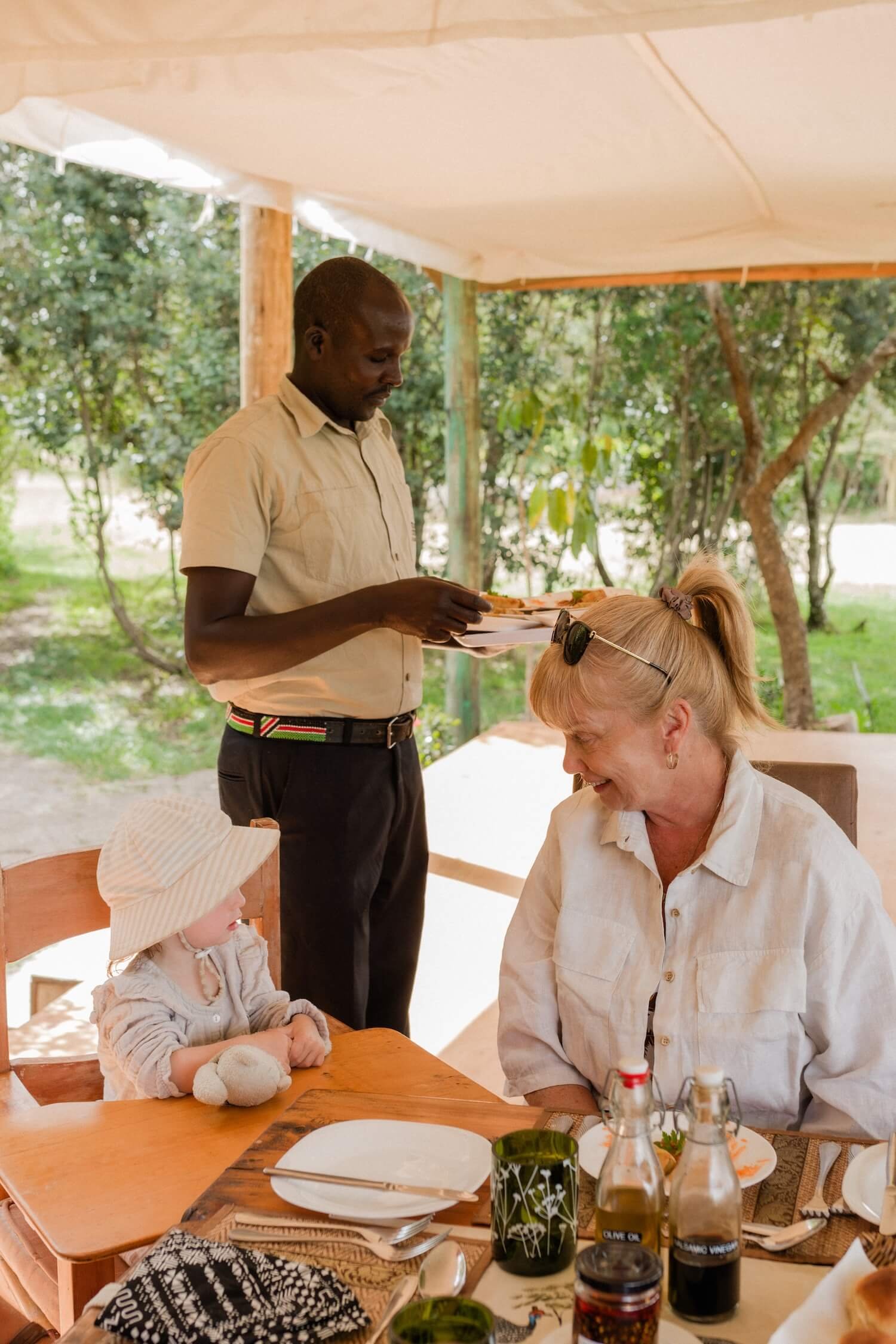
Family lunch at The Safari Cottages, Kenya
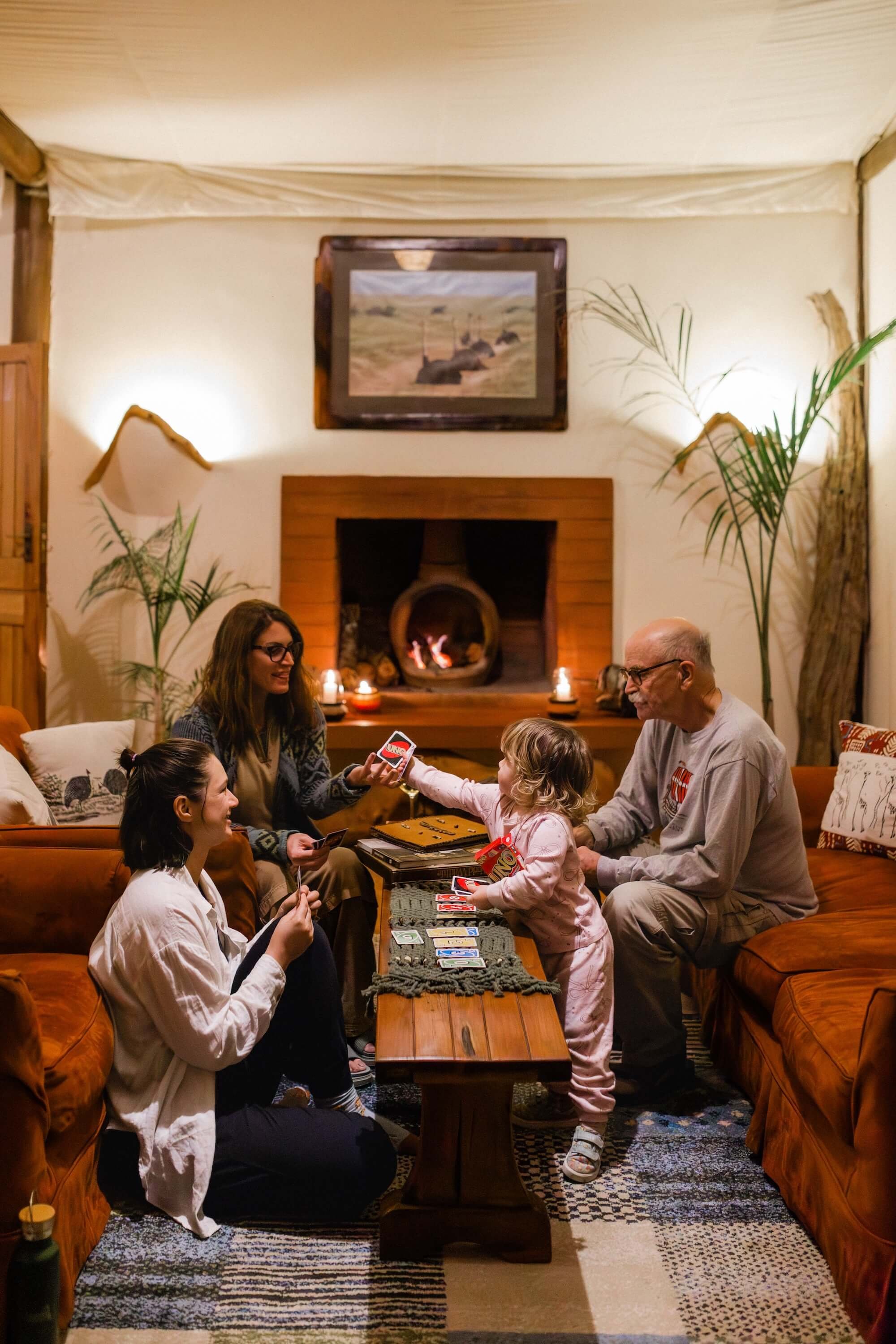
An evening in with games
Myth 5: "A Family Safari Will Be Prohibitively Expensive"
Reality: Family Pricing Makes It More Affordable Than You Think
Yes, safaris aren't budget travel. But when you book smart, they're often cheaper than you'd expect.
Look for accommodations that offer discounted rates or even free stays for children under 3 or under 12. Many lodges across Kenya have these policies specifically to encourage family bookings. The Safari Cottages offer family rates that make a multi-night stay really reasonable, especially in the green season (April, May - mid-June and November).
If you're heading to the Kenyan coast (before or after your safari), private villa stays can reduce costs when traveling with multiple children. You do your own cooking (or hire a chef for specific meals), which cuts accommodation costs significantly.
Calculate the full cost of a family holiday at home — flights, accommodation, meals, activities — and compare it to a safari package. You might be surprised at how competitive it actually is.
The Real Picture: Families Thrive on Safari
We've raised two children in the African bush. Our grandchildren visit Kenya every year. They love the freedom and space and connect with the wildlife and joyful staff. They spend time with our chefs in the kitchen. They help with daily tasks. They name all the animals on game drives.
A family safari isn't something you have to be brave to do. It's something your family will treasure.
Preparing Your Family for Safari
Practical steps before you travel:
Discuss wildlife safety with children ahead of time (calm, respectful observation from the vehicle)
Pack familiar comfort items (favorite stuffed animal, bedtime book, snacks they know)
Explain that guides are experienced with children and there to help and encourage them to ask questions
Let us know your children's ages, dietary needs, and any concerns in advance
Plan flexible schedules — game drives can be adjusted for rest times
“Our family of eight (including boys ages 8 and 12) stayed for three nights at these wonderful cottages. The accommodations were private and well appointed. The meals were superior, one day we gave the cook a standing ovation! Watching the elephants parade past at lunch was a highlight of our stay. There were plenty of place for our boys to explore safely during the day. Each evenings the guard, Peter, made a small bonfire for us and provided marshmallows and stories to entertain us. One evening he brought out a telescope and showed us the stars of the Southern Hemisphere! He is a real treasure.”
- December 2024 -
Ready to Book Your Family Safari?
If you're still uncertain about taking children on safari, we understand. But the answer to almost every family concern is: it works better than you think.
Our team has decades of experience with family bookings. We know what works. We know what questions to ask. We know how to structure your stay so everyone enjoys it — parents and children alike.
Get in touch with us to discuss your family safari. Tell us your children's ages, your concerns, your goals. We'll build an itinerary that works for your family and answer every question you have.
Experience the Ultimate 3-Day Safari at Ol Pejeta Conservancy
Here’s what you can get up to on a 3 day safari on Ol Pejeta when you stay with The Safari Cottages
Discover the magic of a 3-day safari at Ol Pejeta Conservancy, one of Kenya’s premier wildlife sanctuaries nestled between the foothills of Mount Kenya and the Aberdare Mountain Range. This exclusive safari offers an unforgettable adventure into the heart of Laikipia, where you can witness Africa’s iconic wildlife up close, including the Big Five, endangered species like Jackson’s hartebeest and reticulated giraffe and southern black rhino as well as meeting the critically endangered northern white rhino - the last two left in the world reside on Ol Pejeta.
A day on safari can look different for different people and their interests, and it can play out very differently depending on where in the continent you are. So, what can you expect from a day on safari in Ol Pejeta, with The Safari Cottages? Let’s get stuck in!
First off, there’s so much to do and to see here that we recommend a minimum 3 night stay; that’s two full days with the afternoon of your arrival and the morning of your departure adding up to three days. And here’s how we’d suggest you spend your time so you get the most out of your Kenya safari holiday with us.

You’ll have amazing views of Mt Kenya from all around Ol Pejeta
SUGGESTED ITINERARY FOR YOUR 3 DAY SAFARI IN OL PEJETA
DAY ONE
Your safari begins with a scenic drive or a flight from Nairobi to Ol Pejeta, a private conservancy renowned for its conservation efforts and diverse wildlife. As soon as you enter the gates you are on your first game drive, spotting elephants, lions, rhinos, and rare chimpanzees in their natural habitat. The conservancy’s commitment to wildlife protection ensures a rich and authentic safari experience. If you depart from Nairobi in the morning you’ll likely arrive at The Safari Cottages in time for lunch. When you arrive you’ll be met by our team and management will give you a short briefing explaining a little more about the property layout, safety and what you can get up to during your stay.
It’s pretty hot in the middle of the day so you'll have lunch on your verandah, served up by your chef and waiter, before relaxing and unpacking after your travels. We suggest heading out on your first game drive today around 4.30PM and your team can prepare a cup of tea and a snack for you before you go incase you’re feeling peckish. After a game drive and a sundowner (a drink and snacks enjoyed whilst watching the sun set) you can return to camp to an open fire and enjoy dinner on your verandah or under the stars before tucking in for a good night’s sleep.

Returning from your game drive to a roaring fire
DAY TWO
Today is your prime wildlife day! You’ll spend the day exploring Ol Pejeta’s vast landscapes on morning and afternoon game drives. Highlights include visiting the chimpanzee sanctuary and the rhino conservancy, where you can learn about ongoing efforts to protect these endangered species. Evening drives offer a chance to see nocturnal wildlife and enjoy stunning sunsets over the savannah

Lions hunting on a morning game drive
You’ll be gently woken around 6:00 AM with your preferred tea or coffee before heading out just before sunrise — one of the best times for predator activity. You’ll head off just before sunrise at 6.30AM in search of lions, leopards, cheetah, elephant, black and white rhino, giraffe and so much more! The conservancy abounds with an incredible density and variety of game so be sure you’ve packed an extra memory card for your camera - you’re going to need it. As the sun rises and you start to warm up you’ll tuck into a picnic breakfast and a cup of freshly brewed Kenyan coffee or tea.
You’ll meander back through the bush as your game drive continues and the heat of the day really starts to set in, then arrive at your safari cottage to a colourful lunch, a cool drink and a chance to rest.
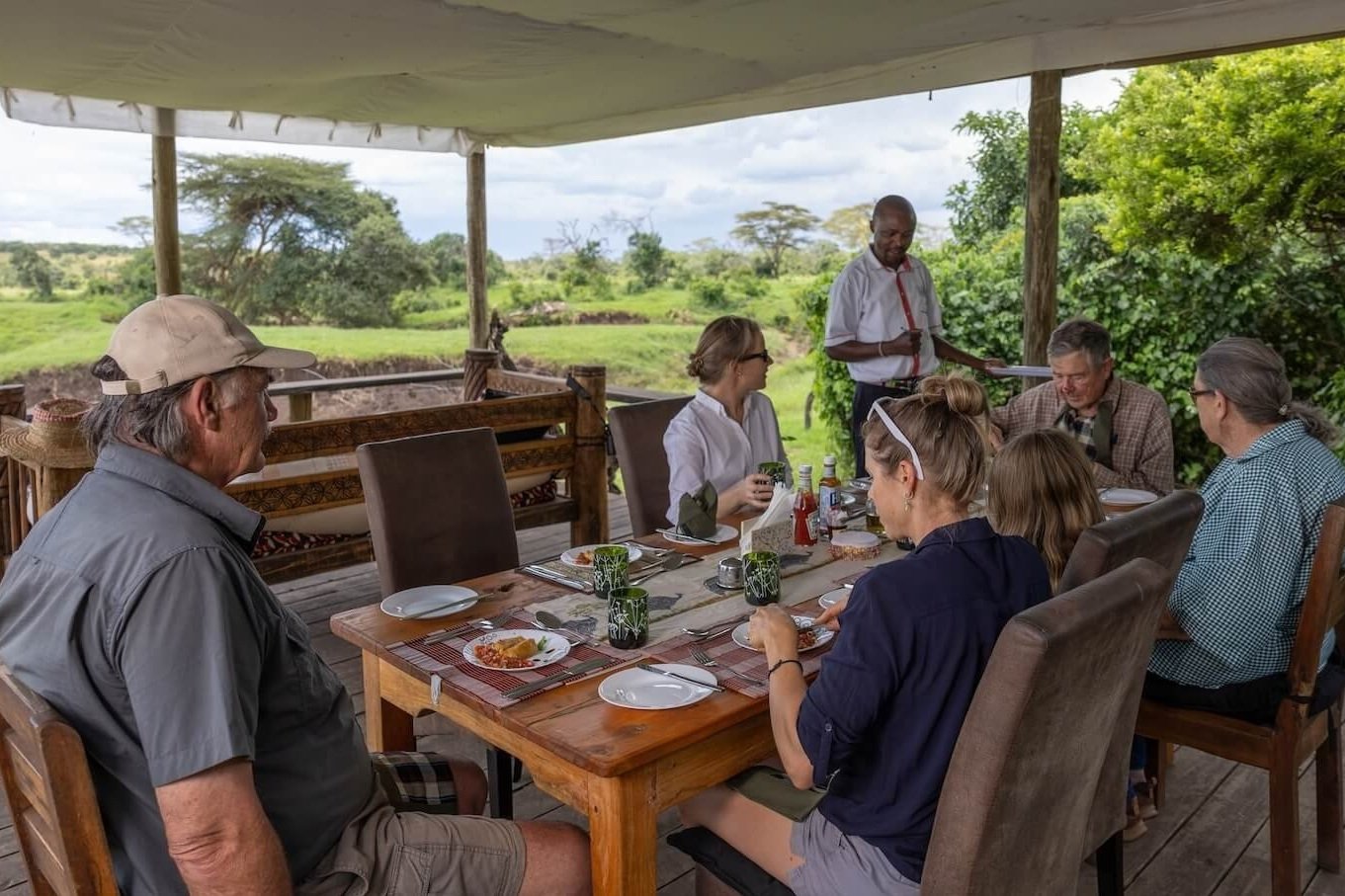
Tucking in to leisurely lunch on the riverside deck
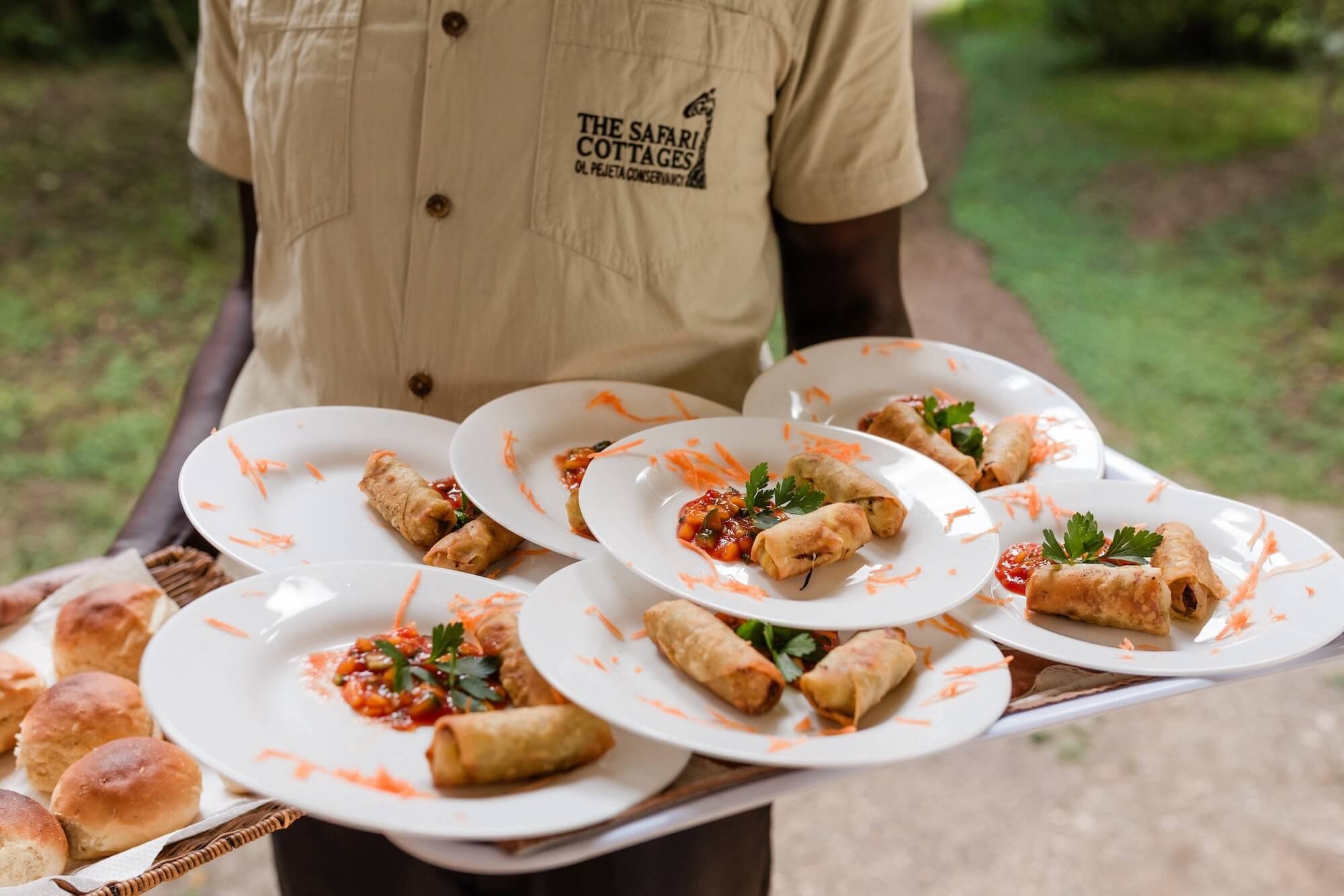
Spring rolls for starters
Midday at The Safari Cottages is a time to rest and recalibrate; animals are usually asleep in the shade of the trees at this time of day so we follow their lead and take the opportunity to relax too. If you’re not a napper then that’s okay too, here are some lovely ways to enjoy midday on the property…
Guided walk and birdwatching around the property: our guide will take you on a walk around the property pointing out birds, plants and tress of note. Elephants and giraffe often linger about the back of camp in the heat of the day so you might spot them on your walk too.
Yoga on the verandah: each safari cottage is provided with yoga mats to help you stretch out and feel great on your safari
Garden tours: our thriving garden is the source of a lot of our salads and fresh herbs and the chefs are very proud of their green fingers
Cooking lessons with your private chef: learn how to make some of our favourite Kenyan staples
Reading or simply soaking in the views: your verandah has lovely views across the river and plains and you never know what you might spot!
This relaxed downtime is one of the biggest advantages of a private safari experience.
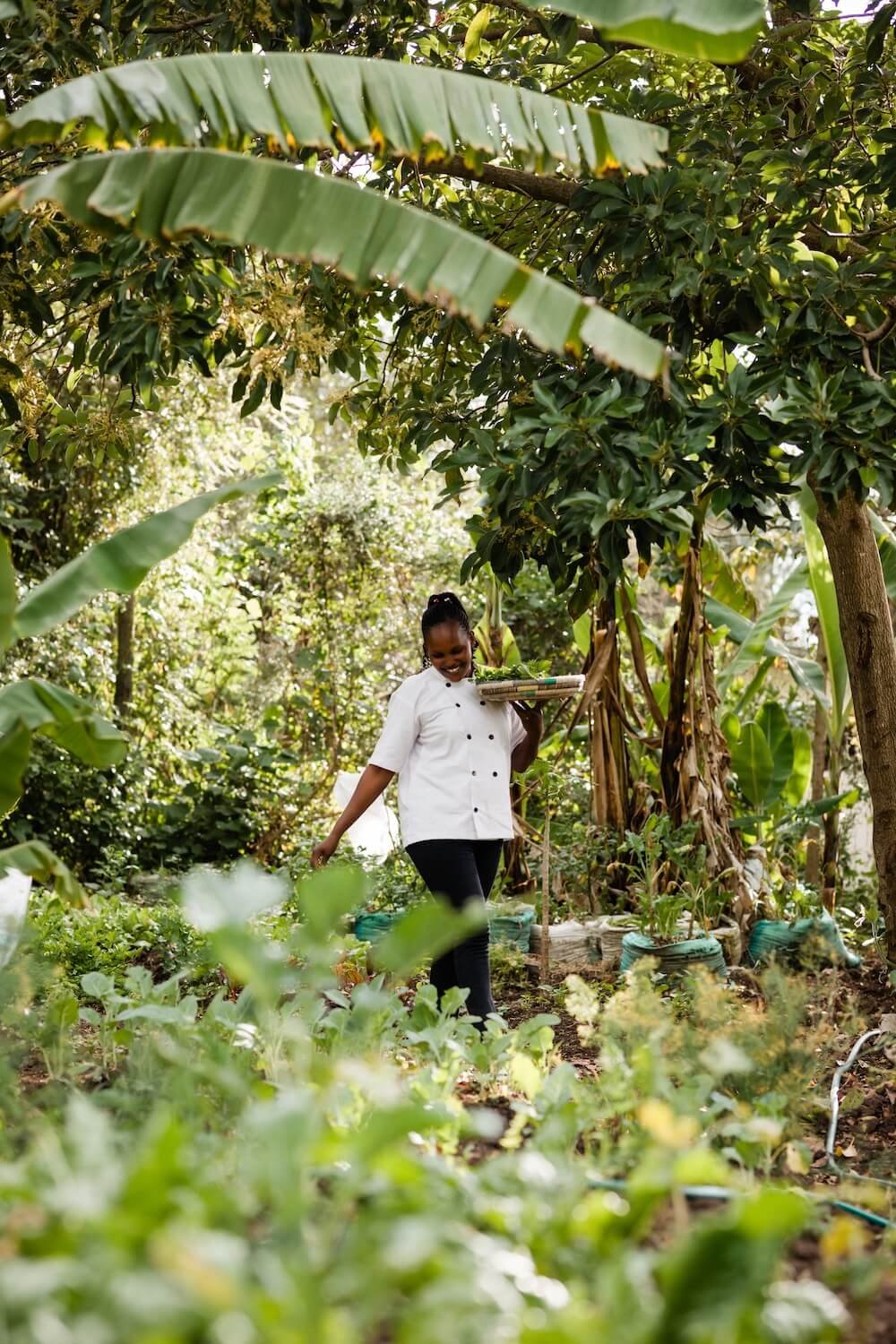
A tour of the garden with Chef Vicky
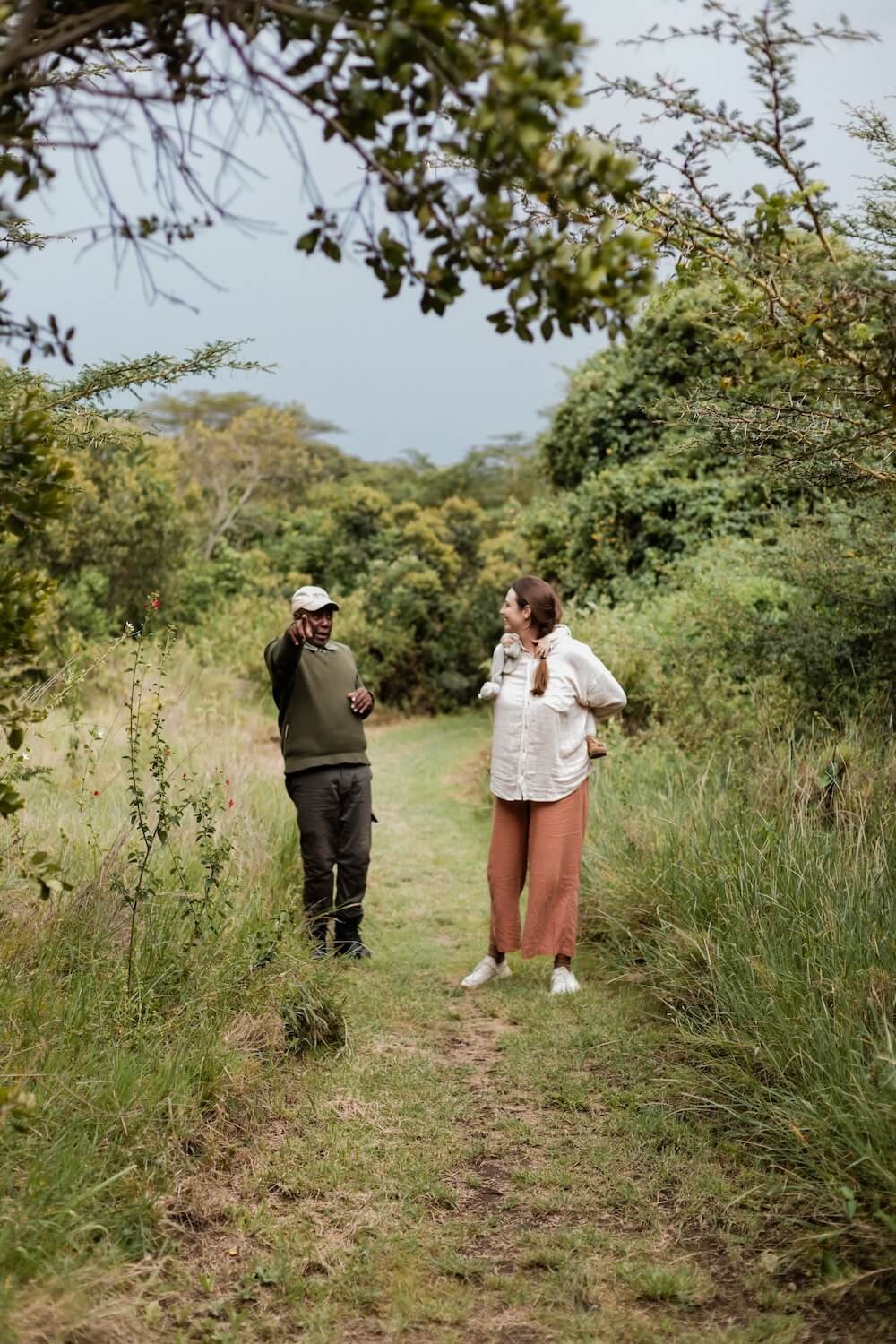
A guided bush walk with Peter
After an afternoon cup of tea you’ll head out again around 4.30PM to see what wonderful wildlife awaits you on the plains surrounding our little spot of heaven in the bush. The golden hour light makes this a favourite drive for photographers. After your sundowner you’ll head back “home” to a roaring fire under the stars and a drink before dinner. If you have a cloudless night consider asking the askaris to share their knowledge of the southern night skies — a memorable and often overlooked experience.
DAY THREE
A highlight unique to Ol Pejeta is the chance to visit Najin and Fatu, the world’s last two northern white rhinos and, this morning, you’ll head off after a light breakfast to meet them. Ol Pejeta’s passionate rhino caretakers will meet you and guide you to the spacious enclosure that Najin and Fatu, a mother and daughter due call their home. They will tell you all about how these gorgeous girls found their way to Kenya and the impressive project that Ol Pejeta and it’s partners have undertaken to bring Northern White rhinos back from the brink of extinction.
This heart-warming and educational conservation experience includes:
Guided visit to the northern white rhino enclosure with expert caretakers who will share Najin and Fatu’s story with you. They will also give you insight into the northern white rhino recovery project; a world-first IVF program
There is a small curio shop on site and an education centre, and if you’d like to make a donation to the Northern White Rhino program you can do that here too
Then, with a heart full, you’ll return back to your bush home for brunch and a chance to relax in the heat of the day or enjoy any of the on-property experiences that you may have missed out on the day before.
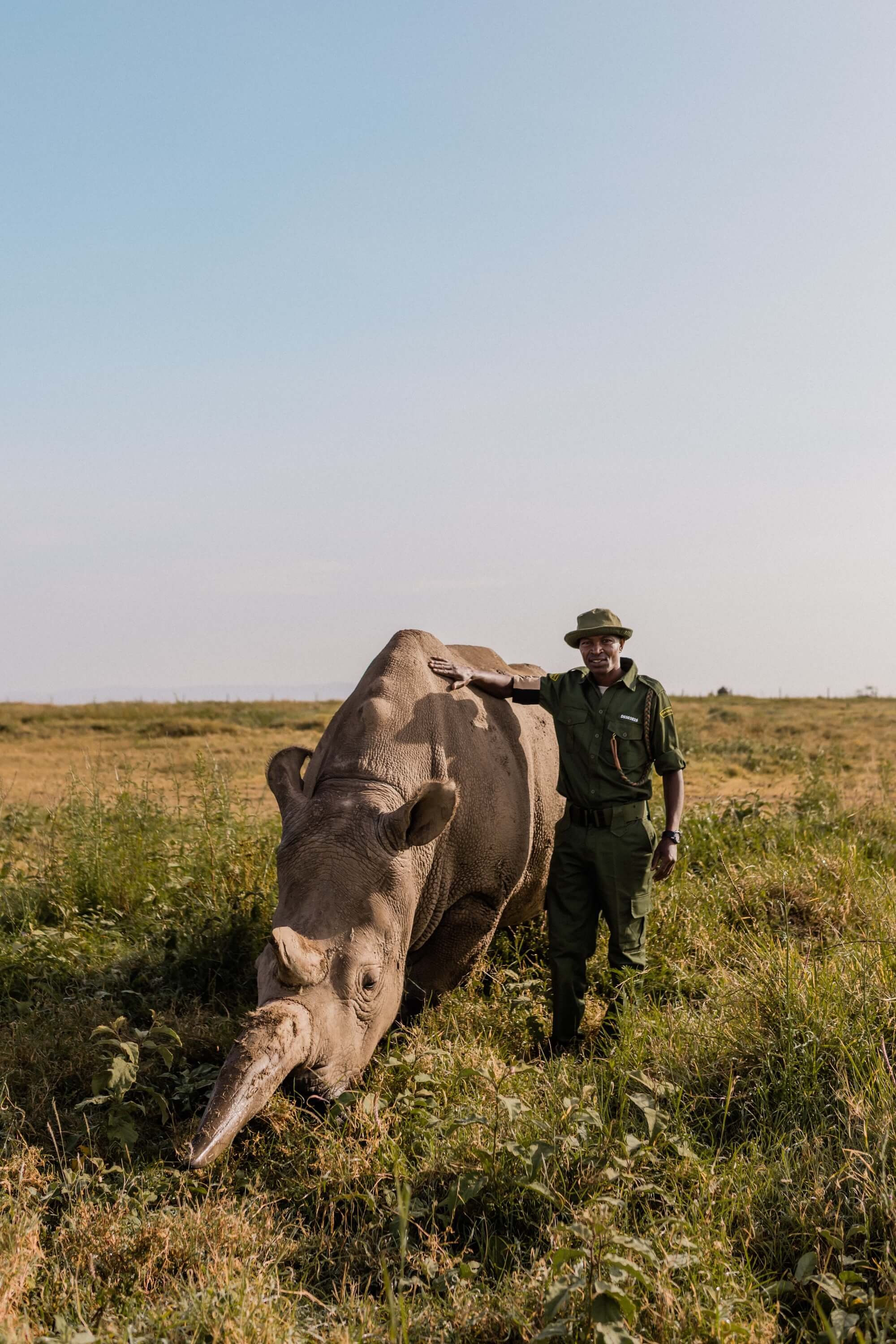
Najin with head caretaker Zachariah Mutai
Meeting the last two Northern White Rhinos in the world
This afternoon you’ll embark on your final evening game drive and sundowner, returning with a spotlight on a night drive in search of Kenya’s more secretive nocturnal species like leopard, aardvarks and white tailed mongoose. Enjoy dinner and a drink around the fire before tucking in for the night.

A big male cheetah posing for the shot on an afternoon game drive
DEPARTURE DAY
After breakfast today your guide will drive you to Nanyuki Airport to meet your flight to your next destination, or drop you off at the Ol Pejeta entrance gate to meet your road transfer back to Nairobi. Your three day safari with us will leave you full to bursting with enthusiasm for the wilderness, wildlife and people that call this corner of the world home and leave you inspired by the hard work and dedication of our conservation team. If you do choose to linger longer you can continue your safari on the conservancy or explore further afield with a day trip to the local town, Aberdares National Park or Ngare Ndare too.
Remember, you have a private guide and vehicle for the duration of your stay with us so this outline is just one idea. You can do as little or as much as you’d like.
ESTIMATED COSTS FOR THIS 3-DAY OL PEJETA SAFARI COTTAGES SAFARI
High Season 2026: (15 June - 31 Oct) - USD2,360 per person
Low Season 2026: (01 Nov - 15 Dec) - USD2,090 per person
High Season 2027: (01 Jan - 07 Jan & 15 June - 31 Oct) - USD2,470 per person
Low Season 2027: (7 Jan - 14 June & 01 Nov - 15 Dec) - USD2,185 per person
Notes on pricing:
Prices include accommodation, all meals, drinks and a private vehicle and guide. Transport too and from Ol Pejeta is not included.
The above prices are based on 2026 rates and subject to change for 2027
Children under 12 are half prices and under 3 are free
Please contact us with the number of people in your party and the ages of any children + your preferred travel dates for a personal and accurate quote
Want to linger a little longer? Lovely! Here’s our suggested itinerary for a 5-night stay, including prices.
BOOK YOUR SAFARI AT OL PEJETA SAFARI COTTAGES
Best Time to Visit Kenya for a Safari: A Month-by-Month Guide
When is the best time to visit Kenya for a safari? Our month-by-month guide covers wildlife, weather, costs and crowds for every season — written by people who live at Ol Pejeta Conservancy year-round.
You've decided Kenya is the destination. Now comes the question everyone asks: when's the best time to go?
The honest answer — and we say this as people who live here twelve months a year — is that Kenya is extraordinary in every season! The wildlife doesn't migrate away from Ol Pejeta. The landscape doesn't stop being spectacular when it rains. But different months absolutely do offer different experiences, and understanding what to expect from each one will help you choose the trip that's right for you.
This is our month-by-month guide to the best time to visit Kenya for a safari.
January to March: Dry, Hot and Excellent for Wildlife
January is a tale of two halves. The first two weeks carry over the festive season's higher prices and visitor numbers, but from mid-January the country quietens, rates drop to mid-season levels and the experience noticeably opens up. February and March are, in our view, some of the most underrated months on the Kenya safari calendar.
What to expect: Dry, warm conditions across most of the country. The grass is beginning to thin after the short rains, which makes wildlife easier to spot. Plains game — zebra, wildebeest, gazelle — give birth in February and March ahead of the April rains, which in turn drives a noticeable uptick in predator activity. Lions, cheetahs and leopards are well-fed and highly visible. Temperatures at Ol Pejeta sit comfortably in the mid-twenties during the day, dropping pleasantly in the evenings.
Wildlife highlight: February and March are among the best months for big cat sightings at Ol Pejeta, The Masai Mara, Samburu region and Amboseli and surrounds. The open plains and active predators make for some of the most compelling game drive experiences of the year.
Crowds and cost: Low to mid-season. Good availability, lower rates than peak, and private conservancies especially feel very spacious.
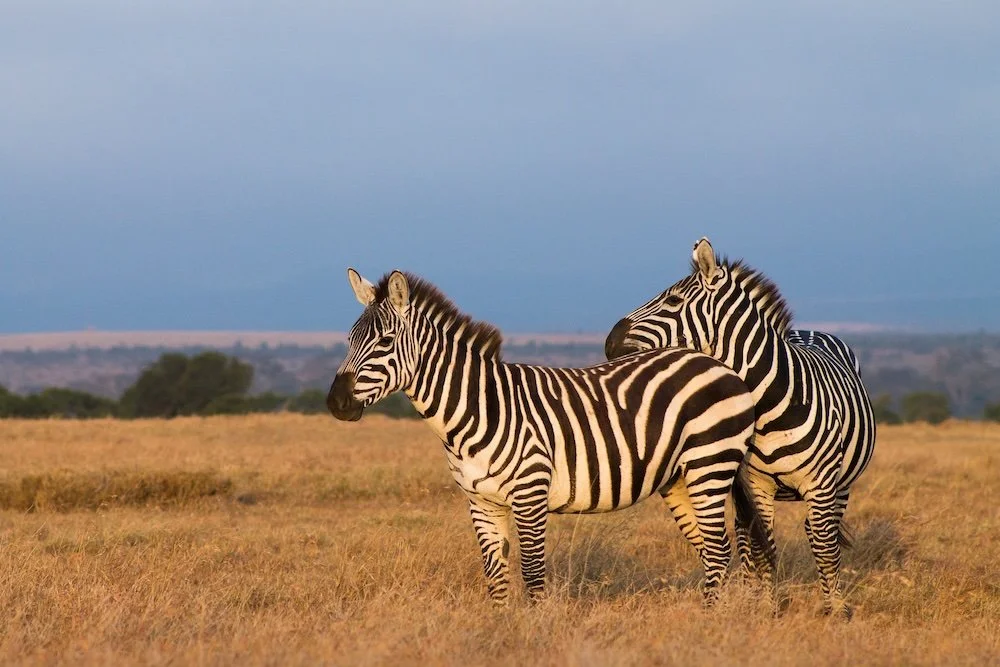
Golden light: March on Ol Pejeta
April to May: The Green Season — and Why It's Worth Reconsidering
April and May have a reputation in Kenya that we'd suggest you consider with an open mind. Historically known as "the long rains," they're still widely treated as a red flag, but global weather patterns are shifting, and this rule doesn't hold as firmly as it did ten years ago.
What to expect: Rains do arrive in April most years, typically as powerful afternoon showers rather than all-day downpours. The conservancy turns a vivid, deep green almost overnight. The plains become lush and photogenic in a way the dry season simply can't match. Drier conditions largely return by mid-May, and by the end of May many properties have reopened for the season. The practical reality is that a lot of camps close in April and May for maintenance, and some more remote locations struggle with road access. At Ol Pejeta, our all-weather roads run regardless of rainfall — game drives go out every morning and afternoon, whatever the forecast. We are open all year.
Wildlife highlight: Green season wildlife photography is extraordinary. Dramatic cloud formations, diffuse light, vivid backdrops and animals in peak condition after abundant water and vegetation. Hyena pups are commonly sighted in April. Birdlife is at its most active and diverse.
Crowds and cost: The lowest rates of the year. Some of our guests choose April and May precisely because they have the stunning wilderness almost entirely to themselves. If that kind of solitude is what you're looking for, this is the window.
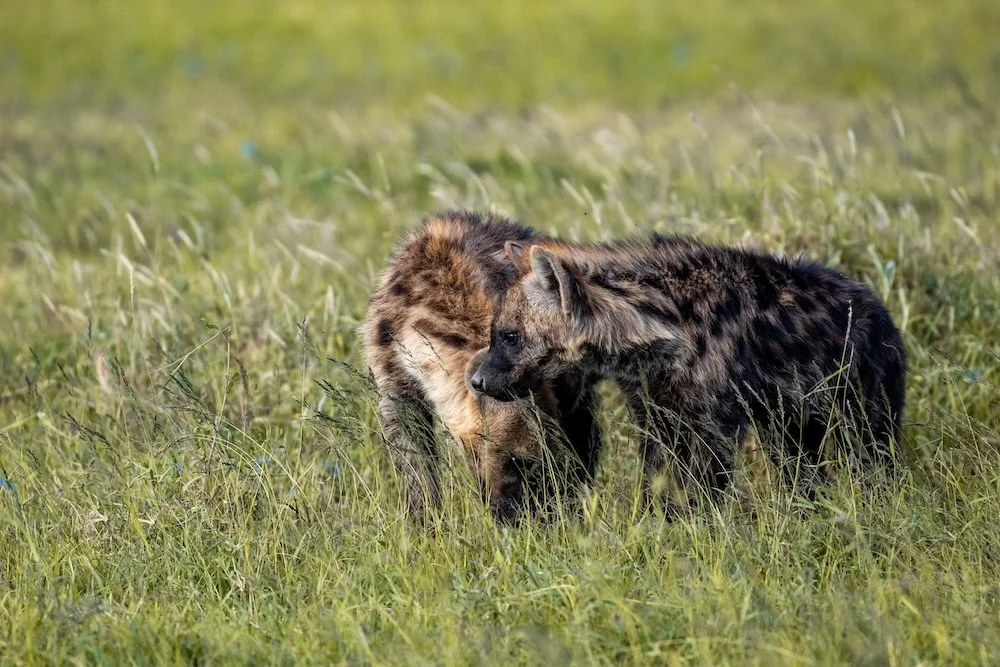
Hyena pups on Ol Pejeta

Kite surfing in Diani
June: Shoulder Season — the Best of Both Worlds
June is an incredibly rewarding month to travel to Kenya, and one of the most underbooked. Following the rains, the landscape is still lush and green but the skies are clearing and the grass is beginning to thin. At Ol Pejeta and around most of the country things are still pretty quiet, rates are still at or near low-season levels, and the dry season conditions that make wildlife viewing so reliable are already beginning to arrive.
What to expect: Comfortable temperatures, clearing skies and increasingly good game viewing as vegetation opens up. Predators are active. The Big Five are consistently present on Ol Pejeta year-round, and June offers them in ideal conditions — not yet the crowds of July and August, not the uncertainty of the rains.
Wildlife highlight: June is excellent for cheetah sightings. As the grass thins, these open-plains hunters become much easier to find and observe. Early June also sees the beginnings of the Great Migration's movement north toward Kenya from Tanzania's Serengeti. No major herd movement yet, but they are starting to trickle in.
A note on the coast: Beaches in northern Kenya — particularly around Watamu — can be affected by seaweed in early June. This is harmless but worth knowing if a beach extension is part of your plan.
Crowds and cost: Shoulder season. Excellent value and good availability before July's surge.
July to October: Peak Season — Kenya's Finest Safari Months
This is Kenya's most celebrated safari window, and the reputation is deserved. The dry season is in full effect, the grass is at its shortest, wildlife concentrates around permanent water sources and the sightings are at their most prolonged and reliable. July also marks the beginning of the Great Wildebeest Migration in the Masai Mara — one of the most spectacular wildlife events on earth — which draws significant numbers of visitors and photographers to Kenya's most famous reserve.
What to expect: Clear skies, warm days and cool nights. At Ol Pejeta, temperatures sit comfortably in the low-to-mid twenties during the day. The conservancy is at its most open, game drives are consistently productive, and the quality of the light — particularly in the late afternoon — is exceptional.
July and August represent peak season at most Kenya properties. Visitor numbers are at their highest and rates reflect that. September and October are, in our view, among the very best months to visit: the dry season conditions remain excellent, the intensity of high summer has eased, and the conservancy is noticeably quieter than it was in August.
Wildlife highlight: The dry season is the best time of year to see the Big Five reliably and repeatedly. Elephants gather in large family groups around river systems. Rhinos — both black and southern white — are consistently visible on the open plains of Ol Pejeta. Lion prides are active and predictable. And guided bush walks are at their most rewarding, with shorter grass giving a clearer view of the landscape on foot.
Crowds and cost: Peak season rates across the board. Advance booking is strongly recommended for July and August in particular.
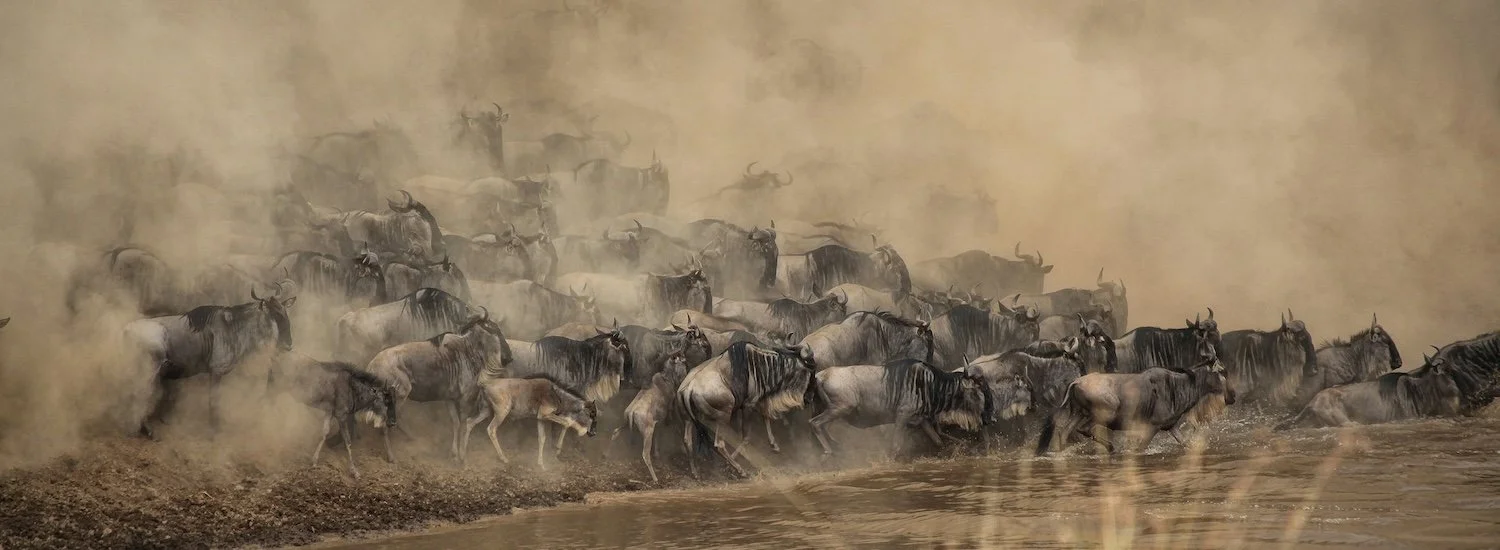
The famous Mara river crossings
November: Short Rains — Dramatic Light and Good Value
November marks the beginning of Kenya's short rains, which typically run through to mid-December. These are shorter and less intense than the long rains — usually concentrated in afternoon showers — and most properties remain fully open throughout.
What to expect: A greening landscape, dramatic skies and light that photographers reliably describe as extraordinary. Afternoon cloud formations build over the plains, and the combination of vivid green grass and dramatic weather makes for genuinely cinematic game drive conditions. Wildlife viewing remains strong throughout November — the resident species at Ol Pejeta are here year-round.
Tourist numbers begin to ease in November as the migration season in the Mara winds down, which means a quieter conservancy and rates that reflect it.
Wildlife highlight: November is excellent for birdwatching. Migratory species arrive in significant numbers from Europe and Asia, joining Ol Pejeta's resident population of over 300 species. If birdwatching is a priority, this is one of the best months.
Crowds and cost: Shoulder to low season. Good availability and value before the December surge.
December: Festive Season — Vibrant, Expensive, and Worth It
December splits neatly in two. Early December is much like November — the short rains are finishing, wildlife is thriving after the rains, and the conservancy is quieter than high season. From mid-December, the festive season begins in earnest. This is the busiest and most expensive time to visit Kenya, but it's also one of the most rewarding: the weather is largely clearing to sunny skies, wildlife is in excellent condition, and the energy of the season — particularly on the coast — is hard to match.
Wildlife highlight: December wildlife viewing is excellent, with the rains having brought the plains to life and predator activity running high. This is also when The Safari Cottages feels particularly special — fires lit in the evenings, Christmas on the verandah, stars over the conservancy.
Crowds and cost: High season rates from mid-December through early January. Book well in advance.

On safari with The Safari Cottages in Ol Pejeta
A Note on Rainfall and Changing Weather Patterns
One thing we'd ask you to take from this guide: Kenya's seasons are not as fixed as they once were. Global weather patterns are shifting, and the calendar rules that held firmly twenty years ago are now guidelines rather than guarantees. We have had dry Aprils and wet Julys. We've had years where the short rains didn't arrive until December.
Our honest advice: travel for the wildlife, not the weather. At Ol Pejeta, the animals are here every month of the year. The experience changes with the season, but it never disappoints.
-
The dry season from July to October offers the most reliable wildlife viewing, with thinning grass, concentrating animals and clear skies. January to March is a quieter, more affordable alternative with excellent conditions. June is an outstanding shoulder-season choice. But here at Ol Pejeta every month is rewarding and we are open all year.
-
April and May are the lowest-priced months at most Kenya properties, including The Safari Cottages. Though bear in mind that a lot of camps will be closed during this time so you may have less options. Rates drop significantly for those that remain open and wildlife areas are at their quietest. November and early December also offer good value with better weather than the long rains.
-
The Great Wildebeest Migration reaches Kenya's Masai Mara from approximately July through October, with the dramatic river crossings typically peaking in August and September. The migration is specific to the Masai Mara region and is not visible from Ol Pejeta in Laikipia.
-
Less so than the conventional wisdom suggests. Rains do arrive in April most years, but at Ol Pejeta our all-weather roads mean game drives run regardless of conditions. The green season offers extraordinary photography, much lower rates and a conservancy almost entirely to yourself. Many of our guests choose April specifically for the solitude.
-
Kenya sits on the equator, which means temperatures are broadly consistent year-round — warm days and cool evenings. Laikipia's altitude (around 1,700 metres) means The Safari Cottages is cooler than the coast, with most morning game drives requiring a fleece. The main variables are rainfall: concentrated in April–May and November–December, and the dryness of the landscape, which affects vegetation and wildlife visibility.
Planning your route around Kenya? Our guide to choosing the best Kenya safari itinerary covers the logistics of combining Ol Pejeta with other destinations.
Keep reading for more travel information to inspire your Kenya safari holiday
Your safari at Ol Pejeta is extraordinary on its own, but three additional conservation activities transform it from wildlife viewing to understanding real conservation work. Meet the world's last two Northern white rhinos, visit rescued chimpanzees in the Sweetwaters Sanctuary, and witness the K9 anti-poaching unit track suspects (you!) through the bush. These are the experiences that change what your safari means.